




Explain the mechanism of sex-determination in humans.
Answer
 Verified
622.5k+ views
Hint:In humans, 50% of total produced sperm bears X-chromosomes and 50% bears Y-chromosomes which means the offspring has the 50% chance to become male and 50% chance to become female.
Complete answer:
The sex-determining mechanism is a biological system that defines the development of sexual traits in an organism. Many of the species that make up their descendants by sexual reproduction have two sexes. In several animals, sex determination is genetic: females and males have non-identical alleles or even distinct genes that determine their sexual morphology.
In the case of humans, the sex-determining process is XX-XY type. Of the 23 pairs of chromosomes present, 22 pairs are almost the same in both males and females; these are autosomes. A pair of X-chromosomes is found in the female, while the existence of the X-chromosomes and the Y-chromosomes decides the male characteristics. During spermatogenesis between males, two types of gametes are formed. 50 per cent of the total produced sperm bears X-chromosome and the remaining 50 per cent comprises Y-chromosomes in addition to autosomes. Females, though, develop only one type of egg with an X-chromosome. There is an equivalent chance of egg fertilisation of sperm that bears either X or Y chromosome. In the event that the ovum fertilized with the sperm bearing the X-chromosome, the zygote grows into a female (XX) and the fertilisation of the ovum with the Y-chromosome resulting in sperm a male progeny. It is also clear that it is the genetic composition of the sperm that decides the child’s sex.
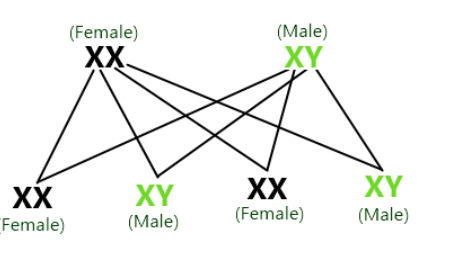
Fig: Sex determination in human
Note:In humans, the chromosome structure of sex selection is of the XX-XY type. In humans, the nucleus of each cell comprises 46 chromosomes or 23 pairs of body character chromosomes and one pair of sex chromosomes.
Complete answer:
The sex-determining mechanism is a biological system that defines the development of sexual traits in an organism. Many of the species that make up their descendants by sexual reproduction have two sexes. In several animals, sex determination is genetic: females and males have non-identical alleles or even distinct genes that determine their sexual morphology.
In the case of humans, the sex-determining process is XX-XY type. Of the 23 pairs of chromosomes present, 22 pairs are almost the same in both males and females; these are autosomes. A pair of X-chromosomes is found in the female, while the existence of the X-chromosomes and the Y-chromosomes decides the male characteristics. During spermatogenesis between males, two types of gametes are formed. 50 per cent of the total produced sperm bears X-chromosome and the remaining 50 per cent comprises Y-chromosomes in addition to autosomes. Females, though, develop only one type of egg with an X-chromosome. There is an equivalent chance of egg fertilisation of sperm that bears either X or Y chromosome. In the event that the ovum fertilized with the sperm bearing the X-chromosome, the zygote grows into a female (XX) and the fertilisation of the ovum with the Y-chromosome resulting in sperm a male progeny. It is also clear that it is the genetic composition of the sperm that decides the child’s sex.
Fig: Sex determination in human
Note:In humans, the chromosome structure of sex selection is of the XX-XY type. In humans, the nucleus of each cell comprises 46 chromosomes or 23 pairs of body character chromosomes and one pair of sex chromosomes.
Recently Updated Pages
Master Class 12 Business Studies: Engaging Questions & Answers for Success

Master Class 12 Chemistry: Engaging Questions & Answers for Success
Master Class 12 Biology: Engaging Questions & Answers for Success
Class 12 Question and Answer - Your Ultimate Solutions Guide
Master Class 11 English: Engaging Questions & Answers for Success
Master Class 11 Social Science: Engaging Questions & Answers for Success
Trending doubts
Which are the Top 10 Largest Countries of the World?
Draw a labelled sketch of the human eye class 12 physics CBSE
Differentiate between homogeneous and heterogeneous class 12 chemistry CBSE
In order to find out the different types of gametes class 12 biology NEET_UG
Why is the cell called the structural and functional class 12 biology CBSE
Draw ray diagrams each showing i myopic eye and ii class 12 physics CBSE