



Explain the mechanism of opening and closing of stomata.
Answer
 Verified
656.1k+ views
Hint: Guard cells regulate the opening and closing of stomata. Sunlight is the main agent to induce the opening and closing of stomata.
Complete answer:
Stomata are the pores present in abundance at the lower epidermis of the leaf. They are also present in the stem. The gaseous exchange and transpiration occur through stomata. The stomata are surrounded by two guard cells which regulate its opening and closing. Stomata open during the day time for gaseous exchange and also release water vapour through transpiration. The opening and closing of stomata is due to the change in turgor pressure of the guard cell.
During the day the roots absorb water due to greater transpiration pull and it is transported to different parts of the plant through xylem. The guard cell on receiving this water swells and becomes turgid. As a result of which the stomatal pore is open.
At night, the roots absorb less water, thus the guard cell becomes flaccid and shrinks. As a result of which stomatal pores closes.
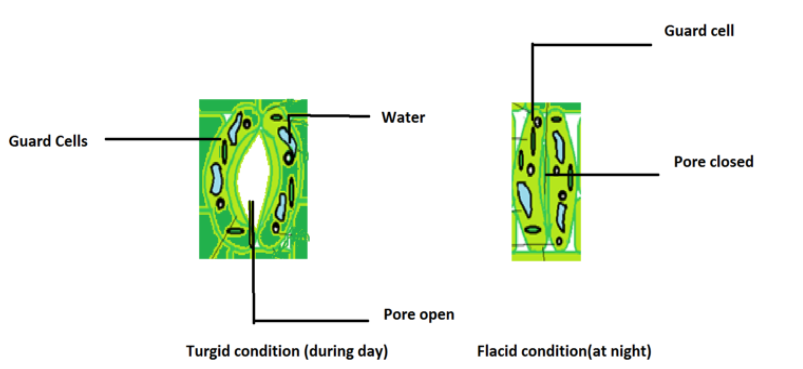
Additional information During the day time plant takes carbon dioxide from the atmosphere for photosynthesis and releases oxygen which we breathe. This gaseous exchange occurs through stomatal pore. At night photosynthesis doesn’t take place. Plants take in oxygen for respiration and release carbon dioxide.
Note: The rate of transpiration is regulated by the guard cells. When the guard cells are turgid, stomata open and when it is flaccid, the stomata closes.
Complete answer:
Stomata are the pores present in abundance at the lower epidermis of the leaf. They are also present in the stem. The gaseous exchange and transpiration occur through stomata. The stomata are surrounded by two guard cells which regulate its opening and closing. Stomata open during the day time for gaseous exchange and also release water vapour through transpiration. The opening and closing of stomata is due to the change in turgor pressure of the guard cell.
During the day the roots absorb water due to greater transpiration pull and it is transported to different parts of the plant through xylem. The guard cell on receiving this water swells and becomes turgid. As a result of which the stomatal pore is open.
At night, the roots absorb less water, thus the guard cell becomes flaccid and shrinks. As a result of which stomatal pores closes.
Additional information During the day time plant takes carbon dioxide from the atmosphere for photosynthesis and releases oxygen which we breathe. This gaseous exchange occurs through stomatal pore. At night photosynthesis doesn’t take place. Plants take in oxygen for respiration and release carbon dioxide.
Note: The rate of transpiration is regulated by the guard cells. When the guard cells are turgid, stomata open and when it is flaccid, the stomata closes.
Recently Updated Pages
If x a + bt + ct2 where x is in meters and t is in class 11 physics CBSE

A car covers the first half distance between two places class 11 physics CBSE
The resultant of two vectors overrightarrow P and overrightarrow class 11 physics CBSE
Find the value of cos 135 class 11 maths CBSE
A mass M is held in place by an applied force F and class 11 physics CBSE
A solution of glucose in water is labelled as 10 dfracwv class 11 chemistry CBSE
Trending doubts
Find the value of the expression given below sin 30circ class 11 maths CBSE
What is the maximum height of a projectile class 11 physics CBSE
Derive an expression for maximum height and range of class 11 physics CBSE
Describe various types of epithelial tissues with the class 11 biology CBSE
Lysosomes are known as suicidal bags of cell why class 11 biology CBSE
State and derive law of conservation of momentum class 11 physics CBSE