




Explain the following terms giving a suitable example for each.
i.) Elastomers
ii.) Condensation polymers
iii.) Addition polymers
Answer
 Verified
670.5k+ views
Hint: As the name suggests, elastomer means a material with an ‘elastic’ property. Similarly, condensation polymer is the type of polymer manufactured via ‘condensation’ process and addition polymer is the type of polymer manufactured via ‘addition’ of individual monomers.
Complete step by step solution:
Elastomers –
It is a type of polymer which has a unique property of ‘elasticity’. They are also very ‘viscous’ or dense in nature. The monomers in elastomers are bonded by weak intermolecular forces, as a result of which, they are viscoelastic in nature. They generally have a lower Young’s modulus and higher yield strength. Being elastic in nature, they regain their shape after being stretched.
For example – Natural rubber, polybutadiene, neoprene, etc.
Condensation polymers –
As the name suggests, condensation polymers are those which are prepared by the process of condensation, i.e. the process of joining two molecules by losing a small molecule, such as water or methanol.
It is also known as step-growth polymerization.
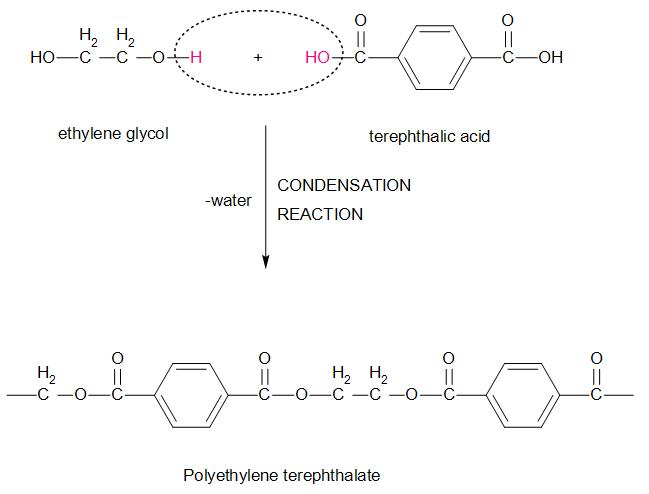
For example – PET (Polyethylene terephthalate) is made up of condensation of ethylene glycol and terephthalic acid by removal of a water molecule.
 Addition polymers –
As the name suggests, addition polymers are those which are prepared by the process of addition of monomers via addition across the unsaturated bond (generally a double bond) to form a long polymeric chain.
Unlike in condensation polymerization, it does not include removal of any molecule.
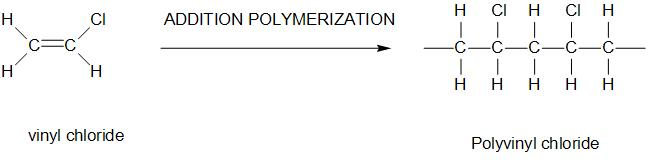
For example, Polyvinyl chloride is made by an additional reaction between vinyl chloride monomers.
Note: Elastomers are very widely used in motor vehicles – in its components like tyres and thermoset. They are also used in cable and wires; as adhesives and sealants in construction, etc. Condensation polymers such as PET are used in making food grade plastic bottles. Additional polymers like polystyrene are used in the manufacture of food-grade yoghurt cups.
It is a type of polymer which has a unique property of ‘elasticity’. They are also very ‘viscous’ or dense in nature. The monomers in elastomers are bonded by weak intermolecular forces, as a result of which, they are viscoelastic in nature. They generally have a lower Young’s modulus and higher yield strength. Being elastic in nature, they regain their shape after being stretched.
For example – Natural rubber, polybutadiene, neoprene, etc.
Condensation polymers –
As the name suggests, condensation polymers are those which are prepared by the process of condensation, i.e. the process of joining two molecules by losing a small molecule, such as water or methanol.
It is also known as step-growth polymerization.
For example – PET (Polyethylene terephthalate) is made up of condensation of ethylene glycol and terephthalic acid by removal of a water molecule.
As the name suggests, addition polymers are those which are prepared by the process of addition of monomers via addition across the unsaturated bond (generally a double bond) to form a long polymeric chain.
Unlike in condensation polymerization, it does not include removal of any molecule.
For example, Polyvinyl chloride is made by an additional reaction between vinyl chloride monomers.
Additional Information: Young’s modulus is a mechanical property which measures the ‘stiffness’ of a solid material. It is expressed as a ratio between stress (force per unit area) and strain (proportional deformation) of a material.
Note: Elastomers are very widely used in motor vehicles – in its components like tyres and thermoset. They are also used in cable and wires; as adhesives and sealants in construction, etc. Condensation polymers such as PET are used in making food grade plastic bottles. Additional polymers like polystyrene are used in the manufacture of food-grade yoghurt cups.
Recently Updated Pages
What is BLO What is the full form of BLO class 8 social science CBSE

Explain the Treaty of Vienna of 1815 class 10 social science CBSE
10 examples of friction in our daily life
Draw a diagram of nephron and explain its structur class 11 biology CBSE
Write structures of the following compounds i 2 Chloro3methylpentane class 11 chemistry CBSE
A Paragraph on Pollution in about 100-150 Words
Trending doubts
Draw a labelled sketch of the human eye class 12 physics CBSE
Which are the Top 10 Largest Countries of the World?
Differentiate between homogeneous and heterogeneous class 12 chemistry CBSE
Draw ray diagrams each showing i myopic eye and ii class 12 physics CBSE
Materials which do not allow an electric current to class 12 physics CBSE
Which is the correct genotypic ratio of mendel dihybrid class 12 biology CBSE