




Explain $S{N^2}$ reaction with one example.
Answer
 Verified
612.3k+ views
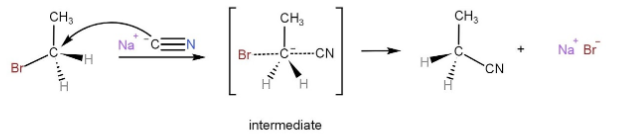
Hint: $S{N^2}$ reaction is a type of reaction in organic chemistry. It involves the nucleophilic substitution of a reactant on the carbon atom on which the leaving group is present. It is a one step reaction involving the formation of an intermediate.
Complete step by step answer:
In the $S{N^2}$ reaction, the nucleophile attacks on the carbon on which the leaving group is present, where the attack of nucleophile and the elimination of the leaving group is simultaneous.
Since, there are two reacting molecules in a single step therefore, it is called a bimolecular reaction.
The nucleophile attacks from one side and the leaving group is eliminated from the opposite side, due to this inversion in the molecule taking place.
An example of $S{N^2}$ reaction is,
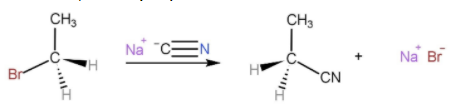
Here, $C{N^ - }$ is the attacking nucleophile and $B{r^ - }$ is the leaving group.
Mechanism of the reaction is,
Note:
-In $S{N^2}$ reactions, the order of reactivity of alkyl halides is,
Methyl>$1^\circ > 2^\circ $.
-In $3^\circ $ alkyl halides, due to the bulkiness of the molecule, there is steric hindrance and the nucleophile cannot attack. Therefore, $3^\circ $ alkyl halides do not undergo $S{N^2}$ reaction.
-In methyl groups there is no steric hindrance due to which the attack of nucleophile and elimination of leaving group occurs readily.
-As the crowding on the carbon atom increases as in case of $1^\circ $ and $2^\circ $, the rate of $S{N^2}$ reaction decreases.
Complete step by step answer:
In the $S{N^2}$ reaction, the nucleophile attacks on the carbon on which the leaving group is present, where the attack of nucleophile and the elimination of the leaving group is simultaneous.
Since, there are two reacting molecules in a single step therefore, it is called a bimolecular reaction.
The nucleophile attacks from one side and the leaving group is eliminated from the opposite side, due to this inversion in the molecule taking place.
An example of $S{N^2}$ reaction is,
Here, $C{N^ - }$ is the attacking nucleophile and $B{r^ - }$ is the leaving group.
Mechanism of the reaction is,
Note:
-In $S{N^2}$ reactions, the order of reactivity of alkyl halides is,
Methyl>$1^\circ > 2^\circ $.
-In $3^\circ $ alkyl halides, due to the bulkiness of the molecule, there is steric hindrance and the nucleophile cannot attack. Therefore, $3^\circ $ alkyl halides do not undergo $S{N^2}$ reaction.
-In methyl groups there is no steric hindrance due to which the attack of nucleophile and elimination of leaving group occurs readily.
-As the crowding on the carbon atom increases as in case of $1^\circ $ and $2^\circ $, the rate of $S{N^2}$ reaction decreases.
Recently Updated Pages
Master Class 12 Business Studies: Engaging Questions & Answers for Success

Master Class 12 Chemistry: Engaging Questions & Answers for Success
Master Class 12 Biology: Engaging Questions & Answers for Success
Class 12 Question and Answer - Your Ultimate Solutions Guide
Master Class 9 General Knowledge: Engaging Questions & Answers for Success
Master Class 9 Maths: Engaging Questions & Answers for Success
Trending doubts
Which are the Top 10 Largest Countries of the World?
Draw a labelled sketch of the human eye class 12 physics CBSE
Name the crygenes that control cotton bollworm and class 12 biology CBSE
Differentiate between homogeneous and heterogeneous class 12 chemistry CBSE
In a transcription unit the promoter is said to be class 12 biology CBSE
Sulphuric acid is known as the king of acids State class 12 chemistry CBSE