




Explain Mendel’s mono hybridization experiment. Write the rules proposed on the basis of this experiment. Draw its diagram using Punnett square.
Answer
 Verified
587.4k+ views
Hint:-Geneticists use the monohybrid cross to observe how homozygous descendants transmit heterozygous genotypes inherited from their ancestors. The inheritance of one gene is accountable for a monohybrid cross. It can be easily seen via Punnett Square.
Complete solution:-
A monohybrid cross is a genetic combination of homozygous genotypes between two individuals, resulting in a contrary phenotype. Mendel started with a pair of pea plants with two contrasting characteristics, i.e., one purple and one white, for the monohybrid cross. Plants with purple flowers were dominant plants that have resulted in the cross-pollination of purple and white flower plants. The hybrid plants were all purple. As the first hybrid generation (F1), he called this, and the offspring were called Filial1 or F1 progeny.
He performed an experiment with all seven contrasting pairs and found that one pattern in their behavior was exhibited by the entire F1 progeny, i.e., they resembled one of the parents. Fully missing was another parent character. He proceeded with his self-pollination experiment with F1 progeny plants. Surprisingly, one out of four plants had white flowers, while the other three were tall, he noted. The purple and white flower plants had a 3:1 ratio.
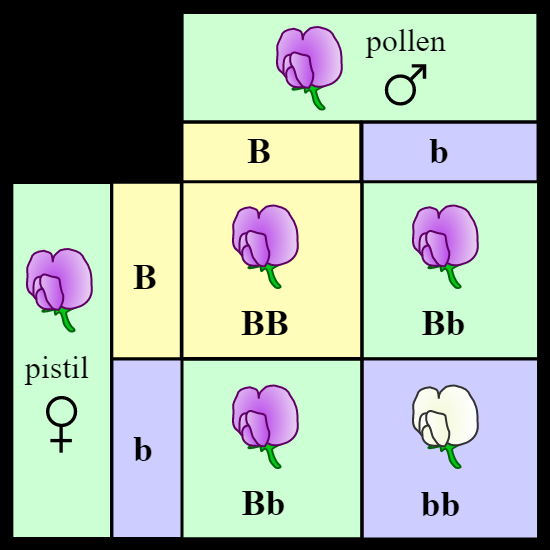
Note:- Gregor Johann Mendel, is known as the father and founder of genetics. The Law of Dominance, Law of Segregation, and Law of Independent Assortment are the three laws, known as Mendel’s laws of inheritance. These laws are based on the following four basic concepts:
● In more than one type of an allele, a gene does exist.
● The allelic pairs split when meiosis produces gametes, resulting in each gamete with a single allele.
● For each trait, every organism inherits two alleles.
● A pair’s two alleles are separate, i.e., one is dominant and the other is recessive.
Complete solution:-
A monohybrid cross is a genetic combination of homozygous genotypes between two individuals, resulting in a contrary phenotype. Mendel started with a pair of pea plants with two contrasting characteristics, i.e., one purple and one white, for the monohybrid cross. Plants with purple flowers were dominant plants that have resulted in the cross-pollination of purple and white flower plants. The hybrid plants were all purple. As the first hybrid generation (F1), he called this, and the offspring were called Filial1 or F1 progeny.
He performed an experiment with all seven contrasting pairs and found that one pattern in their behavior was exhibited by the entire F1 progeny, i.e., they resembled one of the parents. Fully missing was another parent character. He proceeded with his self-pollination experiment with F1 progeny plants. Surprisingly, one out of four plants had white flowers, while the other three were tall, he noted. The purple and white flower plants had a 3:1 ratio.
Note:- Gregor Johann Mendel, is known as the father and founder of genetics. The Law of Dominance, Law of Segregation, and Law of Independent Assortment are the three laws, known as Mendel’s laws of inheritance. These laws are based on the following four basic concepts:
● In more than one type of an allele, a gene does exist.
● The allelic pairs split when meiosis produces gametes, resulting in each gamete with a single allele.
● For each trait, every organism inherits two alleles.
● A pair’s two alleles are separate, i.e., one is dominant and the other is recessive.
Recently Updated Pages
Three beakers labelled as A B and C each containing 25 mL of water were taken A small amount of NaOH anhydrous CuSO4 and NaCl were added to the beakers A B and C respectively It was observed that there was an increase in the temperature of the solutions contained in beakers A and B whereas in case of beaker C the temperature of the solution falls Which one of the following statements isarecorrect i In beakers A and B exothermic process has occurred ii In beakers A and B endothermic process has occurred iii In beaker C exothermic process has occurred iv In beaker C endothermic process has occurred

Master Class 12 Social Science: Engaging Questions & Answers for Success
Master Class 12 Physics: Engaging Questions & Answers for Success
Master Class 12 Maths: Engaging Questions & Answers for Success
Master Class 12 Economics: Engaging Questions & Answers for Success
Master Class 12 Chemistry: Engaging Questions & Answers for Success
Three beakers labelled as A B and C each containing 25 mL of water were taken A small amount of NaOH anhydrous CuSO4 and NaCl were added to the beakers A B and C respectively It was observed that there was an increase in the temperature of the solutions contained in beakers A and B whereas in case of beaker C the temperature of the solution falls Which one of the following statements isarecorrect i In beakers A and B exothermic process has occurred ii In beakers A and B endothermic process has occurred iii In beaker C exothermic process has occurred iv In beaker C endothermic process has occurred
Master Class 12 Social Science: Engaging Questions & Answers for Success
Master Class 12 Physics: Engaging Questions & Answers for Success
Trending doubts
Which are the Top 10 Largest Countries of the World?
Draw a labelled sketch of the human eye class 12 physics CBSE
Explain the structure of megasporangium class 12 biology CBSE
What are the major means of transport Explain each class 12 social science CBSE
Differentiate between homogeneous and heterogeneous class 12 chemistry CBSE
Sulphuric acid is known as the king of acids State class 12 chemistry CBSE