




Explain Hall-Heroult method of obtaining pure aluminium from alumina with figure.
Answer
 Verified
559.5k+ views
Hint: This is an industrial process to obtain pure aluminium. It involves the melting of aluminium oxide also known as oxide in molten cryolite and electrolysing the molten salt bath. This process takes place at $ 940 - 980^\circ C $ and produces $ 99.5 - 99.8\% $ pure aluminium.
Complete answer:
Charles Hall and Paul Heroult invented a method to obtain aluminium from alumina with the help of electrochemical methods. The melting point of alumina is very high and passing of electric current does not take place through solid form of alumina, therefore a small amount of cryolite is added to carry the electrolysis. This acts as a good conductor of electricity. When we add feldspar it lowers the melting point of the alumina. So in all a mixture of alumina, cryolite, and feldspar is subjected to electrolysis to obtain the pure form of aluminium. For the process of electrolysis, an iron vessel where we can see a coating on the inside of this vessel of carbon layered graphite. This acts as a cathode. This carbon rod is connected with a copper clam and immersed in an electrolyte. This acts as an anode. When electric current is passed, the molten aluminium will be deposited at the cathode and there will be release of oxygen at anode.
The process can be understood by the following diagram:
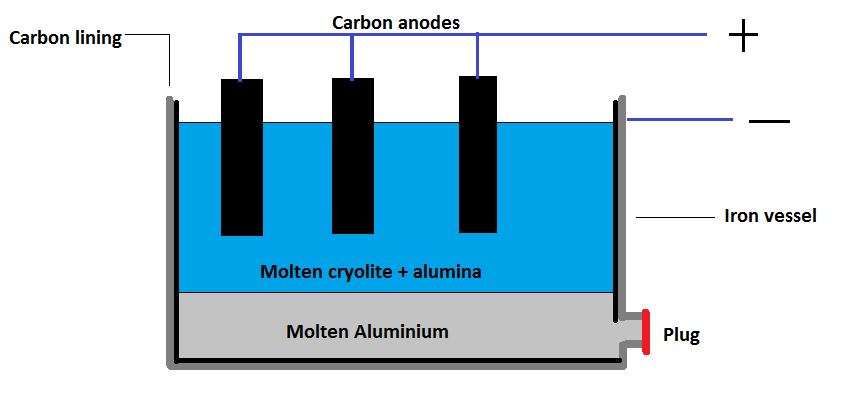
The reaction is given as follows;
At cathode- $ 2Al{}_3 + (I) + 6e \to 2Al(I) $
At anode- $ 6O{}_2 - (I) \to 6O{}_{2(g)} + 12e{}^ - $
Note:
Elemental aluminium is not possible to be obtained by electrolysis of an aqueous aluminium salt, because hydronium ions oxidize elemental aluminium. Molten aluminium salt can be used instead of aluminium oxide and has a melting point of $ 2072^\circ C $ .
Complete answer:
Charles Hall and Paul Heroult invented a method to obtain aluminium from alumina with the help of electrochemical methods. The melting point of alumina is very high and passing of electric current does not take place through solid form of alumina, therefore a small amount of cryolite is added to carry the electrolysis. This acts as a good conductor of electricity. When we add feldspar it lowers the melting point of the alumina. So in all a mixture of alumina, cryolite, and feldspar is subjected to electrolysis to obtain the pure form of aluminium. For the process of electrolysis, an iron vessel where we can see a coating on the inside of this vessel of carbon layered graphite. This acts as a cathode. This carbon rod is connected with a copper clam and immersed in an electrolyte. This acts as an anode. When electric current is passed, the molten aluminium will be deposited at the cathode and there will be release of oxygen at anode.
The process can be understood by the following diagram:
The reaction is given as follows;
At cathode- $ 2Al{}_3 + (I) + 6e \to 2Al(I) $
At anode- $ 6O{}_2 - (I) \to 6O{}_{2(g)} + 12e{}^ - $
Note:
Elemental aluminium is not possible to be obtained by electrolysis of an aqueous aluminium salt, because hydronium ions oxidize elemental aluminium. Molten aluminium salt can be used instead of aluminium oxide and has a melting point of $ 2072^\circ C $ .
Recently Updated Pages
Master Class 12 Economics: Engaging Questions & Answers for Success

Master Class 12 English: Engaging Questions & Answers for Success
Master Class 12 Social Science: Engaging Questions & Answers for Success
Master Class 12 Maths: Engaging Questions & Answers for Success
Master Class 12 Physics: Engaging Questions & Answers for Success
Master Class 9 General Knowledge: Engaging Questions & Answers for Success
Trending doubts
Which are the Top 10 Largest Countries of the World?
Draw a labelled sketch of the human eye class 12 physics CBSE
Differentiate between homogeneous and heterogeneous class 12 chemistry CBSE
Why is the cell called the structural and functional class 12 biology CBSE
Draw ray diagrams each showing i myopic eye and ii class 12 physics CBSE
Which is the correct genotypic ratio of mendel dihybrid class 12 biology CBSE