




Explain briefly why boron trichloride is a gas and aluminium trichloride is a dimer solid.
Answer
 Verified
551.7k+ views
Hint : Both have a trigonal planar structure. Boron has no vacant d orbitals but aluminium does. Boron forms $ p\pi - p\pi $ intermolecular bonding whereas aluminium forms $ p\pi - p\pi $ bonding with other aluminium chloride molecules.
Complete Step By Step Answer:
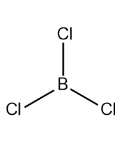
Boron trichloride is a colorless gas with the molecular formula $ BC{l_3} $ . It is a reagent in organic synthesis. It is highly reactive toward the water. $ BC{l_3} $ has a very pungent odor. The structure of $ BC{l_3} $ is trigonal planar. It has a bond length of $ 175pm $ . In the structure the central atom boron is surrounded by three chlorine atoms, giving rise to the trigonal planar structure. Aluminium trichloride $ AlC{l_3} $ also known as aluminium chloride is a white color solid. It also has a pungent odor. The structure of $ AlC{l_3} $ is also trigonal planar, where the central atom Al is surrounded by three chlorine atoms.
The structure of $ BC{l_3} $ is:
The structure of $ AlC{l_3} $ is:
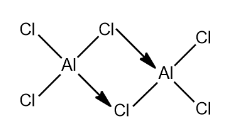
The valence shell configuration of Boron is $ 1{s^2}2{s^2}2{p^1} $ . It can be seen that boron does not have any vacant 2d-orbitals and so it cannot extend its coordination number beyond $ 3 $ . The valence shell configuration of Al is $ 1{s^2}2{s^2}2{p^6}3{s^2}3{p^1} $ has vacant 3d orbitals. So it can extend its coordination number beyond $ 3 $ . Also both $ BC{l_3} $ and $ AlC{l_3} $ are electron-deficient species. $ BC{l_3} $ has intermolecular $\pi - p\pi $ bonding to compensate for this electron deficiency. And in case $ AlC{l_3} $ it shows $ p\pi - p\pi $ bonding with another $ AlC{l_3} $ molecule to compensate for the electron deficiency. $ AlC{l_3} $ dimerizes to attain the octet by forming a dative bond between Cl and Al atoms. Therefore because of the above reasons, boron trichloride is a gas, and aluminium trichloride is a dimer solid.
Note :
boron does not have any vacant shell as aluminium has. And aluminium has only $ 6 $ electrons in its valence shell so to complete its octet state Al accepts $ 2 $ more electrons from another $ AlCl_3 $ molecule and it forms a coordinate bond with Cl thus it exists as a dimer.
Complete Step By Step Answer:
Boron trichloride is a colorless gas with the molecular formula $ BC{l_3} $ . It is a reagent in organic synthesis. It is highly reactive toward the water. $ BC{l_3} $ has a very pungent odor. The structure of $ BC{l_3} $ is trigonal planar. It has a bond length of $ 175pm $ . In the structure the central atom boron is surrounded by three chlorine atoms, giving rise to the trigonal planar structure. Aluminium trichloride $ AlC{l_3} $ also known as aluminium chloride is a white color solid. It also has a pungent odor. The structure of $ AlC{l_3} $ is also trigonal planar, where the central atom Al is surrounded by three chlorine atoms.
The structure of $ BC{l_3} $ is:
The structure of $ AlC{l_3} $ is:
The valence shell configuration of Boron is $ 1{s^2}2{s^2}2{p^1} $ . It can be seen that boron does not have any vacant 2d-orbitals and so it cannot extend its coordination number beyond $ 3 $ . The valence shell configuration of Al is $ 1{s^2}2{s^2}2{p^6}3{s^2}3{p^1} $ has vacant 3d orbitals. So it can extend its coordination number beyond $ 3 $ . Also both $ BC{l_3} $ and $ AlC{l_3} $ are electron-deficient species. $ BC{l_3} $ has intermolecular $\pi - p\pi $ bonding to compensate for this electron deficiency. And in case $ AlC{l_3} $ it shows $ p\pi - p\pi $ bonding with another $ AlC{l_3} $ molecule to compensate for the electron deficiency. $ AlC{l_3} $ dimerizes to attain the octet by forming a dative bond between Cl and Al atoms. Therefore because of the above reasons, boron trichloride is a gas, and aluminium trichloride is a dimer solid.
Note :
boron does not have any vacant shell as aluminium has. And aluminium has only $ 6 $ electrons in its valence shell so to complete its octet state Al accepts $ 2 $ more electrons from another $ AlCl_3 $ molecule and it forms a coordinate bond with Cl thus it exists as a dimer.
Recently Updated Pages
Master Class 11 English: Engaging Questions & Answers for Success

Master Class 11 Social Science: Engaging Questions & Answers for Success
Master Class 11 Maths: Engaging Questions & Answers for Success
Master Class 11 Biology: Engaging Questions & Answers for Success
Master Class 11 Physics: Engaging Questions & Answers for Success
Master Class 11 Chemistry: Engaging Questions & Answers for Success
Trending doubts
One Metric ton is equal to kg A 10000 B 1000 C 100 class 11 physics CBSE
What is cell theory Who formulated it class 11 biology CBSE
Phyllotaxy is the arrangement of ALeaflets BLeaves class 11 biology CBSE
Difference Between Prokaryotic Cells and Eukaryotic Cells
The symbiotic association of fungi and algae is called class 11 biology CBSE
Cell theory was formulated by A Schleiden and Schwann class 11 biology CBSE