




Explain briefly:
(a)Capillary water
(b)Osmosis
(c)Aeroponics
Answer
 Verified
606.3k+ views
Hint: Capillary, osmosis, and aeroponics are the methods of water movement in soil and towards the basis of the plant. These methods of water movement help in uprising the water content of the soil. The movement of water in soil depends on soil.
Complete answer:
Capillary water
-The ability of a liquid to flow in narrow spaces without the help of external forces like gravity.
-Capillarity motion in water occurs thanks to intermolecular forces between the liquid and surrounding solid surface and due to the pressure of cohesion and adhesion which causes the liquid work against gravity.
-The upward movement of a liquid against the force of gravity inside narrow spaces in the soil is called capillary rise. This property of liquid is called capillarity.
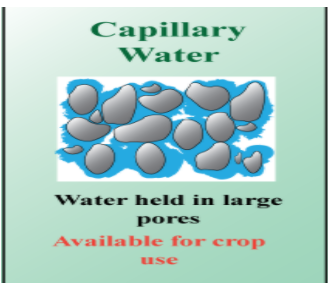
-Capillary water is held in the capillary pore or micropore which is retained on the soil particles.
-The molecules of capillary water are free and mobile and are present in a liquid state which makes water evaporate easily at ordinary temperatures.
-Plant roots are able to absorb the capillary water thus, known as available water.
-Factors affecting capillary water:
a)Surface Tension: With the increase in surface tension, the amount of capillary water also increases.
b)SoIl Texture: As the greater the surface area and greater the number of micropores results in a finer the texture of a soil and greater the amount of capillary water.
c)Organic Matter: The greater the presence of organic matter results in an increase in the amount of capillary water holding capacity.
Osmosis
-Osmosis is the phenomenon of movement of solvent molecules from their higher contraction to lower concentration or from an answer of low concentration to high concentration through semipermeable membranes.
-In osmosis, only solvent particles move. Solute particles tend to not move and therefore the movement is through the semipermeable membrane.
Aeroponics
-Aeroponics is the practice of growing plants in an air and mist environment without the utilization of soil or nutrient medium under the aseptic condition in a greenhouse or laboratories.
-Aeroponics helps in making any land useful for production with nutrient and pH control.
-In this root zone temperature is maintained with effective drainage and availability of root oxygen.
-This method conserves water by lower usage and nutrient and pH control.
Note: -Examples of capillary action:
-Drawing up of liquids between the hairs in the paintbrush.
-Drainage of constantly producing tear fluid from the eye.
-Observed in the thin layer chromatography.
-Drawing of ink to the tips of fountain pen nibs.
-Moving of groundwater from wet areas of the soil to dry areas.
Complete answer:
Capillary water
-The ability of a liquid to flow in narrow spaces without the help of external forces like gravity.
-Capillarity motion in water occurs thanks to intermolecular forces between the liquid and surrounding solid surface and due to the pressure of cohesion and adhesion which causes the liquid work against gravity.
-The upward movement of a liquid against the force of gravity inside narrow spaces in the soil is called capillary rise. This property of liquid is called capillarity.
-Capillary water is held in the capillary pore or micropore which is retained on the soil particles.
-The molecules of capillary water are free and mobile and are present in a liquid state which makes water evaporate easily at ordinary temperatures.
-Plant roots are able to absorb the capillary water thus, known as available water.
-Factors affecting capillary water:
a)Surface Tension: With the increase in surface tension, the amount of capillary water also increases.
b)SoIl Texture: As the greater the surface area and greater the number of micropores results in a finer the texture of a soil and greater the amount of capillary water.
c)Organic Matter: The greater the presence of organic matter results in an increase in the amount of capillary water holding capacity.
Osmosis
-Osmosis is the phenomenon of movement of solvent molecules from their higher contraction to lower concentration or from an answer of low concentration to high concentration through semipermeable membranes.
-In osmosis, only solvent particles move. Solute particles tend to not move and therefore the movement is through the semipermeable membrane.
Aeroponics
-Aeroponics is the practice of growing plants in an air and mist environment without the utilization of soil or nutrient medium under the aseptic condition in a greenhouse or laboratories.
-Aeroponics helps in making any land useful for production with nutrient and pH control.
-In this root zone temperature is maintained with effective drainage and availability of root oxygen.
-This method conserves water by lower usage and nutrient and pH control.
Note: -Examples of capillary action:
-Drawing up of liquids between the hairs in the paintbrush.
-Drainage of constantly producing tear fluid from the eye.
-Observed in the thin layer chromatography.
-Drawing of ink to the tips of fountain pen nibs.
-Moving of groundwater from wet areas of the soil to dry areas.
Recently Updated Pages
Three beakers labelled as A B and C each containing 25 mL of water were taken A small amount of NaOH anhydrous CuSO4 and NaCl were added to the beakers A B and C respectively It was observed that there was an increase in the temperature of the solutions contained in beakers A and B whereas in case of beaker C the temperature of the solution falls Which one of the following statements isarecorrect i In beakers A and B exothermic process has occurred ii In beakers A and B endothermic process has occurred iii In beaker C exothermic process has occurred iv In beaker C endothermic process has occurred

Master Class 11 Social Science: Engaging Questions & Answers for Success
Master Class 11 Physics: Engaging Questions & Answers for Success
Master Class 11 Maths: Engaging Questions & Answers for Success
Master Class 11 Economics: Engaging Questions & Answers for Success
Master Class 11 Computer Science: Engaging Questions & Answers for Success
Three beakers labelled as A B and C each containing 25 mL of water were taken A small amount of NaOH anhydrous CuSO4 and NaCl were added to the beakers A B and C respectively It was observed that there was an increase in the temperature of the solutions contained in beakers A and B whereas in case of beaker C the temperature of the solution falls Which one of the following statements isarecorrect i In beakers A and B exothermic process has occurred ii In beakers A and B endothermic process has occurred iii In beaker C exothermic process has occurred iv In beaker C endothermic process has occurred
Master Class 11 Social Science: Engaging Questions & Answers for Success
Master Class 11 Physics: Engaging Questions & Answers for Success
Trending doubts
One Metric ton is equal to kg A 10000 B 1000 C 100 class 11 physics CBSE
There are 720 permutations of the digits 1 2 3 4 5 class 11 maths CBSE
State and prove Bernoullis theorem class 11 physics CBSE
Draw a diagram of a plant cell and label at least eight class 11 biology CBSE
Difference Between Prokaryotic Cells and Eukaryotic Cells
1 Quintal is equal to a 110 kg b 10 kg c 100kg d 1000 class 11 physics CBSE