




Explain blood circulation in Human Heart.
Answer
 Verified
637.5k+ views
Hint: The circulatory system is made up of arteries and veins which brings blood to the heart and supplies to other parts of the body. The heart is the main pumping organ which pumps deoxygenated blood to the lungs and oxygenated blood to all parts of the body.
Complete answer:
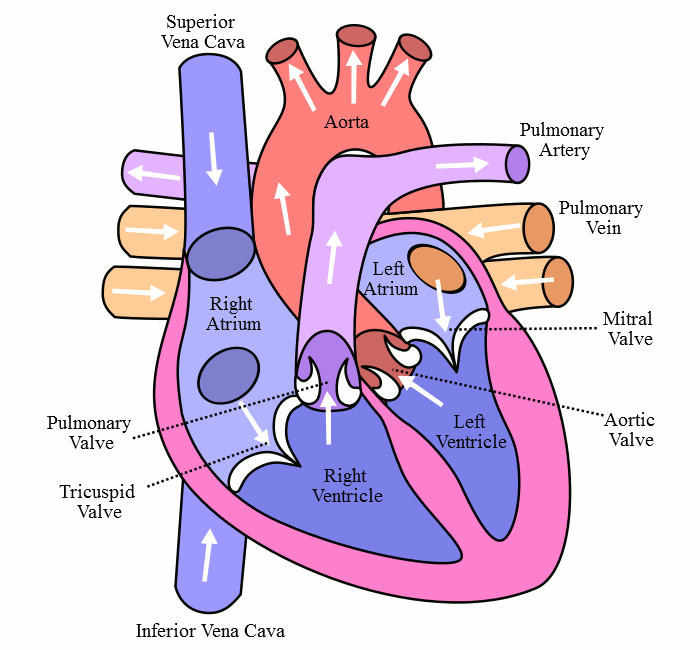
1.Heart is the main muscular organ which constantly supplies oxygenated blood to the brain and all parts of the body and also sends deoxygenated blood to lungs for oxygenation. The blood circulation in the heart is as follows-
2.The superior and inferior vena cava brings the deoxygenated blood from all the parts of the body to the right atrium.
3.The atrium contract and the blood flows from the atrium to the right ventricle through the tricuspid valve which regulates the flow of blood.
4.The ventricles contract and the blood through the pulmonic valve reach the pulmonary artery which carries blood to the lung for oxygenation.
5.Then the oxygen rich blood is brought back to heart by pulmonary vein to the left atrium.
6.The left atrium contracts and the blood from the atrium moves to the left ventricle through the mitral valve which prevents the backflow of the blood.
7.Further ventricles contract and the oxygenated blood is moved away from the heart through the aorta and arteries to all parts of the body. Aorta is guarded by an aortic valve.
The diagram below shows the blood flow through the heart.
Note: The wall of the heart is made up of cardiac muscles which facilitate the contraction of muscle and hereby facilitating the blood circulation. All the arteries in our body carry oxygenated blood except the pulmonary artery and all the veins carry deoxygenated blood except the pulmonary vein. The aorta is the largest artery in our body.
Complete answer:
1.Heart is the main muscular organ which constantly supplies oxygenated blood to the brain and all parts of the body and also sends deoxygenated blood to lungs for oxygenation. The blood circulation in the heart is as follows-
2.The superior and inferior vena cava brings the deoxygenated blood from all the parts of the body to the right atrium.
3.The atrium contract and the blood flows from the atrium to the right ventricle through the tricuspid valve which regulates the flow of blood.
4.The ventricles contract and the blood through the pulmonic valve reach the pulmonary artery which carries blood to the lung for oxygenation.
5.Then the oxygen rich blood is brought back to heart by pulmonary vein to the left atrium.
6.The left atrium contracts and the blood from the atrium moves to the left ventricle through the mitral valve which prevents the backflow of the blood.
7.Further ventricles contract and the oxygenated blood is moved away from the heart through the aorta and arteries to all parts of the body. Aorta is guarded by an aortic valve.
The diagram below shows the blood flow through the heart.
Note: The wall of the heart is made up of cardiac muscles which facilitate the contraction of muscle and hereby facilitating the blood circulation. All the arteries in our body carry oxygenated blood except the pulmonary artery and all the veins carry deoxygenated blood except the pulmonary vein. The aorta is the largest artery in our body.
Recently Updated Pages
If x a + bt + ct2 where x is in meters and t is in class 11 physics CBSE

A car covers the first half distance between two places class 11 physics CBSE
The resultant of two vectors overrightarrow P and overrightarrow class 11 physics CBSE
Find the value of cos 135 class 11 maths CBSE
A mass M is held in place by an applied force F and class 11 physics CBSE
A solution of glucose in water is labelled as 10 dfracwv class 11 chemistry CBSE
Trending doubts
Find the value of the expression given below sin 30circ class 11 maths CBSE
What is the maximum height of a projectile class 11 physics CBSE
Derive an expression for maximum height and range of class 11 physics CBSE
Describe various types of epithelial tissues with the class 11 biology CBSE
Lysosomes are known as suicidal bags of cell why class 11 biology CBSE
State and derive law of conservation of momentum class 11 physics CBSE