




Explain $\text{ }\beta -\text{ }$ elimination.
Answer
 Verified
598.5k+ views
Hint: When haloalkanes with $\text{ }\beta -\text{ }$ hydrogen atoms are boiled with an alcoholic solution of potassium hydroxide, they undergo the elimination of hydrogen halide $\text{ }\left( \text{HX} \right)\text{ }$ resulting in the formation of alkenes. These reactions are known as the dehydrohalogenation or $\text{ }\beta -\text{ }$ elimination reactions. The major product is obtained by Saytzeff’s rule.
Complete Solution :
When haloalkanes with $\text{ }\beta -\text{ }$ hydrogen atoms are boiled with an alcoholic solution of potassium hydroxide, they undergo the elimination of hydrogen halide $\text{ }\left( \text{HX} \right)\text{ }$ resulting in the formation of alkenes. The general reaction of the dehydrohalogenation of the haloalkanes is as shown below:
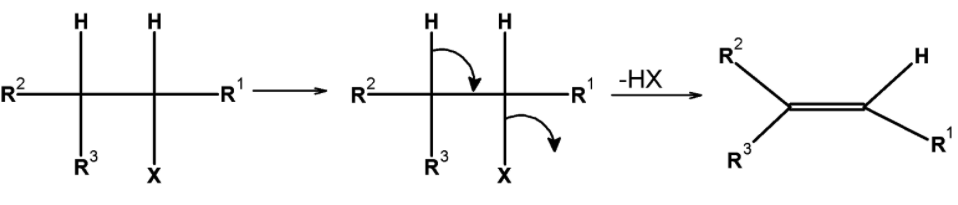
- These reactions are called the $\text{ }\beta -\text{ }$ elimination reactions because the hydrogen atom present at the $\text{ }\beta -\text{ }$ position of haloalkanes (i.e. at the carbon atom next to that which carries the halogen) is removed.
- These reactions are also known as the dehydrohalogenation reaction (removal of hydrogen halide) reactions. The elimination reaction occurs by the abstraction of a proton from a carbon atom next to the carbon bearing halogen atom and halide ion is also resulting in a new pi-bond.
- The 1-Bromobutane reacted with the alcoholic potassium hydroxide $\text{ KOH }$ .here, bromine (halogen group) is at the $\text{ }\alpha \text{ }$ position and hydrogen is at the $\text{ }\beta \text{ }$ position. when boiled with $\text{ KOH }$, hydrogen atom transfers its electron pair to the adjacent carbon-carbon bond, and bromide is removed from the molecule. This forms a double bond between the alpha and beta carbon atom and gives a1-butene as the product.
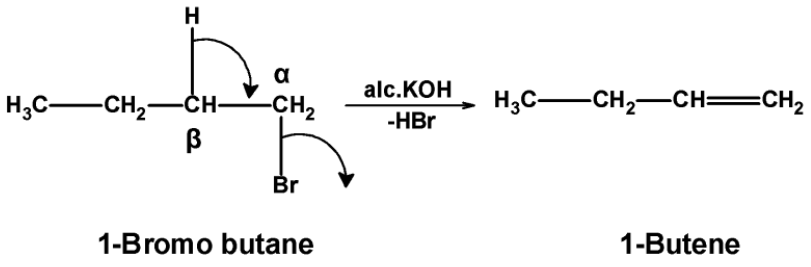
Thus, 1-Bromobutane on reaction with alcohol $\text{ KOH }$ gives 1-butene.
So, the correct answer is “Option A”.
Note: In the case of haloalkanes which has more than one $\text{ }\beta -\text{ }$ position can eliminate the hydrogen halide in two different ways, then that alkene will be preferred in which carbon atoms joined by the double bond are maximum alkylated i.e. contain the largest number of alkyl groups. This rule is called Saytzeff’s rule. The rule gives the major product formed in the $\text{ }\beta -\text{ }$ elimination reaction. Here ,1-bromobutane has one $\text{ }\beta -\text{ }$ position thus there would be only one major product.
Complete Solution :
When haloalkanes with $\text{ }\beta -\text{ }$ hydrogen atoms are boiled with an alcoholic solution of potassium hydroxide, they undergo the elimination of hydrogen halide $\text{ }\left( \text{HX} \right)\text{ }$ resulting in the formation of alkenes. The general reaction of the dehydrohalogenation of the haloalkanes is as shown below:
- These reactions are called the $\text{ }\beta -\text{ }$ elimination reactions because the hydrogen atom present at the $\text{ }\beta -\text{ }$ position of haloalkanes (i.e. at the carbon atom next to that which carries the halogen) is removed.
- These reactions are also known as the dehydrohalogenation reaction (removal of hydrogen halide) reactions. The elimination reaction occurs by the abstraction of a proton from a carbon atom next to the carbon bearing halogen atom and halide ion is also resulting in a new pi-bond.
- The 1-Bromobutane reacted with the alcoholic potassium hydroxide $\text{ KOH }$ .here, bromine (halogen group) is at the $\text{ }\alpha \text{ }$ position and hydrogen is at the $\text{ }\beta \text{ }$ position. when boiled with $\text{ KOH }$, hydrogen atom transfers its electron pair to the adjacent carbon-carbon bond, and bromide is removed from the molecule. This forms a double bond between the alpha and beta carbon atom and gives a1-butene as the product.
Thus, 1-Bromobutane on reaction with alcohol $\text{ KOH }$ gives 1-butene.
So, the correct answer is “Option A”.
Note: In the case of haloalkanes which has more than one $\text{ }\beta -\text{ }$ position can eliminate the hydrogen halide in two different ways, then that alkene will be preferred in which carbon atoms joined by the double bond are maximum alkylated i.e. contain the largest number of alkyl groups. This rule is called Saytzeff’s rule. The rule gives the major product formed in the $\text{ }\beta -\text{ }$ elimination reaction. Here ,1-bromobutane has one $\text{ }\beta -\text{ }$ position thus there would be only one major product.
Recently Updated Pages
Master Class 12 Economics: Engaging Questions & Answers for Success

Master Class 12 English: Engaging Questions & Answers for Success
Master Class 12 Social Science: Engaging Questions & Answers for Success
Master Class 12 Maths: Engaging Questions & Answers for Success
Master Class 12 Physics: Engaging Questions & Answers for Success
Master Class 9 General Knowledge: Engaging Questions & Answers for Success
Trending doubts
A dentist uses a small mirror that gives a magnification class 12 physics CBSE
Differentiate between insitu conservation and exsitu class 12 biology CBSE
A person looks into the mirror by placing it close class 12 physics CBSE
Drive an expression for the electric field due to an class 12 physics CBSE
Acetic acid dimerises in Benzene solution The Vant class 12 chemistry CBSE
What is the process of formation of government in class 12 social science CBSE