




Explain Adsorption theory of Heterogeneous Catalysis.
Answer
 Verified
655.2k+ views
Hint:Adsorption is a Surface phenomenon, i.e. the molecules of the adsorbate do not enter inside the adsorbent, they just stick to the surface. Hence, to solve this problem, firstly we should understand about surface chemistry, Adsorption, Catalyst, then we will learn about the Adsorption theory of Heterogeneous catalysis.
Complete step by step solution:
> Adsorption: The incident of attracting and retaining the substance by a solid (or a liquid) on its surface resulting in a higher concentration of molecules on the surface is known as Adsorption.
Ex: Clay, Silica
> Catalyst: It is defined as a substance that can be added to a reaction to increase the reaction rate without getting consumed in the process.
> Absorption theory of heterogeneous catalysis, when the reactants of gaseous state or in dissolved state in any solution they adhere on the surface of a suitable catalyst in the solid state. As a result, the concentration of the reactant of the surface of the catalyst availability and probability of the phenomena of a reaction between two increases, and thus the rate of the reaction increases. Also, during the adsorption of reactants to the surface of the catalyst, some amount of energy is released as the process is exothermic in nature.
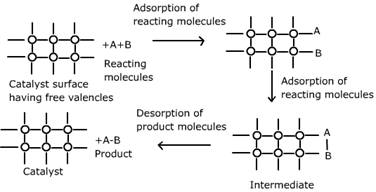
Note: Adsorption hypothesis of catalysis based on the mechanism of heterogeneous catalysis. According to the perspective when the catalyst is in solid phase and the reactants are in gaseous phase or in solution, the molecules of the reactants get absorbed on the catalyst surface. Adsorption is an exothermic process, the heat of adsorption is held by the catalyst surface, which is used on enhancing the chemical movement of reactants molecules.
Complete step by step solution:
> Adsorption: The incident of attracting and retaining the substance by a solid (or a liquid) on its surface resulting in a higher concentration of molecules on the surface is known as Adsorption.
Ex: Clay, Silica
> Catalyst: It is defined as a substance that can be added to a reaction to increase the reaction rate without getting consumed in the process.
> Absorption theory of heterogeneous catalysis, when the reactants of gaseous state or in dissolved state in any solution they adhere on the surface of a suitable catalyst in the solid state. As a result, the concentration of the reactant of the surface of the catalyst availability and probability of the phenomena of a reaction between two increases, and thus the rate of the reaction increases. Also, during the adsorption of reactants to the surface of the catalyst, some amount of energy is released as the process is exothermic in nature.
Note: Adsorption hypothesis of catalysis based on the mechanism of heterogeneous catalysis. According to the perspective when the catalyst is in solid phase and the reactants are in gaseous phase or in solution, the molecules of the reactants get absorbed on the catalyst surface. Adsorption is an exothermic process, the heat of adsorption is held by the catalyst surface, which is used on enhancing the chemical movement of reactants molecules.
Recently Updated Pages
Explain the structure of megasporangium class 12 biology CBSE

Why is chloroform kept in dark coloured bottles class 12 chemistry CBSE
Derive the balancing condition of a Wheatstone bri class 12 physics CBSE
Draw VI characteristics of a pn junction diode Explain class 12 physics CBSE
Is it possible to carry pride in ones language too class 12 english CBSE
In a population at Hardy Weinberg equilibrium the allele class 12 biology CBSE
Trending doubts
Draw a labelled sketch of the human eye class 12 physics CBSE
Which are the Top 10 Largest Countries of the World?
Draw ray diagrams each showing i myopic eye and ii class 12 physics CBSE
Which is the correct genotypic ratio of mendel dihybrid class 12 biology CBSE
Differentiate between homogeneous and heterogeneous class 12 chemistry CBSE
Which animal never drinks water in its entire life class 12 biology CBSE