




Excretory organs of cockroach are
A. Trachea
B. Kidney
C. Nephridia
D. Malpighian tubules
Answer
 Verified
663k+ views
Hint: It is a type of excretory system that helps in the maintenance of osmoregulation and is found in some of the insects.
Complete step-by-step answer:
Cockroaches are insects belonging to the phylum Arthropoda, which are dark brown and inhabit the unhygienic places. The metabolic waste of their body is excreted by ciliated and glandular malpighian tubules.
Additional Information:
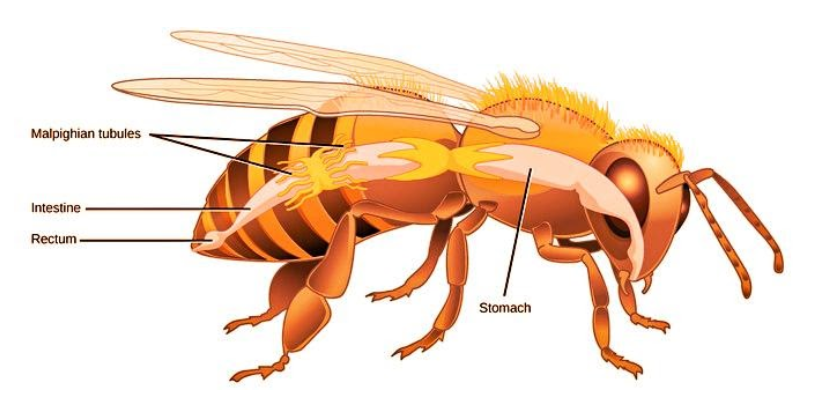
-The excretory system present in them is the malpighian tubules which consist of a branched network. The network is the extension of the alimentary canal which helps in the absorption of water and solutes and also in the removal of the wastes from the hemolymph.
-The wastes are then released from the organism in the form of solid nitrogenous compounds and calcium oxalate.
-The branched network system of malpighian tubules was named after the anatomist in the seventeenth-century, Marcello Malpighi.
-They are slender tubes normally found in the posterior regions of the alimentary canal of the arthropod.
-Most tubes are normally highly convoluted and differ according to the species.
-They contain actin fir structural support and microvilli for the propulsion of substances along the tubules.
-Wastes such as urea and amino acids are transported by the distal part of the tubules.
-Almost solid uric acid is finally eliminated with the feces after reabsorption.
So, the correct answer is ‘Malpighian tubules’.
Note: Various organisms have different types of the excretory system. Nephridia is the excretory organ in the case of earthworm (annelid) which is made up of coiled tubes that open in the body cavity. Invertebrates, the kidney is the organ of excretion. The neh=phron is the basic structural and functional unit of the kidney.
Complete step-by-step answer:
Cockroaches are insects belonging to the phylum Arthropoda, which are dark brown and inhabit the unhygienic places. The metabolic waste of their body is excreted by ciliated and glandular malpighian tubules.
Additional Information:
-The excretory system present in them is the malpighian tubules which consist of a branched network. The network is the extension of the alimentary canal which helps in the absorption of water and solutes and also in the removal of the wastes from the hemolymph.
-The wastes are then released from the organism in the form of solid nitrogenous compounds and calcium oxalate.
-The branched network system of malpighian tubules was named after the anatomist in the seventeenth-century, Marcello Malpighi.
-They are slender tubes normally found in the posterior regions of the alimentary canal of the arthropod.
-Most tubes are normally highly convoluted and differ according to the species.
-They contain actin fir structural support and microvilli for the propulsion of substances along the tubules.
-Wastes such as urea and amino acids are transported by the distal part of the tubules.
-Almost solid uric acid is finally eliminated with the feces after reabsorption.
So, the correct answer is ‘Malpighian tubules’.
Note: Various organisms have different types of the excretory system. Nephridia is the excretory organ in the case of earthworm (annelid) which is made up of coiled tubes that open in the body cavity. Invertebrates, the kidney is the organ of excretion. The neh=phron is the basic structural and functional unit of the kidney.
Recently Updated Pages
If x a + bt + ct2 where x is in meters and t is in class 11 physics CBSE

A car covers the first half distance between two places class 11 physics CBSE
The resultant of two vectors overrightarrow P and overrightarrow class 11 physics CBSE
Find the value of cos 135 class 11 maths CBSE
A mass M is held in place by an applied force F and class 11 physics CBSE
A solution of glucose in water is labelled as 10 dfracwv class 11 chemistry CBSE
Trending doubts
One Metric ton is equal to kg A 10000 B 1000 C 100 class 11 physics CBSE
Find the value of the expression given below sin 30circ class 11 maths CBSE
What do you mean by retardation What is its SI uni class 11 physics CBSE
Draw a diagram of nephron and explain its structur class 11 biology CBSE
10 examples of friction in our daily life
Difference between physical and chemical change class 11 chemistry CBSE