



How do you evaluate the integral of $\int{\dfrac{dx}{1+{{x}^{2}}}}$from $-1$ to $1$ ?
Answer
 Verified
622.8k+ views
Hint: Integration is the summation of all the smaller parts. There are two types of integration. One is indefinite integration. This one doesn’t have limits that mean we don’t have a boundary for this. And the second one is definite integration. There are certain defined limits here. There is a lower limit and an upper limit. And we have to add or integrate only between these limits.
Complete step by step answer:
There is one key formula that we should know before starting our integration. And that is :
$\int\limits_{a}^{b}{f\left( x \right)dx=\left[ F\left( x \right) \right]_{a}^{b}=F\left( a \right)-F\left( b \right)}$
Where $f$ be a continuous function defined on the closed integral $\left[ a,b \right]$ and $F$ be an antiderivative of $f.$
Let us consider $f\left( x \right)=\dfrac{1}{1+{{x}^{2}}}$ .
$\dfrac{1}{1+{{x}^{2}}}$ is surely continuous on $\left[ -1,1 \right]$, and we can verify it from the below shown graph.
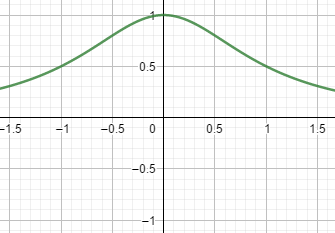
Now we are supposed to integrate this within $\left( -1,1 \right)$ . We represent this in the following way :
$\Rightarrow \int\limits_{-1}^{1}{\dfrac{dx}{1+{{x}^{2}}}}$ .
Here $-1$ is called the lower limit and $1$ is called the upper limit.
We know that :
$\int{\dfrac{dx}{1+{{x}^{2}}}={{\tan }^{-1}}x}$.
We know this from our previous knowledge.
Now let’s do the same but after that, we should apply the limits.
Upon integrating, we get the following :
$\begin{align}
& \Rightarrow \int\limits_{-1}^{1}{\dfrac{dx}{1+{{x}^{2}}}} \\
& \Rightarrow \int\limits_{-1}^{1}{\dfrac{dx}{1+{{x}^{2}}}}=\left[ {{\tan }^{-1}}x \right]_{-1}^{1} \\
\end{align}$
We know that $\tan \dfrac{\pi }{4}=1$ . So we can say ${{\tan }^{-1}}\left( 1 \right)=\dfrac{\pi }{4}$ …..$eqn\left( 1 \right)$
And we also know that $\tan \left( -\dfrac{\pi }{4} \right)=-1$ . So we can say ${{\tan }^{-1}}\left( -1 \right)=-\dfrac{\pi }{4}$ …..$eqn\left( 2 \right)$
Now let us make use of it $eqn\left( 1 \right)\And eqn\left( 2 \right)$ . Upon doing so, we get the following :
$\begin{align}
& \Rightarrow {{\tan }^{-1}}\left( 1 \right)-{{\tan }^{-1}}\left( -1 \right) \\
& \Rightarrow \dfrac{\pi }{4}-\left( -\dfrac{\pi }{4} \right) \\
& \therefore \dfrac{\pi }{2} \\
\end{align}$
If the limits are not mentioned in the question and we are just asked to integrate it then just ${{\tan }^{-1}}x$would be our answer. We don’t have to substitute the limits.
Hence, upon evaluating the integral $\int{\dfrac{dx}{1+{{x}^{2}}}}$ from $-1$ to $1$ we get $\dfrac{\pi }{2}$.
Note: We have to be careful while integrating. Sometimes, we should also make use of some substitutions in order to make the sum easier. We should remember the properties of definite integrals and also the anti-derivatives of all the crucial functions.
Complete step by step answer:
There is one key formula that we should know before starting our integration. And that is :
$\int\limits_{a}^{b}{f\left( x \right)dx=\left[ F\left( x \right) \right]_{a}^{b}=F\left( a \right)-F\left( b \right)}$
Where $f$ be a continuous function defined on the closed integral $\left[ a,b \right]$ and $F$ be an antiderivative of $f.$
Let us consider $f\left( x \right)=\dfrac{1}{1+{{x}^{2}}}$ .
$\dfrac{1}{1+{{x}^{2}}}$ is surely continuous on $\left[ -1,1 \right]$, and we can verify it from the below shown graph.
Now we are supposed to integrate this within $\left( -1,1 \right)$ . We represent this in the following way :
$\Rightarrow \int\limits_{-1}^{1}{\dfrac{dx}{1+{{x}^{2}}}}$ .
Here $-1$ is called the lower limit and $1$ is called the upper limit.
We know that :
$\int{\dfrac{dx}{1+{{x}^{2}}}={{\tan }^{-1}}x}$.
We know this from our previous knowledge.
Now let’s do the same but after that, we should apply the limits.
Upon integrating, we get the following :
$\begin{align}
& \Rightarrow \int\limits_{-1}^{1}{\dfrac{dx}{1+{{x}^{2}}}} \\
& \Rightarrow \int\limits_{-1}^{1}{\dfrac{dx}{1+{{x}^{2}}}}=\left[ {{\tan }^{-1}}x \right]_{-1}^{1} \\
\end{align}$
We know that $\tan \dfrac{\pi }{4}=1$ . So we can say ${{\tan }^{-1}}\left( 1 \right)=\dfrac{\pi }{4}$ …..$eqn\left( 1 \right)$
And we also know that $\tan \left( -\dfrac{\pi }{4} \right)=-1$ . So we can say ${{\tan }^{-1}}\left( -1 \right)=-\dfrac{\pi }{4}$ …..$eqn\left( 2 \right)$
Now let us make use of it $eqn\left( 1 \right)\And eqn\left( 2 \right)$ . Upon doing so, we get the following :
$\begin{align}
& \Rightarrow {{\tan }^{-1}}\left( 1 \right)-{{\tan }^{-1}}\left( -1 \right) \\
& \Rightarrow \dfrac{\pi }{4}-\left( -\dfrac{\pi }{4} \right) \\
& \therefore \dfrac{\pi }{2} \\
\end{align}$
If the limits are not mentioned in the question and we are just asked to integrate it then just ${{\tan }^{-1}}x$would be our answer. We don’t have to substitute the limits.
Hence, upon evaluating the integral $\int{\dfrac{dx}{1+{{x}^{2}}}}$ from $-1$ to $1$ we get $\dfrac{\pi }{2}$.
Note: We have to be careful while integrating. Sometimes, we should also make use of some substitutions in order to make the sum easier. We should remember the properties of definite integrals and also the anti-derivatives of all the crucial functions.
Recently Updated Pages
Which of the following graphs shows the variation of class 12 physics CBSE

Draw a labelled diagram of the human male reproductive class 12 biology CBSE
Describe the experiment to compare the emf of two cells class 12 physics CBSE
What is standard hydrogen electrode
What is conventional current and electric current class 12 physics CBSE
2Bromopentane is treated with an alcoholic KOH solution class 12 chemistry CBSE
Trending doubts
Draw a labelled sketch of the human eye class 12 physics CBSE
Which are the Top 10 Largest Countries of the World?
Differentiate between homogeneous and heterogeneous class 12 chemistry CBSE
Draw ray diagrams each showing i myopic eye and ii class 12 physics CBSE
Which is the correct genotypic ratio of mendel dihybrid class 12 biology CBSE
What is the Full Form of PVC, PET, HDPE, LDPE, PP and PS ?