




Eusporangiate fern is produced from
(A)Group of sporangial initial cell
(B)Single initial cell
(C)Epidermal cells
(D)Hypodermal cell
Answer
 Verified
641.4k+ views
Hint: As the word suggests, the eu prefix means true. The eusporangiate development is true development from a certain community of cells. The cells which are adjacent to these cells also contribute to the formation of the wall or stack of the sporangium.
Complete answer:
The eusporangiate sporangia develop from a group of sporangial initial cells. They divide into two components: the outer and the inner component. The outer cells give rise to the cell wall whereas the sporogenous tissues arise from the inner cell wall.
Additional Information: Ferns differ from the mosses as they are vascular which means they have specialized tissues that conduct water and nutrients and in having life cycles in which the sporophyte is the dominant phase. Ferns have very complex leaves which are known as megaphylls, which are more complex than the microphylls of clubmosses. Most ferns are leptosporangiate ferns. They also produce coiled fiddleheads that uncoil and expand into fronds
Some characteristics of the division Pteridophyta are:
These are flowerless, seedless, spore-producing vascular plants that have successfully invaded the land.
-The plants that come under this division are sporophytes. Their reproduction is asexual by the formation of spores in sporangia.
-The main body of pteridophytes is differentiated into true roots, stem, and true leaves.
-The vascular tissues are present in these and are organized in definite groups.
-The leptosporangiate type of sporangium arises from a single superficial initial. The inner cell forms a stalk here while the cell present on the outside gives rise to the sporogenous tissue.
So, the correct answer is ‘Group of the sporangial initial cell’.
Note: Pteridophytes are also known as vascular cryptogams.
-The fertilization in pteridophytes is zooidogamy (affected by water).
-The term pteridophyte is taken from greek meaning, Pteron= father/fern; phyton= plants.
-Late paleozoic age is known as the age of pteridophytes.
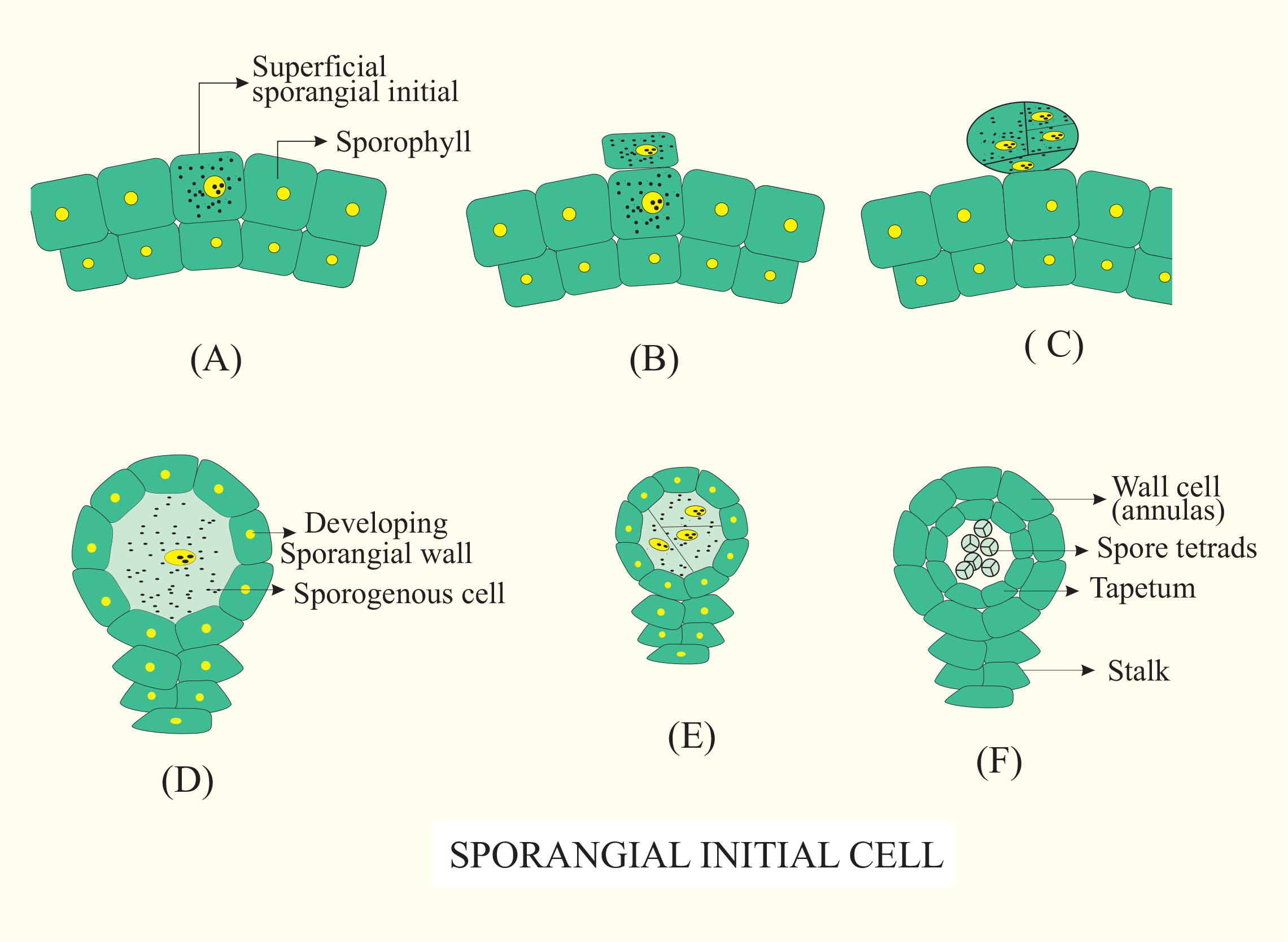
Complete answer:
The eusporangiate sporangia develop from a group of sporangial initial cells. They divide into two components: the outer and the inner component. The outer cells give rise to the cell wall whereas the sporogenous tissues arise from the inner cell wall.
Additional Information: Ferns differ from the mosses as they are vascular which means they have specialized tissues that conduct water and nutrients and in having life cycles in which the sporophyte is the dominant phase. Ferns have very complex leaves which are known as megaphylls, which are more complex than the microphylls of clubmosses. Most ferns are leptosporangiate ferns. They also produce coiled fiddleheads that uncoil and expand into fronds
Some characteristics of the division Pteridophyta are:
These are flowerless, seedless, spore-producing vascular plants that have successfully invaded the land.
-The plants that come under this division are sporophytes. Their reproduction is asexual by the formation of spores in sporangia.
-The main body of pteridophytes is differentiated into true roots, stem, and true leaves.
-The vascular tissues are present in these and are organized in definite groups.
-The leptosporangiate type of sporangium arises from a single superficial initial. The inner cell forms a stalk here while the cell present on the outside gives rise to the sporogenous tissue.
So, the correct answer is ‘Group of the sporangial initial cell’.
Note: Pteridophytes are also known as vascular cryptogams.
-The fertilization in pteridophytes is zooidogamy (affected by water).
-The term pteridophyte is taken from greek meaning, Pteron= father/fern; phyton= plants.
-Late paleozoic age is known as the age of pteridophytes.
Recently Updated Pages
Which will be the least stable resonating structure class 11 chemistry CBSE

How many 5 digit telephone numbers can be construc-class-11-maths-CBSE
How do you find the angle of the resultant vector class 11 physics CBSE
Draw labelled diagram of the following i Gram seed class 11 biology CBSE
1 Quintal is equal to a 110 kg b 10 kg c 100kg d 1000 class 11 physics CBSE
What is the need and importance of classification class 11 biology CBSE
Trending doubts
Find the value of the expression given below sin 30circ class 11 maths CBSE
One Metric ton is equal to kg A 10000 B 1000 C 100 class 11 physics CBSE
Draw a diagram of nephron and explain its structur class 11 biology CBSE
10 examples of friction in our daily life
Draw a diagram of a plant cell and label at least eight class 11 biology CBSE
Difference Between Prokaryotic Cells and Eukaryotic Cells