



Ethyl acetate is treated with excess of methyl magnesium iodide in dry ether. The reaction mixture is treated with water. The organic products obtained are?
(A) \[C{{H}_{3}}C{{H}_{2}}\overset{OH}{\mathop{\overset{|}{\mathop{C}}\,}}\,{{(C{{H}_{3}})}_{2}}\,and\,C{{H}_{3}}OH\]
(B) \[{{(C{{H}_{3}}C{{H}_{2}})}_{2}}\overset{OH}{\mathop{\overset{|}{\mathop{C}}\,}}\,C{{H}_{3\,}}and\,C{{H}_{3}}OH\]
(C) ${{\left( C{{H}_{3}}C{{H}_{2}} \right)}_{3}}COH\,and\,C{{H}_{3}}C{{H}_{2}}OH$
(D) ${{(C{{H}_{3}})}_{3}}COH\,and\,C{{H}_{3}}C{{H}_{2}}OH$
Answer
 Verified
608.4k+ views
Hint:So in the given reaction, the reactant is methyl magnesium bromide which can be also called as Grignard reagent as the alkyl magnesium halides are Grignard reagent and it is a good nucleophile hence the reaction will be a nucleophilic addition reaction.
Complete step-by-step answer: So in the question reaction with various steps are given after completion of each step we will obtain a product which on treatment with another reagent will give entirely different product.
The first reactant here is ethyl acetate with methyl magnesium iodide. We know that ethyl acetate is an acetate molecule which has which has ethyl group as the alkyl chain and the molecular formulae is$C{{H}_{3}}C{{O}_{2}}C{{H}_{2}}C{{H}_{3}}$.
And we know that the other reactant is Grignard reagent, all the alkyl magnesium halides are Grignard reagent, which is a good nucleophile for the electrophilic species like carbonyl groups. So the reaction involved here is nucleophilic addition reaction.
The double bond present in O atom of acetate molecule shift towards the O atoms giving it a negative charge and the C atom will be positively charged.
The methyl group in Grignard reagent will have partial negative charge and the Mg will have positive charge. The negatively charged C in Grignard reagent attacks the C and an adduct is formed, it is hydrolyzed and gets a ketone.
Since in the question it is given that excess of Grignard reagent is used, hence this ketone will again react with the Grignard reagent following the same mechanism as above and is treated with water, the final product obtained is an alcohol.
The reaction mechanism is as follows:
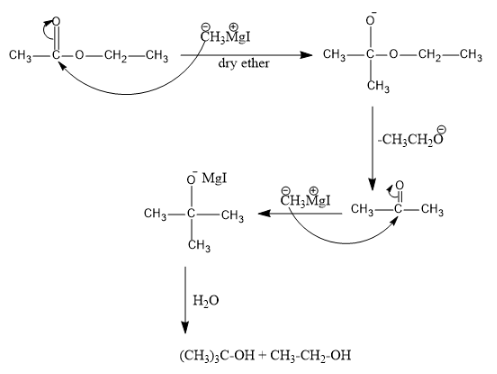
Hence by comparing the answer with the given options, option (d) is the correct answer for the question.
Note:We should take care of the arrows we use to denote the direction of flow of the electrons. And while shifting the bonds give proper charge for the atoms and always double check whether the valency of all the atoms are satisfied or not.
Complete step-by-step answer: So in the question reaction with various steps are given after completion of each step we will obtain a product which on treatment with another reagent will give entirely different product.
The first reactant here is ethyl acetate with methyl magnesium iodide. We know that ethyl acetate is an acetate molecule which has which has ethyl group as the alkyl chain and the molecular formulae is$C{{H}_{3}}C{{O}_{2}}C{{H}_{2}}C{{H}_{3}}$.
And we know that the other reactant is Grignard reagent, all the alkyl magnesium halides are Grignard reagent, which is a good nucleophile for the electrophilic species like carbonyl groups. So the reaction involved here is nucleophilic addition reaction.
The double bond present in O atom of acetate molecule shift towards the O atoms giving it a negative charge and the C atom will be positively charged.
The methyl group in Grignard reagent will have partial negative charge and the Mg will have positive charge. The negatively charged C in Grignard reagent attacks the C and an adduct is formed, it is hydrolyzed and gets a ketone.
Since in the question it is given that excess of Grignard reagent is used, hence this ketone will again react with the Grignard reagent following the same mechanism as above and is treated with water, the final product obtained is an alcohol.
The reaction mechanism is as follows:
Hence by comparing the answer with the given options, option (d) is the correct answer for the question.
Note:We should take care of the arrows we use to denote the direction of flow of the electrons. And while shifting the bonds give proper charge for the atoms and always double check whether the valency of all the atoms are satisfied or not.
Recently Updated Pages
Which of the following graphs shows the variation of class 12 physics CBSE

Draw a labelled diagram of the human male reproductive class 12 biology CBSE
Describe the experiment to compare the emf of two cells class 12 physics CBSE
What is standard hydrogen electrode
What is conventional current and electric current class 12 physics CBSE
2Bromopentane is treated with an alcoholic KOH solution class 12 chemistry CBSE
Trending doubts
Draw a labelled sketch of the human eye class 12 physics CBSE
Which are the Top 10 Largest Countries of the World?
Differentiate between homogeneous and heterogeneous class 12 chemistry CBSE
Draw ray diagrams each showing i myopic eye and ii class 12 physics CBSE
Which is the correct genotypic ratio of mendel dihybrid class 12 biology CBSE
What is the Full Form of PVC, PET, HDPE, LDPE, PP and PS ?