




What is the essential condition for diffraction of light to occur?
Answer
 Verified
581.1k+ views
Hint: Diffraction and scattering of light can be used interchangeably. However, diffraction is controlled or methodical scattering. Diffraction of light occurs when it passes through a corner or orifice of small aperture.
Complete step by step answer:
Diffraction of light is a well known phenomenon, and it is one of the most significant reasons why our sky has blue colour during the day. However, we used the term diffraction in a more conservative way.
Diffraction occurs when we pass a light through a orifice of small aperture. When it passes through the aperture, the beam of light spreads out instead of forming a very fine beam due to the orifice.
A very common demonstration can be observed by putting two fingers between your eye and light source. As we move the fingers close to each other, we begin to see a series of light and dark lines parallel to the space between the fingers. This is due to the effect of diffraction. As you have probably noticed, the diffraction pattern occurs only when the distance between the fingers is very small.
It is the most essential condition for the diffraction to occur. The opening or slit width has to be comparable or less than the wavelength of light for prominent diffraction patterns.
It is one of the reasons why the sky is blue instead of white. If all the colours had the same amount of diffraction, the sky would look white. However, the diffraction of blue light is most prominent and it reaches our eyes. That is why the sky appears blue.
Note:
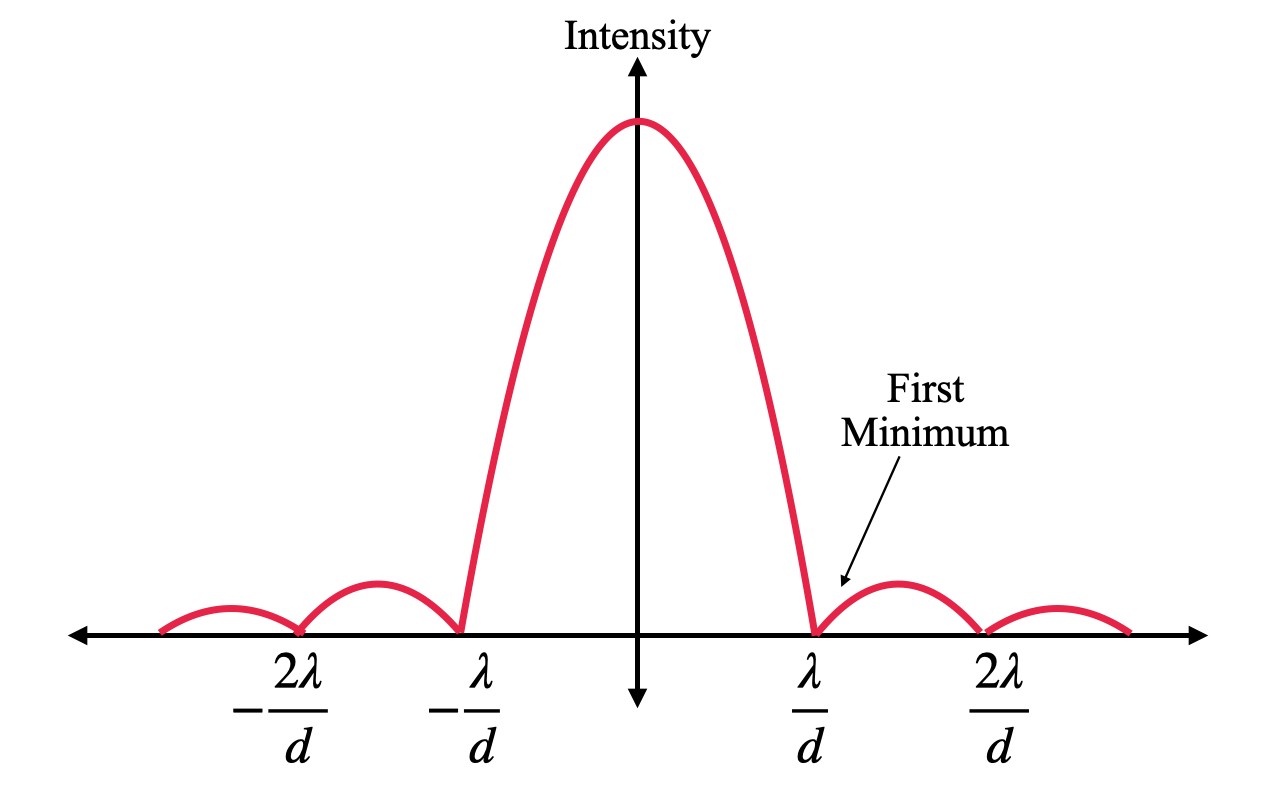
One of the most popular experiments involving the diffraction of light is the single slit experiment. Light is passed through a small opening and the diffraction pattern is observed on a screen beside the opening. The following diagram shows the diffraction pattern.
The maximum intensity is observed just behind the opening. However, the intensity starts decreasing due to the destructive interference between the diffracted light waves.
Complete step by step answer:
Diffraction of light is a well known phenomenon, and it is one of the most significant reasons why our sky has blue colour during the day. However, we used the term diffraction in a more conservative way.
Diffraction occurs when we pass a light through a orifice of small aperture. When it passes through the aperture, the beam of light spreads out instead of forming a very fine beam due to the orifice.
A very common demonstration can be observed by putting two fingers between your eye and light source. As we move the fingers close to each other, we begin to see a series of light and dark lines parallel to the space between the fingers. This is due to the effect of diffraction. As you have probably noticed, the diffraction pattern occurs only when the distance between the fingers is very small.
It is the most essential condition for the diffraction to occur. The opening or slit width has to be comparable or less than the wavelength of light for prominent diffraction patterns.
It is one of the reasons why the sky is blue instead of white. If all the colours had the same amount of diffraction, the sky would look white. However, the diffraction of blue light is most prominent and it reaches our eyes. That is why the sky appears blue.
Note:
One of the most popular experiments involving the diffraction of light is the single slit experiment. Light is passed through a small opening and the diffraction pattern is observed on a screen beside the opening. The following diagram shows the diffraction pattern.
The maximum intensity is observed just behind the opening. However, the intensity starts decreasing due to the destructive interference between the diffracted light waves.
Recently Updated Pages
Explain the structure of megasporangium class 12 biology CBSE

Why is chloroform kept in dark coloured bottles class 12 chemistry CBSE
Derive the balancing condition of a Wheatstone bri class 12 physics CBSE
Draw VI characteristics of a pn junction diode Explain class 12 physics CBSE
Is it possible to carry pride in ones language too class 12 english CBSE
In a population at Hardy Weinberg equilibrium the allele class 12 biology CBSE
Trending doubts
Draw a labelled sketch of the human eye class 12 physics CBSE
Which are the Top 10 Largest Countries of the World?
Draw ray diagrams each showing i myopic eye and ii class 12 physics CBSE
Which is the correct genotypic ratio of mendel dihybrid class 12 biology CBSE
Differentiate between homogeneous and heterogeneous class 12 chemistry CBSE
Which animal never drinks water in its entire life class 12 biology CBSE