




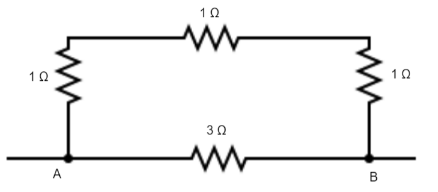
Equivalent resistance between points A and B is
A. $3\,\Omega $
B. $6\,\Omega $
C. $1.5\,\Omega $
D. $4.5\,\Omega $
Answer
 Verified
496.8k+ views
Hint:Equivalent resistance between two points can be evaluated after simplifying the circuit into simple series parallel combinations of resistors and then applying the appropriate formula. We will first identify which resistors are in series and which are in parallel and then apply suitable formulas. Since the equivalent resistance is asked between points A and B, we shall keep these as reference.
Formula used:
When the resistors are connected in series their equivalent is given by ${R_s} = {R_1} + {R_2}........ + {R_n}$ . When the resistors are connected in parallel, the equivalent resistance is given by $\dfrac{1}{{{R_p}}} = \dfrac{1}{{{R_1}}} + \dfrac{1}{{{R_2}}} + ......... + \dfrac{1}{{{R_n}}}$ .
Complete step by step answer:
A series connection is identified to be the connection where the resistors are connected in a chain like fashion whereas in a parallel connection the resistors have the same starting and ending points in the circuit. In the given circuit, the $1\,\Omega $ resistors are in series and their series combination is in parallel with the $3\,\Omega $ resistor.
Using the formula for the series connection of resistors,
${R_s} = {R_1} + {R_2}........ + {R_n}$
Here we have three resistors so this formula reduces to ${R_s} = {R_1} + {R_2} + {R_3}$.
Substituting the values we get,
${R_s} = 1 + 1 + 1$
$ \Rightarrow {R_s} = 3\,\Omega $
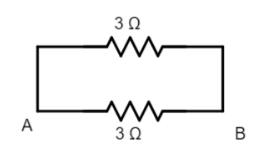
Now the circuit is simplified as a parallel combination of two $3\,\Omega $ resistors.
Using the formula for the parallel connection of resistors,
$\dfrac{1}{{{R_p}}} = \dfrac{1}{{{R_1}}} + \dfrac{1}{{{R_2}}} + ......... + \dfrac{1}{{{R_n}}}$
Here we have two resistors so this formula reduces to $\dfrac{1}{{{R_p}}} = \dfrac{1}{{{R_1}}} + \dfrac{1}{{{R_2}}}$
Substituting the values we get,
$\dfrac{1}{{{R_p}}} = \dfrac{1}{3} + \dfrac{1}{3}$
$ \Rightarrow \dfrac{1}{{{R_p}}} = \dfrac{2}{3}$
$ \therefore {R_p} = \dfrac{3}{2}\,\Omega $ which is the same as $1.5\,\Omega $
Hence, option C is the correct answer.
Note:We must carefully analyze the circuit for the series and parallel combinations. Sometimes it might happen due to the diagrammatic representation, we may perceive a wrong combination. Always remember that in a series combination, there is a voltage drop across all the resistors and the current remains the same. However, if the current gets distributed and there is no potential drop then it is a parallel combination.
Formula used:
When the resistors are connected in series their equivalent is given by ${R_s} = {R_1} + {R_2}........ + {R_n}$ . When the resistors are connected in parallel, the equivalent resistance is given by $\dfrac{1}{{{R_p}}} = \dfrac{1}{{{R_1}}} + \dfrac{1}{{{R_2}}} + ......... + \dfrac{1}{{{R_n}}}$ .
Complete step by step answer:
A series connection is identified to be the connection where the resistors are connected in a chain like fashion whereas in a parallel connection the resistors have the same starting and ending points in the circuit. In the given circuit, the $1\,\Omega $ resistors are in series and their series combination is in parallel with the $3\,\Omega $ resistor.
Using the formula for the series connection of resistors,
${R_s} = {R_1} + {R_2}........ + {R_n}$
Here we have three resistors so this formula reduces to ${R_s} = {R_1} + {R_2} + {R_3}$.
Substituting the values we get,
${R_s} = 1 + 1 + 1$
$ \Rightarrow {R_s} = 3\,\Omega $
Now the circuit is simplified as a parallel combination of two $3\,\Omega $ resistors.
Using the formula for the parallel connection of resistors,
$\dfrac{1}{{{R_p}}} = \dfrac{1}{{{R_1}}} + \dfrac{1}{{{R_2}}} + ......... + \dfrac{1}{{{R_n}}}$
Here we have two resistors so this formula reduces to $\dfrac{1}{{{R_p}}} = \dfrac{1}{{{R_1}}} + \dfrac{1}{{{R_2}}}$
Substituting the values we get,
$\dfrac{1}{{{R_p}}} = \dfrac{1}{3} + \dfrac{1}{3}$
$ \Rightarrow \dfrac{1}{{{R_p}}} = \dfrac{2}{3}$
$ \therefore {R_p} = \dfrac{3}{2}\,\Omega $ which is the same as $1.5\,\Omega $
Hence, option C is the correct answer.
Note:We must carefully analyze the circuit for the series and parallel combinations. Sometimes it might happen due to the diagrammatic representation, we may perceive a wrong combination. Always remember that in a series combination, there is a voltage drop across all the resistors and the current remains the same. However, if the current gets distributed and there is no potential drop then it is a parallel combination.
Recently Updated Pages
Master Class 12 Economics: Engaging Questions & Answers for Success

Master Class 12 Physics: Engaging Questions & Answers for Success
Master Class 12 English: Engaging Questions & Answers for Success
Master Class 12 Social Science: Engaging Questions & Answers for Success
Master Class 12 Maths: Engaging Questions & Answers for Success
Master Class 12 Business Studies: Engaging Questions & Answers for Success
Trending doubts
Which are the Top 10 Largest Countries of the World?
What are the major means of transport Explain each class 12 social science CBSE
Draw a labelled sketch of the human eye class 12 physics CBSE
Why cannot DNA pass through cell membranes class 12 biology CBSE
Differentiate between insitu conservation and exsitu class 12 biology CBSE
Draw a neat and well labeled diagram of TS of ovary class 12 biology CBSE