




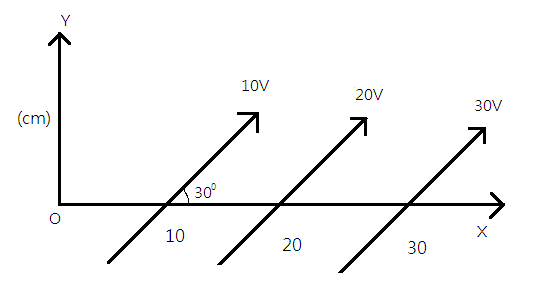
Equipotential surfaces are shown in fig, then the electric field strength will be
A. $100\,V{m^{ - 1}}$ along X-axis
B. $100\,V{m^{ - 1}}$ along Y-axis
C. $200\,V{m^{ - 1}}$ at an angle ${120^ \circ }$ with X-axis
D. $50\,V{m^{ - 1}}$ at an angle ${180^ \circ }$ with X-axis
Answer
 Verified
629.1k+ views
Hint: The potential difference between two surfaces is given, the distance between two equipotential surfaces is also given. Potential difference is the dot product of electric field strength with the displacement vector. Substitute the values of potential difference and distance vector to find the electric field strength.
Complete step by step answer:
Equipotential surface is the locus of all points which are at the same potential level. Work done to move a charge from one point to another on the equipotential surface is zero. Any surface with the same electric potential at every point is termed as an equipotential surface.
Let $\vartriangle V$ be the potential difference between two equipotential surfaces.
$E$ be the electric field strength
$\vartriangle r$ be the distance between the two equipotential surfaces.
The potential difference is dot product of electric field and distance vector, given as:
$\vartriangle V = - E.\vartriangle r$
The negative sign indicates that work must be done against the field to move the charge apart.
$ \Rightarrow \vartriangle V = - E\vartriangle r\cos \theta $
$ \Rightarrow E = - \dfrac{{\vartriangle V}}{{\vartriangle r\cos \theta }}$
Let us consider the equipotential surface at $10\,cm$ and $20\,cm$ . These surfaces have potential of $20\,V$ and $10\,V$ respectively. Therefore, we can have
$\vartriangle V = 20V - 10V = 10V$ and $\vartriangle r = 20cm - 10cm = 0.1m$
The electric field is perpendicular to the equipotential surface, as shown below
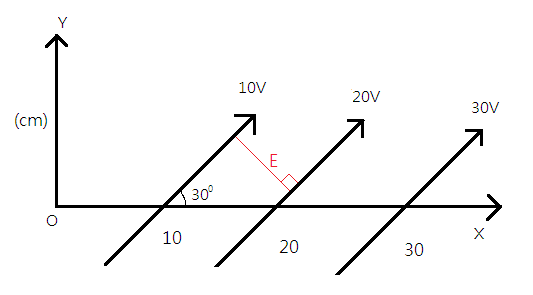
It is clear that the electric field makes an angle of ${120^ \circ }$ with the positive X-axis, $\theta = {120^ \circ }$
Substituting the values, we get
$E = - \dfrac{{10}}{{0.1 \times \cos {{120}^ \circ }}}$
$\cos {120^ \circ } = - \dfrac{1}{2}$
$ \Rightarrow E = - \dfrac{{10}}{{0.1 \times \left( { - \dfrac{1}{2}} \right)}}$
$ \Rightarrow E = 200\,V{m^{ - 1}}$
Thus, the electric field strength is of $200\,V{m^{ - 1}}$ and it is at an angle of ${120^ \circ }$ with X-axis.
So, the correct answer is “Option C”.
Note:
Surfaces which are at same potential are known as equipotential surfaces.
The equipotential surface can be in any shape.
The potential difference is the dot product of the electric field strength and the distance.
The potential difference is taken as negative.
Complete step by step answer:
Equipotential surface is the locus of all points which are at the same potential level. Work done to move a charge from one point to another on the equipotential surface is zero. Any surface with the same electric potential at every point is termed as an equipotential surface.
Let $\vartriangle V$ be the potential difference between two equipotential surfaces.
$E$ be the electric field strength
$\vartriangle r$ be the distance between the two equipotential surfaces.
The potential difference is dot product of electric field and distance vector, given as:
$\vartriangle V = - E.\vartriangle r$
The negative sign indicates that work must be done against the field to move the charge apart.
$ \Rightarrow \vartriangle V = - E\vartriangle r\cos \theta $
$ \Rightarrow E = - \dfrac{{\vartriangle V}}{{\vartriangle r\cos \theta }}$
Let us consider the equipotential surface at $10\,cm$ and $20\,cm$ . These surfaces have potential of $20\,V$ and $10\,V$ respectively. Therefore, we can have
$\vartriangle V = 20V - 10V = 10V$ and $\vartriangle r = 20cm - 10cm = 0.1m$
The electric field is perpendicular to the equipotential surface, as shown below
It is clear that the electric field makes an angle of ${120^ \circ }$ with the positive X-axis, $\theta = {120^ \circ }$
Substituting the values, we get
$E = - \dfrac{{10}}{{0.1 \times \cos {{120}^ \circ }}}$
$\cos {120^ \circ } = - \dfrac{1}{2}$
$ \Rightarrow E = - \dfrac{{10}}{{0.1 \times \left( { - \dfrac{1}{2}} \right)}}$
$ \Rightarrow E = 200\,V{m^{ - 1}}$
Thus, the electric field strength is of $200\,V{m^{ - 1}}$ and it is at an angle of ${120^ \circ }$ with X-axis.
So, the correct answer is “Option C”.
Note:
Surfaces which are at same potential are known as equipotential surfaces.
The equipotential surface can be in any shape.
The potential difference is the dot product of the electric field strength and the distance.
The potential difference is taken as negative.
Recently Updated Pages
Explain the structure of megasporangium class 12 biology CBSE

Why is chloroform kept in dark coloured bottles class 12 chemistry CBSE
Derive the balancing condition of a Wheatstone bri class 12 physics CBSE
Draw VI characteristics of a pn junction diode Explain class 12 physics CBSE
Is it possible to carry pride in ones language too class 12 english CBSE
In a population at Hardy Weinberg equilibrium the allele class 12 biology CBSE
Trending doubts
Draw a labelled sketch of the human eye class 12 physics CBSE
Which are the Top 10 Largest Countries of the World?
Draw ray diagrams each showing i myopic eye and ii class 12 physics CBSE
Which is the correct genotypic ratio of mendel dihybrid class 12 biology CBSE
Differentiate between homogeneous and heterogeneous class 12 chemistry CBSE
Which animal never drinks water in its entire life class 12 biology CBSE