




Equation of a stationary wave is given by
A. $y = A\sin (kx - \omega t)$
B. $y = 2A\sin kx.\cos \omega t$
C. $y = A\cos 2\pi (kx - \dfrac{t}{T})$
D. $y = A\cos (2\pi t/I)$
Answer
 Verified
618.6k+ views
Hint: The wave can be defined as a disturbance which propagates or travel energy from one place to another without the transport of matter. Characteristics of waves is given by crest and trough, amplitude, wavelength, frequency and phase.
Complete answer:
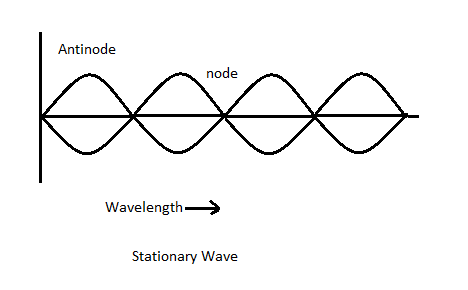
We have studied that stationary waves are produced by superposition of two progressive waves of equal amplitude and frequency, travelling with the same speed in opposite directions. The stationary waveform does not move through medium; energy is not away from the source. The amplitude of a stationary wave can vary from zero at a node to maximum at an antinode, and depends on position along the wave. In this wave, between nodes all particles are at the same phase.
Diagram of stationary Wave is given below;
We know that stationary waves are a combination of two waves moving in opposite directions having the same frequency and amplitude. So let's consider a wave of amplitude $A$ travelling in positive X- direction and another wave of amplitude $A$ travelling in negative direction. Their displacement equation can be given as;
${y_1} = A\sin (\omega t - kx)$ and ${y_2} = A\sin (\omega t + kx)$
Now we can apply superposition principle here, so the displacement of the resultant wave is given by; $y = {y_1} + {y_2}$
$
y = A\sin (\omega t - kx) + A\sin (\omega t + kx) \\
\Rightarrow y = 2A\sin \dfrac{{(\omega t + kx + \omega t - kx)}}{2}\cos \dfrac{{(\omega t + kx + \omega t - kx)}}{2} \\
\Rightarrow y = 2A\sin \omega t.\cos kx \\
$
So, the correct answer is “Option B”.
Note:
So with the help of the equation of stationary waves we can observe some important features of stationary waves. Some musical instruments for example sitar, violin and guitar etc. produce stationary waves.
Complete answer:
We have studied that stationary waves are produced by superposition of two progressive waves of equal amplitude and frequency, travelling with the same speed in opposite directions. The stationary waveform does not move through medium; energy is not away from the source. The amplitude of a stationary wave can vary from zero at a node to maximum at an antinode, and depends on position along the wave. In this wave, between nodes all particles are at the same phase.
Diagram of stationary Wave is given below;
We know that stationary waves are a combination of two waves moving in opposite directions having the same frequency and amplitude. So let's consider a wave of amplitude $A$ travelling in positive X- direction and another wave of amplitude $A$ travelling in negative direction. Their displacement equation can be given as;
${y_1} = A\sin (\omega t - kx)$ and ${y_2} = A\sin (\omega t + kx)$
Now we can apply superposition principle here, so the displacement of the resultant wave is given by; $y = {y_1} + {y_2}$
$
y = A\sin (\omega t - kx) + A\sin (\omega t + kx) \\
\Rightarrow y = 2A\sin \dfrac{{(\omega t + kx + \omega t - kx)}}{2}\cos \dfrac{{(\omega t + kx + \omega t - kx)}}{2} \\
\Rightarrow y = 2A\sin \omega t.\cos kx \\
$
So, the correct answer is “Option B”.
Note:
So with the help of the equation of stationary waves we can observe some important features of stationary waves. Some musical instruments for example sitar, violin and guitar etc. produce stationary waves.
Recently Updated Pages
Master Class 11 English: Engaging Questions & Answers for Success

Master Class 11 Social Science: Engaging Questions & Answers for Success
Master Class 11 Maths: Engaging Questions & Answers for Success
Master Class 11 Biology: Engaging Questions & Answers for Success
Master Class 11 Physics: Engaging Questions & Answers for Success
Master Class 11 Chemistry: Engaging Questions & Answers for Success
Trending doubts
One Metric ton is equal to kg A 10000 B 1000 C 100 class 11 physics CBSE
Difference Between Prokaryotic Cells and Eukaryotic Cells
Two of the body parts which do not appear in MRI are class 11 biology CBSE
Find the value of the expression given below sin 30circ class 11 maths CBSE
Draw a diagram of a plant cell and label at least eight class 11 biology CBSE
10 examples of friction in our daily life