




Equal charges $ Q $ are placed at the four corners A, B, C and D of square of length $ a $ . The magnitude of the force on the charge at B will be:
(A) $ \dfrac{{3{Q^2}}}{{4\pi {\varepsilon _0}{a^2}}} $
(B) $ \dfrac{{4{Q^2}}}{{4\pi {\varepsilon _0}{a^2}}} $
(C) $ \dfrac{{k{Q^2}}}{{{a^2}}}\left( {\dfrac{{2\sqrt 2 + 1}}{2}} \right) $
(D) $ \left( {2 + \dfrac{1}{{\sqrt 2 }}} \right)\dfrac{{3{Q^2}}}{{4\pi {\varepsilon _0}{a^2}}} $
Answer
 Verified
564k+ views
Hint :As there is no specification in question the charge is positive or negative that is why we have to consider the charge as positive. Calculate the net force acting on the required point here. B. angles of square are always right angled.
Complete Step By Step Answer:
Based on the conditions given in the figure let us draw a suitable diagram as follows:
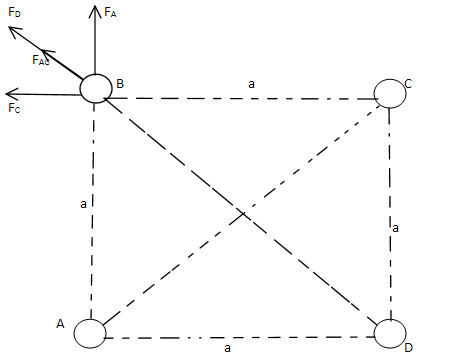
$ Q $ is the charge on the corners of the square and $ a $ is the length of the side of the square.
Force is given by:
$ F = \dfrac{{k{q_1}{q_2}}}{{{r^2}}} $ …….(general formula of electrostatic force) $ (1) $
$ \Rightarrow $ $ F = \dfrac{{k{Q^2}}}{{{a^2}}} $…….(charge and side of square is given) $ (2) $
From $ eq(1) $ and $ (2) $ ,
$ \Rightarrow {F_A} = \dfrac{{k{Q^2}}}{{{a^2}}} $ ; $ {F_C} = \dfrac{{k{Q^2}}}{{{a^2}}} $ and $ {F_D} = \dfrac{{k{Q^2}}}{{2{a^2}}} $ …… $ (3) $
Net force between the forces $ {F_A} $ and $ {F_C} $ is given by
$ \Rightarrow {F_{net}} = \sqrt {F_A^2 + F_C^2 + 2{F_A}{F_C}\cos \theta } $……..( $ {F_A} $ and $ {F_C} $ are perpendicular to each other ) $ (4) $
$ \Rightarrow {F_{net}} = \sqrt 2 {F_A} $………(from $ (3) $ )
$ \Rightarrow {F_{net}} = \sqrt 2 \dfrac{{k{Q^2}}}{{{a^2}}} $ ……… (from $ (3) $ )
Now, overall net force on corner B is given by
$ F_{net}' = {F_{net}} + {F_D} $
$ = \sqrt 2 \dfrac{{k{Q^2}}}{{{a^2}}} + \dfrac{{k{Q^2}}}{{2{a^2}}} $
$ = \dfrac{{k{Q^2}}}{{{a^2}}}\left( {\sqrt 2 + \dfrac{1}{2}} \right) $
$ = \dfrac{{k{Q^2}}}{{{a^2}}}\left( {\dfrac{{2\sqrt 2 + 1}}{2}} \right) $
Therefore, the net force can be called as magnitude of force on B is $ \dfrac{{k{Q^2}}}{{{a^2}}}\left( {\dfrac{{2\sqrt 2 + 1}}{2}} \right) $
Correct answer is option C.
Note :
In the above question we have calculated the magnitude of forces between the force $ {F_A} $ and $ {F_C} $ , the angle between them is $ {90^0} $ . Therefore, $ \cos \theta = 0 $ thus the term becomes $ zero $ in equation $ (4) $ .
Finally the magnitude of force on B is the magnitude of forces $ {F_{net}} $ and $ {F_D} $ .
Complete Step By Step Answer:
Based on the conditions given in the figure let us draw a suitable diagram as follows:
$ Q $ is the charge on the corners of the square and $ a $ is the length of the side of the square.
Force is given by:
$ F = \dfrac{{k{q_1}{q_2}}}{{{r^2}}} $ …….(general formula of electrostatic force) $ (1) $
$ \Rightarrow $ $ F = \dfrac{{k{Q^2}}}{{{a^2}}} $…….(charge and side of square is given) $ (2) $
From $ eq(1) $ and $ (2) $ ,
$ \Rightarrow {F_A} = \dfrac{{k{Q^2}}}{{{a^2}}} $ ; $ {F_C} = \dfrac{{k{Q^2}}}{{{a^2}}} $ and $ {F_D} = \dfrac{{k{Q^2}}}{{2{a^2}}} $ …… $ (3) $
Net force between the forces $ {F_A} $ and $ {F_C} $ is given by
$ \Rightarrow {F_{net}} = \sqrt {F_A^2 + F_C^2 + 2{F_A}{F_C}\cos \theta } $……..( $ {F_A} $ and $ {F_C} $ are perpendicular to each other ) $ (4) $
$ \Rightarrow {F_{net}} = \sqrt 2 {F_A} $………(from $ (3) $ )
$ \Rightarrow {F_{net}} = \sqrt 2 \dfrac{{k{Q^2}}}{{{a^2}}} $ ……… (from $ (3) $ )
Now, overall net force on corner B is given by
$ F_{net}' = {F_{net}} + {F_D} $
$ = \sqrt 2 \dfrac{{k{Q^2}}}{{{a^2}}} + \dfrac{{k{Q^2}}}{{2{a^2}}} $
$ = \dfrac{{k{Q^2}}}{{{a^2}}}\left( {\sqrt 2 + \dfrac{1}{2}} \right) $
$ = \dfrac{{k{Q^2}}}{{{a^2}}}\left( {\dfrac{{2\sqrt 2 + 1}}{2}} \right) $
Therefore, the net force can be called as magnitude of force on B is $ \dfrac{{k{Q^2}}}{{{a^2}}}\left( {\dfrac{{2\sqrt 2 + 1}}{2}} \right) $
Correct answer is option C.
Note :
In the above question we have calculated the magnitude of forces between the force $ {F_A} $ and $ {F_C} $ , the angle between them is $ {90^0} $ . Therefore, $ \cos \theta = 0 $ thus the term becomes $ zero $ in equation $ (4) $ .
Finally the magnitude of force on B is the magnitude of forces $ {F_{net}} $ and $ {F_D} $ .
Recently Updated Pages
Master Class 9 General Knowledge: Engaging Questions & Answers for Success

Master Class 9 Maths: Engaging Questions & Answers for Success
Master Class 9 Science: Engaging Questions & Answers for Success
Master Class 9 English: Engaging Questions & Answers for Success
Master Class 9 Social Science: Engaging Questions & Answers for Success
Class 9 Question and Answer - Your Ultimate Solutions Guide
Trending doubts
Which are the Top 10 Largest Countries of the World?
Draw a labelled sketch of the human eye class 12 physics CBSE
Differentiate between homogeneous and heterogeneous class 12 chemistry CBSE
Sulphuric acid is known as the king of acids State class 12 chemistry CBSE
Why is the cell called the structural and functional class 12 biology CBSE
A dentist uses a small mirror that gives a magnification class 12 physics CBSE