




Equal charges each of \[20\mu C\] are placed at x=0, 2, 4, 8, 16 cm on X-axis. Find the force experienced by the charge at x=2cm.
Answer
 Verified
513.9k+ views
Hint: Apply coulomb’s law. Coulomb’s law states that force between any two point charges is directly proportional to the product of two charges and inversely proportional to the square of distance between them. Also apply the principle of superposition to find the resultant force.
Formula used:
According to Coulomb’s law,
\[F=\dfrac{1}{4\pi {{\varepsilon }_{0}}}\dfrac{qQ}{{{r}^{2}}}\]
Q and q are magnitude of charges
r is the distance between the two point charges.
Where,
\[k=\dfrac{1}{4\pi {{\varepsilon }_{0}}}\]
Where \[{{\varepsilon }_{0}}\]is the permittivity of free space
Complete answer:
Let \[{{q}_{1}},{{q}_{3}},{{q}_{4}},{{q}_{5}}\] be the charges at x=0 ,2, 4,8, 16 cm on X-axis.
The magnitude of charge q is,
\[{{q}_{1}}={{q}_{2}}={{q}_{3}}={{q}_{4}}={{q}_{5}}=q\]
Hence \[q=20\mu C\]
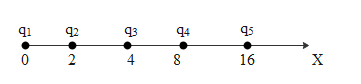
Considering the resultant force as F. F will be the sum of forces \[{{F}_{1}},{{F}_{3}},{{F}_{4}},{{F}_{5}}\].
\[{{F}_{1}}\] is the force on \[{{q}_{2}}\]due to \[{{q}_{1}}\], \[{{F}_{3}}\] is the force on \[{{q}_{2}}\]due to \[{{q}_{3}}\], \[{{F}_{4}}\] is the force on \[{{q}_{2}}\]due to\[{{q}_{4}}\]and \[{{F}_{5}}\] is the force on \[{{q}_{2}}\]due to \[{{q}_{5}}\].
Thus the resultant force is,
\[F={{F}_{1}}+{{F}_{3}}+{{F}_{4}}+{{F}_{5}}\]
\[F=\dfrac{k{{q}_{2}}{{q}_{1}}}{{{\left( {{r}_{21}} \right)}^{2}}}+\dfrac{k{{q}_{2}}{{q}_{3}}}{{{\left( {{r}_{23}} \right)}^{2}}}+\dfrac{k{{q}_{2}}{{q}_{4}}}{{{\left( {{r}_{24}} \right)}^{2}}}+\dfrac{k{{q}_{2}}{{q}_{5}}}{{{\left( {{r}_{25}} \right)}^{2}}}\]
Since,
\[{{q}_{1}}={{q}_{2}}={{q}_{3}}={{q}_{4}}={{q}_{5}}=q\]
\[q=20\mu C\]
Thus the equation becomes,
\[F=\dfrac{k{{q}^{2}}}{{{\left( {{r}_{21}} \right)}^{2}}}+\dfrac{k{{q}^{2}}}{{{\left( {{r}_{23}} \right)}^{2}}}+\dfrac{k{{q}^{2}}}{{{\left( {{r}_{24}} \right)}^{2}}}+\dfrac{k{{q}^{2}}}{{{\left( {{r}_{25}} \right)}^{2}}}\]
Since \[k{{q}^{2}}\]is common in all terms we can take this outside as,
\[F=k{{q}^{2}}\left[ \dfrac{1}{{{\left( {{r}_{21}} \right)}^{2}}}+\dfrac{1}{{{\left( {{r}_{23}} \right)}^{2}}}+\dfrac{1}{{{\left( {{r}_{24}} \right)}^{2}}}+\dfrac{1}{{{\left( {{r}_{25}} \right)}^{2}}} \right]\]
Then substituting the values in the above equation we get, \[F=9\times {{10}^{9}}\times {{\left( 20\times {{10}^{-6}} \right)}^{2}}\left[ \dfrac{1}{{{\left( 2\times {{10}^{-2}} \right)}^{2}}}+\dfrac{1}{{{\left( 2\times {{10}^{-2}} \right)}^{2}}}+\dfrac{1}{{{\left( 6\times {{10}^{-2}} \right)}^{2}}}+\dfrac{1}{{{\left( 14\times {{10}^{-2}} \right)}^{2}}} \right]\]
$F=3.6\left[ 0.25+0.25+0.0277+0.0051 \right]\times {{10}^{4}}$
$F=3.6\times \left[ 0.5328 \right]\times {{10}^{4}}$
$F=1.88568\times {{10}^{4}}$
\[F=1.89\times {{10}^{4}}N\]
Thus the answer is \[1.89\times {{10}^{4}}N\].
Note:
Coulomb's law can be described as an inverse square law. Because the force between any two point charges is inversely proportional to the square of distance between them. Gravitational force is also an example of force which satisfies inverse square law. Force exerted per unit charge is known as electric field.
Formula used:
According to Coulomb’s law,
\[F=\dfrac{1}{4\pi {{\varepsilon }_{0}}}\dfrac{qQ}{{{r}^{2}}}\]
Q and q are magnitude of charges
r is the distance between the two point charges.
Where,
\[k=\dfrac{1}{4\pi {{\varepsilon }_{0}}}\]
Where \[{{\varepsilon }_{0}}\]is the permittivity of free space
Complete answer:
Let \[{{q}_{1}},{{q}_{3}},{{q}_{4}},{{q}_{5}}\] be the charges at x=0 ,2, 4,8, 16 cm on X-axis.
The magnitude of charge q is,
\[{{q}_{1}}={{q}_{2}}={{q}_{3}}={{q}_{4}}={{q}_{5}}=q\]
Hence \[q=20\mu C\]
Considering the resultant force as F. F will be the sum of forces \[{{F}_{1}},{{F}_{3}},{{F}_{4}},{{F}_{5}}\].
\[{{F}_{1}}\] is the force on \[{{q}_{2}}\]due to \[{{q}_{1}}\], \[{{F}_{3}}\] is the force on \[{{q}_{2}}\]due to \[{{q}_{3}}\], \[{{F}_{4}}\] is the force on \[{{q}_{2}}\]due to\[{{q}_{4}}\]and \[{{F}_{5}}\] is the force on \[{{q}_{2}}\]due to \[{{q}_{5}}\].
Thus the resultant force is,
\[F={{F}_{1}}+{{F}_{3}}+{{F}_{4}}+{{F}_{5}}\]
\[F=\dfrac{k{{q}_{2}}{{q}_{1}}}{{{\left( {{r}_{21}} \right)}^{2}}}+\dfrac{k{{q}_{2}}{{q}_{3}}}{{{\left( {{r}_{23}} \right)}^{2}}}+\dfrac{k{{q}_{2}}{{q}_{4}}}{{{\left( {{r}_{24}} \right)}^{2}}}+\dfrac{k{{q}_{2}}{{q}_{5}}}{{{\left( {{r}_{25}} \right)}^{2}}}\]
Since,
\[{{q}_{1}}={{q}_{2}}={{q}_{3}}={{q}_{4}}={{q}_{5}}=q\]
\[q=20\mu C\]
Thus the equation becomes,
\[F=\dfrac{k{{q}^{2}}}{{{\left( {{r}_{21}} \right)}^{2}}}+\dfrac{k{{q}^{2}}}{{{\left( {{r}_{23}} \right)}^{2}}}+\dfrac{k{{q}^{2}}}{{{\left( {{r}_{24}} \right)}^{2}}}+\dfrac{k{{q}^{2}}}{{{\left( {{r}_{25}} \right)}^{2}}}\]
Since \[k{{q}^{2}}\]is common in all terms we can take this outside as,
\[F=k{{q}^{2}}\left[ \dfrac{1}{{{\left( {{r}_{21}} \right)}^{2}}}+\dfrac{1}{{{\left( {{r}_{23}} \right)}^{2}}}+\dfrac{1}{{{\left( {{r}_{24}} \right)}^{2}}}+\dfrac{1}{{{\left( {{r}_{25}} \right)}^{2}}} \right]\]
Then substituting the values in the above equation we get, \[F=9\times {{10}^{9}}\times {{\left( 20\times {{10}^{-6}} \right)}^{2}}\left[ \dfrac{1}{{{\left( 2\times {{10}^{-2}} \right)}^{2}}}+\dfrac{1}{{{\left( 2\times {{10}^{-2}} \right)}^{2}}}+\dfrac{1}{{{\left( 6\times {{10}^{-2}} \right)}^{2}}}+\dfrac{1}{{{\left( 14\times {{10}^{-2}} \right)}^{2}}} \right]\]
$F=3.6\left[ 0.25+0.25+0.0277+0.0051 \right]\times {{10}^{4}}$
$F=3.6\times \left[ 0.5328 \right]\times {{10}^{4}}$
$F=1.88568\times {{10}^{4}}$
\[F=1.89\times {{10}^{4}}N\]
Thus the answer is \[1.89\times {{10}^{4}}N\].
Note:
Coulomb's law can be described as an inverse square law. Because the force between any two point charges is inversely proportional to the square of distance between them. Gravitational force is also an example of force which satisfies inverse square law. Force exerted per unit charge is known as electric field.
Recently Updated Pages
Master Class 12 Economics: Engaging Questions & Answers for Success

Master Class 12 Physics: Engaging Questions & Answers for Success
Master Class 12 English: Engaging Questions & Answers for Success
Master Class 12 Social Science: Engaging Questions & Answers for Success
Master Class 12 Maths: Engaging Questions & Answers for Success
Master Class 12 Business Studies: Engaging Questions & Answers for Success
Trending doubts
Which are the Top 10 Largest Countries of the World?
What are the major means of transport Explain each class 12 social science CBSE
Draw a labelled sketch of the human eye class 12 physics CBSE
Why cannot DNA pass through cell membranes class 12 biology CBSE
Differentiate between insitu conservation and exsitu class 12 biology CBSE
Draw a neat and well labeled diagram of TS of ovary class 12 biology CBSE