




What enzyme unzips DNA and breaks the hydrogen bond?
Answer
 Verified
511.5k+ views
Hint: DNA is a double-stranded helix in which the two strands are joined together by the hydrogen bond. The first step in DNA replication is breaking the hydrogen bond so that the copy of each strand can be made. DNA replication is an important step of cell division.
Complete answer:
DNA is the genetic material contained in the nucleus of the eukaryotic cell. The first step of cell division is the replication of DNA.
To answer this question, we must know the structure and replication of DNA. The DNA is a double helix. Each stand contains complementary bases. The complementary bases are joined by the hydrogen bond.
The DNA replication takes place by the following steps-
1. The unzipping of the double helix and separation of the two strands- In this process, the two strands of the DNA uncoil and then the hydrogen bond between the strands. The Y shaped DNA strand is formed due to the unzipping of the DNA. This process takes place with the help of an enzyme called helicase. The two strands separate and act as a template for synthesising new strands.
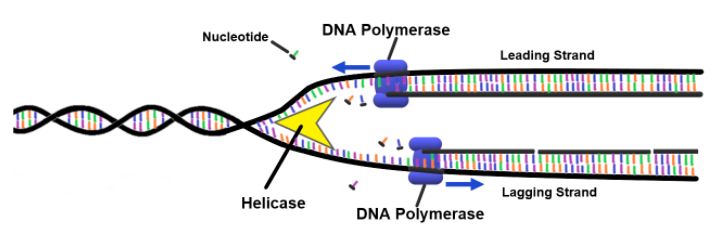
2. The priming of the template- A short segment of the RNA acts as a primer that helps in the elongation of the strand. The DNA polymerase starts adding nucleotide from 5’ to 3’ end.
3. Assembly of the new segment- The proofreading activity is performed by the exonuclease and the two strands are joined by the ligase.
Thus, the correct answer is helicase.
Note: DNA replication is a process in which there are several check gates that help in proofreading and ensure error-free replication. DNA replication is important for the growth, development and repair of the organism. It is also an important part of the inheritance.
Complete answer:
DNA is the genetic material contained in the nucleus of the eukaryotic cell. The first step of cell division is the replication of DNA.
To answer this question, we must know the structure and replication of DNA. The DNA is a double helix. Each stand contains complementary bases. The complementary bases are joined by the hydrogen bond.
The DNA replication takes place by the following steps-
1. The unzipping of the double helix and separation of the two strands- In this process, the two strands of the DNA uncoil and then the hydrogen bond between the strands. The Y shaped DNA strand is formed due to the unzipping of the DNA. This process takes place with the help of an enzyme called helicase. The two strands separate and act as a template for synthesising new strands.
2. The priming of the template- A short segment of the RNA acts as a primer that helps in the elongation of the strand. The DNA polymerase starts adding nucleotide from 5’ to 3’ end.
3. Assembly of the new segment- The proofreading activity is performed by the exonuclease and the two strands are joined by the ligase.
Thus, the correct answer is helicase.
Note: DNA replication is a process in which there are several check gates that help in proofreading and ensure error-free replication. DNA replication is important for the growth, development and repair of the organism. It is also an important part of the inheritance.
Recently Updated Pages
Master Class 12 Economics: Engaging Questions & Answers for Success

Master Class 12 English: Engaging Questions & Answers for Success
Master Class 12 Social Science: Engaging Questions & Answers for Success
Master Class 12 Maths: Engaging Questions & Answers for Success
Master Class 12 Physics: Engaging Questions & Answers for Success
Master Class 9 General Knowledge: Engaging Questions & Answers for Success
Trending doubts
1 ton equals to A 100 kg B 1000 kg C 10 kg D 10000 class 11 physics CBSE
DNA is not present in A Nucleus B Mitochondria C Chloroplast class 11 biology CBSE
Draw a diagram of a plant cell and label at least eight class 11 biology CBSE
Draw a diagram showing the external features of fish class 11 biology CBSE
What is the weight in lbs of a 75 Kg person class 11 physics CBSE
Proton was discovered by A Thomson B Rutherford C Chadwick class 11 chemistry CBSE