




Endosmosis takes place when a plant cell is immersed in
a. Isotonic solution
b. Hypotonic solution
c. Hypertonic solution
d. HCl solution
Answer
 Verified
670.8k+ views
Hint: Endosmosis is a type of passive transport where the water moves from outside medium to inside of the cell. In a hypotonic solution, the concentration of the solvent (water) is high in the outside medium and solute concentration is high inside the cell due to this, solvent (water) enters the cell and increases turgidity.
Complete answer :
Endosmosis is defined as the passage of water from the region of high concentration to the region of low concentration via a semipermeable membrane. It is a type of passive transport because during this transport ATP or energy is not used. The transport takes place along the concentration gradient. During osmosis (Endo/Exosmosis) solvent will always flow in that direction where solute concentration is high and water concentration is low.
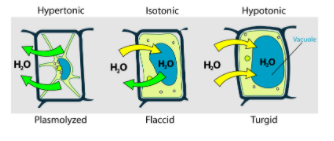
Differences Between Exosmosis and Endosmosis
So, the correct answer is (B) Hypotonic solution
Note: The processes of osmosis and diffusion play a major role in cell communication. It establishes a transport system across cells, for the distribution of-
> Nutrients
> Oxygen
> Elimination of toxins
In 1748, J. A. Nollet first documented the observation of osmosis. The term was given by R. J. H. Dutrochet. The process of osmosis can be defined as the movement of a solvent across a semipermeable membrane to a region of higher concentration of solute and a lower concentration of solvent from a region of higher concentration of solvent and a lower concentration of solute.
There are two different kinds of osmosis:
> Endosmosis
> Exosmosis
Complete answer :
Endosmosis is defined as the passage of water from the region of high concentration to the region of low concentration via a semipermeable membrane. It is a type of passive transport because during this transport ATP or energy is not used. The transport takes place along the concentration gradient. During osmosis (Endo/Exosmosis) solvent will always flow in that direction where solute concentration is high and water concentration is low.
Differences Between Exosmosis and Endosmosis
| Site of Difference | Exosmosis | Endosmosis |
| Solvent movement direction | The solvent flows out of the cells. | The solvent moves inside the cells. |
| Solute Concentration | Solute concentration is high in the medium outside the cell. | Solute concentration is low in the medium surrounding the cell. |
| Water potential | High in the cytosol. | High in the medium solvent outside the cell. |
| The fate of the cells | Cells shrink with water loss. | Cell swell up or turgid. |
| Examples | Water transport from the root hair to the cortical cells of the root. | Water transport from the root to the xylem vessels of the plant. |
So, the correct answer is (B) Hypotonic solution
Note: The processes of osmosis and diffusion play a major role in cell communication. It establishes a transport system across cells, for the distribution of-
> Nutrients
> Oxygen
> Elimination of toxins
In 1748, J. A. Nollet first documented the observation of osmosis. The term was given by R. J. H. Dutrochet. The process of osmosis can be defined as the movement of a solvent across a semipermeable membrane to a region of higher concentration of solute and a lower concentration of solvent from a region of higher concentration of solvent and a lower concentration of solute.
There are two different kinds of osmosis:
> Endosmosis
> Exosmosis
Recently Updated Pages
Which will be the least stable resonating structure class 11 chemistry CBSE

How many 5 digit telephone numbers can be construc-class-11-maths-CBSE
How do you find the angle of the resultant vector class 11 physics CBSE
Draw labelled diagram of the following i Gram seed class 11 biology CBSE
1 Quintal is equal to a 110 kg b 10 kg c 100kg d 1000 class 11 physics CBSE
What is the need and importance of classification class 11 biology CBSE
Trending doubts
Find the value of the expression given below sin 30circ class 11 maths CBSE
One Metric ton is equal to kg A 10000 B 1000 C 100 class 11 physics CBSE
10 examples of friction in our daily life
Draw a diagram of a plant cell and label at least eight class 11 biology CBSE
Difference between physical and chemical change class 11 chemistry CBSE
Proton was discovered by A Thomson B Rutherford C Chadwick class 11 chemistry CBSE