




Embryonated egg of Ascaris is
(a) An egg with gastrula
(b) An egg with the blastula
(c) An egg with juvenile
(d) An egg within an egg
Answer
 Verified
588.3k+ views
Hint: Ascaris is the most common endoparasite in the small intestine of children. It completes its life cycle in only one host. Its embryonated egg multiplies several times before hatching.
Complete answer:
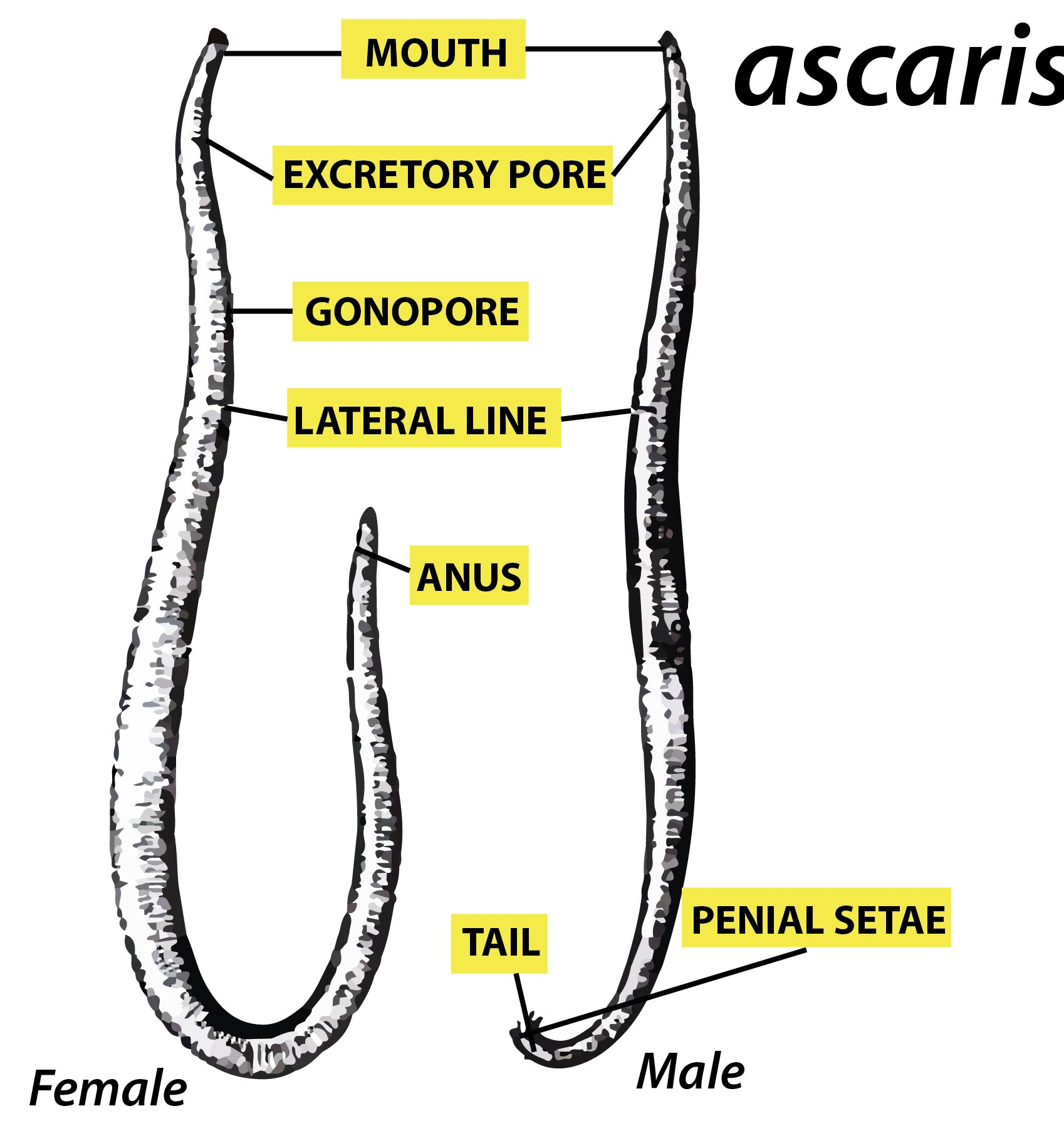
The Male is smaller than the female. It has a curved tail, two pineal setae or copulatory organs, and a cloaca. Ascaris is monogenetic with no intermediate host. Female Ascaris releases the eggs which if remains unfertilized doesn’t become infective. Once fertilized, it undergoes multiple divisions with infective stages developing inside. The embryonated egg is the one that bears a second stage larva inside the egg itself which is also known as the juvenile. Its larva is called rhabditiform.
Additional Information: -Once such an embryonated egg is ingested by humans, it travels via the bloodstream into the intestine. Upon hatching, the Rhabditiform larva is released from the egg. It can travel to the liver and heart by bloodstream.
-Upon reaching the heart, it enters the pulmonary circulation. This leads to its invasion into the alveoli of the lungs. The larva grows and moults in this environment, where they are coughed up and swallowed multiple times.
-The blood again takes them to the small intestine, where they mature and sexually reproduce. If the infection remains undetected, then, the roundworms can live for about 12-18 months.
-The lipid layer of eggs further prevents any desiccation as it is resistant to any harsh effect of acids or alkalis.
-The epidermis of Ascaris is pseudocoel.
-The excretory system consists of a single excretory cell or renette cell.
So, the correct answer is ‘An egg with a juvenile.’
Note: -The infection of roundworms is more persistent in tropical areas where poor sanitation facilities are observed.
-During the migratory period of the larva, acute pneumonitis can be observed in patients where one experiences fever, cough, and wheezing due to hypersensitivity.
Complete answer:
The Male is smaller than the female. It has a curved tail, two pineal setae or copulatory organs, and a cloaca. Ascaris is monogenetic with no intermediate host. Female Ascaris releases the eggs which if remains unfertilized doesn’t become infective. Once fertilized, it undergoes multiple divisions with infective stages developing inside. The embryonated egg is the one that bears a second stage larva inside the egg itself which is also known as the juvenile. Its larva is called rhabditiform.
Additional Information: -Once such an embryonated egg is ingested by humans, it travels via the bloodstream into the intestine. Upon hatching, the Rhabditiform larva is released from the egg. It can travel to the liver and heart by bloodstream.
-Upon reaching the heart, it enters the pulmonary circulation. This leads to its invasion into the alveoli of the lungs. The larva grows and moults in this environment, where they are coughed up and swallowed multiple times.
-The blood again takes them to the small intestine, where they mature and sexually reproduce. If the infection remains undetected, then, the roundworms can live for about 12-18 months.
-The lipid layer of eggs further prevents any desiccation as it is resistant to any harsh effect of acids or alkalis.
-The epidermis of Ascaris is pseudocoel.
-The excretory system consists of a single excretory cell or renette cell.
So, the correct answer is ‘An egg with a juvenile.’
Note: -The infection of roundworms is more persistent in tropical areas where poor sanitation facilities are observed.
-During the migratory period of the larva, acute pneumonitis can be observed in patients where one experiences fever, cough, and wheezing due to hypersensitivity.
Recently Updated Pages
Master Class 11 Economics: Engaging Questions & Answers for Success

Master Class 11 English: Engaging Questions & Answers for Success
Master Class 11 Maths: Engaging Questions & Answers for Success
Class 11 Question and Answer - Your Ultimate Solutions Guide
Master Class 11 Social Science: Engaging Questions & Answers for Success
Master Class 11 Business Studies: Engaging Questions & Answers for Success
Trending doubts
Differentiate between an exothermic and an endothermic class 11 chemistry CBSE
One Metric ton is equal to kg A 10000 B 1000 C 100 class 11 physics CBSE
There are 720 permutations of the digits 1 2 3 4 5 class 11 maths CBSE
In what year Guru Nanak Dev ji was born A15 April 1469 class 11 social science CBSE
Difference Between Prokaryotic Cells and Eukaryotic Cells
Draw a diagram of a plant cell and label at least eight class 11 biology CBSE