




Electrostatic potential at H is
A. \[\dfrac{\sigma }{{^{{\varepsilon _0}}}}\left[ {{{\left( {{a^2} - {H^2}} \right)}^{1/2}} - H} \right]\]
B. \[\dfrac{\sigma }{{^{{\varepsilon _0}}}}\left[ {{{\left( {{a^2} - {H^2}} \right)}^{1/2}} + H} \right]\]
C. \[\dfrac{\sigma }{{^{2{\varepsilon _0}}}}\left[ {{{\left( {{a^2} + {H^2}} \right)}^{1/2}} - H} \right]\]
D. \[\dfrac{\sigma }{{^{2{\varepsilon _0}}}}\left[ {{{\left( {{a^2} - {H^2}} \right)}^{1/2}} - H} \right]\]
Answer
 Verified
585k+ views
Hint:In this question,we are going to use the concept of electrostatic potential and derive the expression of it by assuming certain assumptions.The
potential due to point charge is inversely proportional to square root of distance.
Complete step by step answer:
First let’s calculate potential due to a ring on a point lying on its axis, then we will use it to calculate potential due to disc.
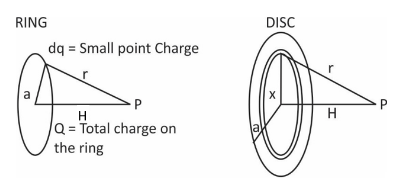
Consider a small point charge on the ring having small charge dq. Now potential due to this point charge can be written as
\[dv = \dfrac{{K(dq)}}{{{r^2}}}\]
Total potential due to ring: \[V = \int {dv} \]
\[V = \int {\dfrac{{K(dq)}}{{{r^2}}}} \]
\[r = \sqrt {{H^2} + {a^2}} \]
\[V = \int {\dfrac{{K(dq)}}{{\sqrt {{H^2} + {a^2}} }}} \]
\[V = \dfrac{K}{{\sqrt {{H^2} + {a^2}} }}\int {dq} \]
\[V = \dfrac{{KQ}}{{\sqrt {{H^2} + {a^2}} }}\]
Now, Consider a small ring in a thin disc, the small ring has radius \[ = x\]and thickness\[ = dx\]. As we have already calculated the potential due to ring, we can say that potential due to the small ring is
\[dV = \dfrac{{Kdq}}{{\sqrt {{H^2} + {x^2}} }}\]
Now, we can integrate thin disc to get potential of entire disc
\[V = \int {dV} \]
\[V = \int {\dfrac{{Kdq}}{{\sqrt {{H^2} + {x^2}} }}} \]
Now we have to substitute dq charge in small ring to thickness dx in terms of x,
\[dq = \,\,\dfrac{{Total\,\,\,ch\arg e}}{{Total\,\,\,area}} \times Area\,\,\,of\,small\,\,ring\]
\[dq = \dfrac{Q}{{\pi {a^2}}} \times \left( {2\pi x} \right) \times dx\]
Area of ring is calculated by approximating small ring as rectangle of length equal to circumference of small ring and height equal to the thickness
\[V = \int {\dfrac{{KQ\,\,\,2\pi x}}{{(\pi {a^2})\,(\sqrt {{H^2} + {x^2}} )}}} dx\]
\[V = \dfrac{{KQ}}{{{a^2}}}\int {\dfrac{{2xdx}}{{\sqrt {{H^2} + {x^2}} }}} \]
Here the limit of $x$ is from $0$ to $a$
So, \[V = \dfrac{{KQ}}{{{a^2}}}\int_0^a {\dfrac{{2xdx}}{{\sqrt {{H^2} + {x^2}} }}} \] ….. (i)
Now, Substituting${H^2} + {x^2} = t$, putting for lower limit $x = 0$then ${H^2} + {0^2} = t$ $ \Rightarrow t = {H^2}$ now for upper limit $x = a$ then ${H^2} + {a^2} = t$,
${H^2} + {x^2} = t$
Differentiating, $t$ with respect to $x$ so, $2x{\text{ }}dx = dt$
Putting all above values in equation (i).
$V = \dfrac{{KQ}}{{{a^2}}}\int_{{H^2}}^{{H^2} + {a^2}} {\dfrac{{dt}}{{\sqrt t }}} $
$
V = \dfrac{{KQ}}{{{a^2}}}2\left( {\sqrt {{H^2} + {a^2}} - \sqrt {{H^2}} } \right) \\
V = \dfrac{{KQ}}{{{a^2}}}2\left( {\sqrt {{H^2} + {a^2}} - H} \right) \\
$
Putting $K = \dfrac{1}{{4\pi {\varepsilon _0}}}$ and $\sigma = \dfrac{Q}{{\pi {a^2}}}$, we get
$V = \dfrac{\sigma }{{2\varepsilon o}}\left( {\sqrt {{H^2} + {a^2}} - H} \right)$
Here option (C) is the correct option.
Note:As the limits of $x$is from $0$to $a$and ${H^2} + {x^2} = t$
at $x = 0,{\text{ t}} = {H^2}$
at $x = a,{\text{ t}} = {{\text{H}}^2} + {a^2}$
So, the limits of $t$will be from ${H^2}$to ${H^2} + {a^2}$
potential due to point charge is inversely proportional to square root of distance.
Complete step by step answer:
First let’s calculate potential due to a ring on a point lying on its axis, then we will use it to calculate potential due to disc.
Consider a small point charge on the ring having small charge dq. Now potential due to this point charge can be written as
\[dv = \dfrac{{K(dq)}}{{{r^2}}}\]
Total potential due to ring: \[V = \int {dv} \]
\[V = \int {\dfrac{{K(dq)}}{{{r^2}}}} \]
\[r = \sqrt {{H^2} + {a^2}} \]
\[V = \int {\dfrac{{K(dq)}}{{\sqrt {{H^2} + {a^2}} }}} \]
\[V = \dfrac{K}{{\sqrt {{H^2} + {a^2}} }}\int {dq} \]
\[V = \dfrac{{KQ}}{{\sqrt {{H^2} + {a^2}} }}\]
Now, Consider a small ring in a thin disc, the small ring has radius \[ = x\]and thickness\[ = dx\]. As we have already calculated the potential due to ring, we can say that potential due to the small ring is
\[dV = \dfrac{{Kdq}}{{\sqrt {{H^2} + {x^2}} }}\]
Now, we can integrate thin disc to get potential of entire disc
\[V = \int {dV} \]
\[V = \int {\dfrac{{Kdq}}{{\sqrt {{H^2} + {x^2}} }}} \]
Now we have to substitute dq charge in small ring to thickness dx in terms of x,
\[dq = \,\,\dfrac{{Total\,\,\,ch\arg e}}{{Total\,\,\,area}} \times Area\,\,\,of\,small\,\,ring\]
\[dq = \dfrac{Q}{{\pi {a^2}}} \times \left( {2\pi x} \right) \times dx\]
Area of ring is calculated by approximating small ring as rectangle of length equal to circumference of small ring and height equal to the thickness
\[V = \int {\dfrac{{KQ\,\,\,2\pi x}}{{(\pi {a^2})\,(\sqrt {{H^2} + {x^2}} )}}} dx\]
\[V = \dfrac{{KQ}}{{{a^2}}}\int {\dfrac{{2xdx}}{{\sqrt {{H^2} + {x^2}} }}} \]
Here the limit of $x$ is from $0$ to $a$
So, \[V = \dfrac{{KQ}}{{{a^2}}}\int_0^a {\dfrac{{2xdx}}{{\sqrt {{H^2} + {x^2}} }}} \] ….. (i)
Now, Substituting${H^2} + {x^2} = t$, putting for lower limit $x = 0$then ${H^2} + {0^2} = t$ $ \Rightarrow t = {H^2}$ now for upper limit $x = a$ then ${H^2} + {a^2} = t$,
${H^2} + {x^2} = t$
Differentiating, $t$ with respect to $x$ so, $2x{\text{ }}dx = dt$
Putting all above values in equation (i).
$V = \dfrac{{KQ}}{{{a^2}}}\int_{{H^2}}^{{H^2} + {a^2}} {\dfrac{{dt}}{{\sqrt t }}} $
$
V = \dfrac{{KQ}}{{{a^2}}}2\left( {\sqrt {{H^2} + {a^2}} - \sqrt {{H^2}} } \right) \\
V = \dfrac{{KQ}}{{{a^2}}}2\left( {\sqrt {{H^2} + {a^2}} - H} \right) \\
$
Putting $K = \dfrac{1}{{4\pi {\varepsilon _0}}}$ and $\sigma = \dfrac{Q}{{\pi {a^2}}}$, we get
$V = \dfrac{\sigma }{{2\varepsilon o}}\left( {\sqrt {{H^2} + {a^2}} - H} \right)$
Here option (C) is the correct option.
Note:As the limits of $x$is from $0$to $a$and ${H^2} + {x^2} = t$
at $x = 0,{\text{ t}} = {H^2}$
at $x = a,{\text{ t}} = {{\text{H}}^2} + {a^2}$
So, the limits of $t$will be from ${H^2}$to ${H^2} + {a^2}$
Recently Updated Pages
Master Class 12 Economics: Engaging Questions & Answers for Success

Master Class 12 Physics: Engaging Questions & Answers for Success
Master Class 12 English: Engaging Questions & Answers for Success
Master Class 12 Social Science: Engaging Questions & Answers for Success
Master Class 12 Maths: Engaging Questions & Answers for Success
Master Class 12 Business Studies: Engaging Questions & Answers for Success
Trending doubts
Which are the Top 10 Largest Countries of the World?
What are the major means of transport Explain each class 12 social science CBSE
Draw a labelled sketch of the human eye class 12 physics CBSE
Why cannot DNA pass through cell membranes class 12 biology CBSE
Differentiate between insitu conservation and exsitu class 12 biology CBSE
Draw a neat and well labeled diagram of TS of ovary class 12 biology CBSE