




Electric charge is uniformly distributed along straight wire of a radius of $ 1 $ mm. The charge per cm length of the wire is Q coulomb. Another cylindrical surface of radius $ 50 $ cm and length $ 1 $ m symmetrically encloses the wire as shown in fig. The total flux passing through the cylindrical surface is:
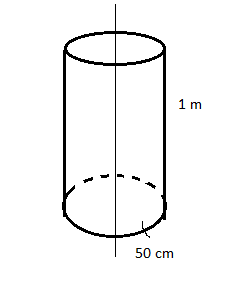
(A) $ \dfrac{Q}{{{ \in _0}}} $
(B) $ \dfrac{{100Q}}{{{ \in _0}}} $
(C) $ \dfrac{{10Q}}{{\pi { \in _0}}} $
(D) $ \dfrac{{100Q}}{{\pi { \in _0}}} $
Answer
 Verified
539.7k+ views
Hint :The Gauss’s law is also known as the Gauss’s flux theorem which is a law relating to the distribution of the electric charge to the resulting electric field. The surface under consideration can be the closed one enclosing the volume such as the spherical surface. Here we will use the given data and will also apply the Gauss’s law to get the required value.
Complete Step By Step Answer:
Gauss law states that – The area integral of the electric field over any closed surface is equal to the net charge enclosed in that surface divided by the permittivity of the space. As a result, it is applicable for any charge distribution. Usually, it is more useful for the symmetrical distribution of charges.
Gauss’s law can be expressed as –
$ {\phi _E} = \dfrac{Q}{{{\varepsilon _0}}} $
Where,
$ {\phi _E} = $ The electric flux through the closed surface S enclosing any volume V
$ Q = $ The total charge enclosed within the Volume V
$ {\varepsilon _0} = $ The electric constant
If the electric field is variable, it can be expressed as –
$ \phi = \int {\overrightarrow E .d\overrightarrow A } $
Charge enclosed by the cylindrical surface of length $ 100\,{\text{cm}} $ is
$ {Q_{enc}} = 100Q $
By applying the Gauss’s law,
$ \phi = \dfrac{{1({Q_{enc}})}}{{{ \in _0}}} $
Placing values-
$ \Rightarrow \phi = \dfrac{{100Q}}{{{ \in _0}}} $
From the given multiple choices, the option B is the correct answer.
Note :
Hence, if the electric field is known everywhere – Gauss's law makes it possible to find the distribution of electric charge in any distribution of the charge. Therefore, the charge in any given region can be deduced by integrating the electric field to find the flux.
Complete Step By Step Answer:
Gauss law states that – The area integral of the electric field over any closed surface is equal to the net charge enclosed in that surface divided by the permittivity of the space. As a result, it is applicable for any charge distribution. Usually, it is more useful for the symmetrical distribution of charges.
Gauss’s law can be expressed as –
$ {\phi _E} = \dfrac{Q}{{{\varepsilon _0}}} $
Where,
$ {\phi _E} = $ The electric flux through the closed surface S enclosing any volume V
$ Q = $ The total charge enclosed within the Volume V
$ {\varepsilon _0} = $ The electric constant
If the electric field is variable, it can be expressed as –
$ \phi = \int {\overrightarrow E .d\overrightarrow A } $
Charge enclosed by the cylindrical surface of length $ 100\,{\text{cm}} $ is
$ {Q_{enc}} = 100Q $
By applying the Gauss’s law,
$ \phi = \dfrac{{1({Q_{enc}})}}{{{ \in _0}}} $
Placing values-
$ \Rightarrow \phi = \dfrac{{100Q}}{{{ \in _0}}} $
From the given multiple choices, the option B is the correct answer.
Note :
Hence, if the electric field is known everywhere – Gauss's law makes it possible to find the distribution of electric charge in any distribution of the charge. Therefore, the charge in any given region can be deduced by integrating the electric field to find the flux.
Recently Updated Pages
Master Class 12 Economics: Engaging Questions & Answers for Success

Master Class 12 Physics: Engaging Questions & Answers for Success
Master Class 12 English: Engaging Questions & Answers for Success
Master Class 12 Social Science: Engaging Questions & Answers for Success
Master Class 12 Maths: Engaging Questions & Answers for Success
Master Class 12 Business Studies: Engaging Questions & Answers for Success
Trending doubts
Which are the Top 10 Largest Countries of the World?
What are the major means of transport Explain each class 12 social science CBSE
Draw a labelled sketch of the human eye class 12 physics CBSE
Why cannot DNA pass through cell membranes class 12 biology CBSE
Differentiate between insitu conservation and exsitu class 12 biology CBSE
Draw a neat and well labeled diagram of TS of ovary class 12 biology CBSE