




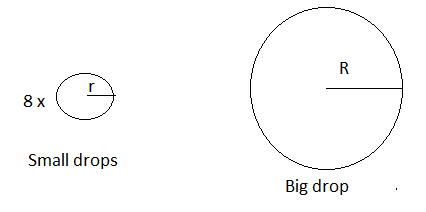
Eight tiny drops are combined to form a big drop. If the potential on each drop is 10 V then potential of big drop will be-
A. 40V
B. 10V
C. 30V
D. 20V
Answer
 Verified
617.1k+ views
Hint: To solve this problem first we need to find the radius of the new big drop, which can be calculated by equating the total volume of 8 drops to the final big drop. Now to calculate potential we need to calculate total charge on the big drop than by applying formula we can calculate potential on big drop.
Formula used:
$V=\dfrac{kq}{r}$
And, volume of sphere=$\dfrac{4}{3}\pi {{r}^{3}}$
Complete Step by step solution:
Given, potential on each drop = 10V
Now, by combining each drop the volume of resultant drop will be equal to 8 times of volume of small drop so,
$8\times {{V}_{s}}={{V}_{L}}$ , here ${{V}_{s}}$(volume of small drops) and ${{V}_{L}}$(volume of large drop)
Now, $8\times \dfrac{4}{3}\pi {{r}^{3}}=\dfrac{4}{3}\pi {{R}^{3}}$
$\Rightarrow R=2r$ …....(1)
R (radius of big drop) and r (radius of small drop)
Now, Potential $V=\dfrac{kq}{r}$, here k (constant = $\dfrac{1}{4\pi\varepsilon_{0}}$), q (charge on sphere) and r(radius of sphere)
If small drops having a charge of q than big drop will be having a charge of Q=8q, because total charge will be conserve,
Now for small drops potential $V=\dfrac{kq}{r}$ ………(2)
For big drop potential $V=\dfrac{kQ}{R}$ …… (3)
From equation (1), (2) and (3) we have,
$\Rightarrow big drop potential V=\dfrac{kQ}{R}=\dfrac{k\times 8q}{2r}$
$\Rightarrow 4\dfrac{k\times q}{r}$=4(potential of small drop from equation 2)
$\Rightarrow 4\times 10=40V$
So, the potential of a big drop will be 40V, hence option (A) will be correct.
Note:
While solving these type of problem conservation of charge and volume should be kept in mind as the total charge and volume will be equal to sum of all small spheres and this rule is not restricted only for spheres for any shape and size these two will be conserved but the difficult part would be to derive formula for potential and volume for those irregular shapes
Formula used:
$V=\dfrac{kq}{r}$
And, volume of sphere=$\dfrac{4}{3}\pi {{r}^{3}}$
Complete Step by step solution:
Given, potential on each drop = 10V
Now, by combining each drop the volume of resultant drop will be equal to 8 times of volume of small drop so,
$8\times {{V}_{s}}={{V}_{L}}$ , here ${{V}_{s}}$(volume of small drops) and ${{V}_{L}}$(volume of large drop)
Now, $8\times \dfrac{4}{3}\pi {{r}^{3}}=\dfrac{4}{3}\pi {{R}^{3}}$
$\Rightarrow R=2r$ …....(1)
R (radius of big drop) and r (radius of small drop)
Now, Potential $V=\dfrac{kq}{r}$, here k (constant = $\dfrac{1}{4\pi\varepsilon_{0}}$), q (charge on sphere) and r(radius of sphere)
If small drops having a charge of q than big drop will be having a charge of Q=8q, because total charge will be conserve,
Now for small drops potential $V=\dfrac{kq}{r}$ ………(2)
For big drop potential $V=\dfrac{kQ}{R}$ …… (3)
From equation (1), (2) and (3) we have,
$\Rightarrow big drop potential V=\dfrac{kQ}{R}=\dfrac{k\times 8q}{2r}$
$\Rightarrow 4\dfrac{k\times q}{r}$=4(potential of small drop from equation 2)
$\Rightarrow 4\times 10=40V$
So, the potential of a big drop will be 40V, hence option (A) will be correct.
Note:
While solving these type of problem conservation of charge and volume should be kept in mind as the total charge and volume will be equal to sum of all small spheres and this rule is not restricted only for spheres for any shape and size these two will be conserved but the difficult part would be to derive formula for potential and volume for those irregular shapes
Recently Updated Pages
Explain the structure of megasporangium class 12 biology CBSE

Why is chloroform kept in dark coloured bottles class 12 chemistry CBSE
Derive the balancing condition of a Wheatstone bri class 12 physics CBSE
Draw VI characteristics of a pn junction diode Explain class 12 physics CBSE
Is it possible to carry pride in ones language too class 12 english CBSE
In a population at Hardy Weinberg equilibrium the allele class 12 biology CBSE
Trending doubts
Draw a labelled sketch of the human eye class 12 physics CBSE
Which are the Top 10 Largest Countries of the World?
Draw ray diagrams each showing i myopic eye and ii class 12 physics CBSE
Which is the correct genotypic ratio of mendel dihybrid class 12 biology CBSE
Differentiate between homogeneous and heterogeneous class 12 chemistry CBSE
Which animal never drinks water in its entire life class 12 biology CBSE