




Ectophloic siphonostele is found in
(a) Adiantum and Cucurbitaceae
(b) Osmunda and Equisetum
(c) Marsilea and Botrychium
(d) Dicksonia and Adiantum
Answer
 Verified
629.1k+ views
Hint: The common name for this plant is a royal fern which is derived from its being one of the largest and most imposing European ferns.
Complete answer:
Protostele and Siphonostele are the two principal types of stelar organisation in vascular plants. Stele is a column containing vascular tissues which is surrounded by pericycle and is separated from ground tissue by endodermis. Siphonostele is medullated protostele i.e. having a central non-vascular pith. The leaf gaps are absent.
Siphonostele is of two types:
1. Ectophloic siphonostele: In this type, the central pith is surrounded successively by xylem, phloem, pericycle, and endodermis. It is found in Osmunda and Equisetum.
2. Amphiphloic siphonostele: In this type, there is a central pith, and xylem is surrounded on either side by phloem, pericycle, and endodermis. It is found in Marsilea and Adiantum.
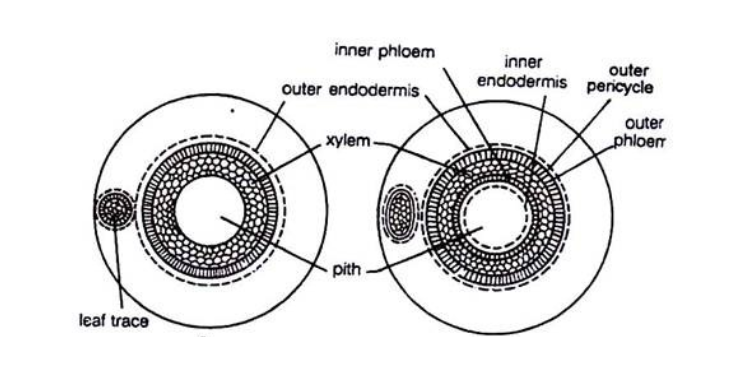
Fig: Left- Ectophloic siphonostele
Right- Amphiphloic siphonostele
Additional Information:
Some modifications of Siphonostele are listed as:
1. Cladosiphonic siphonostele: The siphonostele in which leaf gap is absent is known as cladosiphon siphonostele. Example: Selaginella.
2. Phyllosiphonic siphonostele: The siphonostele in which smaller or larger leaf gaps are there is called phyllosiphonic siphonostele. Example: Filicophyta.
3. Solenostele: The siphonostele which is perforated by scattered leaf traces is known as solenostele.
So, the correct answer is ‘Osmunda and Equisetum’.
Note:
There are two main theories to support the evolution of siphonostele from protostele:
(a) Intraxylary or Intrastelar origin- According to this theory, the siphonostele is evolved by the conversion of the central mass of the xylem into the parenchymatous pith.
(b) Extrastelar Origin: According to this theory, the pith originated as a result of the invasion of parenchymatous cells of the cortex into the stele. This takes place through the leaf gaps and branch gaps. This theory is also famous as invasion theory.
Complete answer:
Protostele and Siphonostele are the two principal types of stelar organisation in vascular plants. Stele is a column containing vascular tissues which is surrounded by pericycle and is separated from ground tissue by endodermis. Siphonostele is medullated protostele i.e. having a central non-vascular pith. The leaf gaps are absent.
Siphonostele is of two types:
1. Ectophloic siphonostele: In this type, the central pith is surrounded successively by xylem, phloem, pericycle, and endodermis. It is found in Osmunda and Equisetum.
2. Amphiphloic siphonostele: In this type, there is a central pith, and xylem is surrounded on either side by phloem, pericycle, and endodermis. It is found in Marsilea and Adiantum.
Fig: Left- Ectophloic siphonostele
Right- Amphiphloic siphonostele
Additional Information:
Some modifications of Siphonostele are listed as:
1. Cladosiphonic siphonostele: The siphonostele in which leaf gap is absent is known as cladosiphon siphonostele. Example: Selaginella.
2. Phyllosiphonic siphonostele: The siphonostele in which smaller or larger leaf gaps are there is called phyllosiphonic siphonostele. Example: Filicophyta.
3. Solenostele: The siphonostele which is perforated by scattered leaf traces is known as solenostele.
So, the correct answer is ‘Osmunda and Equisetum’.
Note:
There are two main theories to support the evolution of siphonostele from protostele:
(a) Intraxylary or Intrastelar origin- According to this theory, the siphonostele is evolved by the conversion of the central mass of the xylem into the parenchymatous pith.
(b) Extrastelar Origin: According to this theory, the pith originated as a result of the invasion of parenchymatous cells of the cortex into the stele. This takes place through the leaf gaps and branch gaps. This theory is also famous as invasion theory.
Recently Updated Pages
Master Class 12 Business Studies: Engaging Questions & Answers for Success

Master Class 12 Chemistry: Engaging Questions & Answers for Success
Master Class 12 Biology: Engaging Questions & Answers for Success
Class 12 Question and Answer - Your Ultimate Solutions Guide
Master Class 11 Social Science: Engaging Questions & Answers for Success
Master Class 11 Chemistry: Engaging Questions & Answers for Success
Trending doubts
Which are the Top 10 Largest Countries of the World?
Draw a labelled sketch of the human eye class 12 physics CBSE
Name the crygenes that control cotton bollworm and class 12 biology CBSE
Differentiate between homogeneous and heterogeneous class 12 chemistry CBSE
How many molecules of ATP and NADPH are required information class 12 biology CBSE
In a transcription unit the promoter is said to be class 12 biology CBSE