




During photorespiration, the oxygen-consuming reaction(s) occur in
A. Stroma of chloroplasts and peroxisomes
B. Grana of chloroplasts and peroxisomes
C. Stroma of chloroplasts
D. Stroma of chloroplasts and mitochondria
Answer
 Verified
585k+ views
Hint: Photorespiration occurs when instead of carbon-dioxide, the Rubisco enzyme binds with oxygen. It results in the reduction of already fixed carbon-dioxide and is thus also called a wasteful pathway. It competes with the Calvin cycle. Oxygen consumption by Rubisco occurs in the chlorophyll-containing organelle of plant cells.
Complete answer: Photorespiration is a process that utilizes oxygen molecules and releases fixed carbon molecules. It occurs in the chlorophyll-containing organelle of plant cells called the chloroplast. The chloroplast is a plastid that consists of a green pigment called chlorophyll that aids in photosynthesis. The chloroplast is a double membrane organelle consisting of stroma which is the aqueous matrix. Inside the stroma lies the thylakoid membranes which are membrane-bound compartments. Some of these are arranged in discs and stacked on each other. This forms the grana of the chloroplast. Peroxisomes are also sites for the oxygen-consuming reaction that occurs during photorespiration. These are small organelles that include various reducing enzymes and some oxidases.
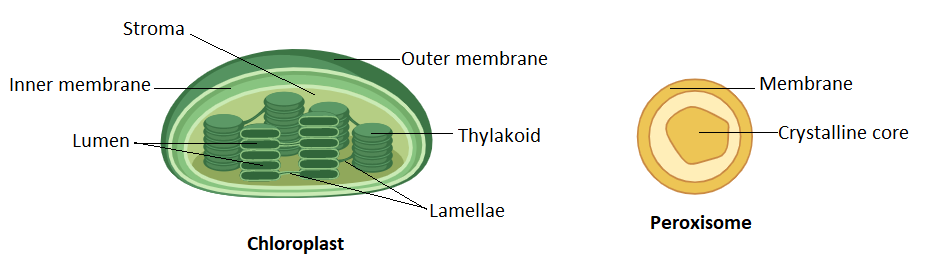
In photorespiration, the RuBP is made using one oxygen molecule by the Rubisco enzyme inside the stroma of the chloroplast. On the other hand, in peroxisomes, the glycolate that is transferred from chloroplast takes up oxygen from glyoxylate. This occurs in the crystalline core of the peroxisomes which provides a reducing environment. Hydrogen peroxide is released as a by-product from peroxisomes.
So, option A is the right answer.
Note: It is an interesting fact to know that billions of years ago a eukaryotic cell engulfed Cyanobacteria which sustained and evolved inside the cell to become chloroplast. Also, photorespiration is a wasteful process that has photoprotective effects. It also helps in maintaining the redox balance in cells.
Complete answer: Photorespiration is a process that utilizes oxygen molecules and releases fixed carbon molecules. It occurs in the chlorophyll-containing organelle of plant cells called the chloroplast. The chloroplast is a plastid that consists of a green pigment called chlorophyll that aids in photosynthesis. The chloroplast is a double membrane organelle consisting of stroma which is the aqueous matrix. Inside the stroma lies the thylakoid membranes which are membrane-bound compartments. Some of these are arranged in discs and stacked on each other. This forms the grana of the chloroplast. Peroxisomes are also sites for the oxygen-consuming reaction that occurs during photorespiration. These are small organelles that include various reducing enzymes and some oxidases.
In photorespiration, the RuBP is made using one oxygen molecule by the Rubisco enzyme inside the stroma of the chloroplast. On the other hand, in peroxisomes, the glycolate that is transferred from chloroplast takes up oxygen from glyoxylate. This occurs in the crystalline core of the peroxisomes which provides a reducing environment. Hydrogen peroxide is released as a by-product from peroxisomes.
So, option A is the right answer.
Note: It is an interesting fact to know that billions of years ago a eukaryotic cell engulfed Cyanobacteria which sustained and evolved inside the cell to become chloroplast. Also, photorespiration is a wasteful process that has photoprotective effects. It also helps in maintaining the redox balance in cells.
Recently Updated Pages
Three beakers labelled as A B and C each containing 25 mL of water were taken A small amount of NaOH anhydrous CuSO4 and NaCl were added to the beakers A B and C respectively It was observed that there was an increase in the temperature of the solutions contained in beakers A and B whereas in case of beaker C the temperature of the solution falls Which one of the following statements isarecorrect i In beakers A and B exothermic process has occurred ii In beakers A and B endothermic process has occurred iii In beaker C exothermic process has occurred iv In beaker C endothermic process has occurred

Master Class 11 Social Science: Engaging Questions & Answers for Success
Master Class 11 Physics: Engaging Questions & Answers for Success
Master Class 11 Maths: Engaging Questions & Answers for Success
Master Class 11 Economics: Engaging Questions & Answers for Success
Master Class 11 Computer Science: Engaging Questions & Answers for Success
Three beakers labelled as A B and C each containing 25 mL of water were taken A small amount of NaOH anhydrous CuSO4 and NaCl were added to the beakers A B and C respectively It was observed that there was an increase in the temperature of the solutions contained in beakers A and B whereas in case of beaker C the temperature of the solution falls Which one of the following statements isarecorrect i In beakers A and B exothermic process has occurred ii In beakers A and B endothermic process has occurred iii In beaker C exothermic process has occurred iv In beaker C endothermic process has occurred
Master Class 11 Social Science: Engaging Questions & Answers for Success
Master Class 11 Physics: Engaging Questions & Answers for Success
Trending doubts
One Metric ton is equal to kg A 10000 B 1000 C 100 class 11 physics CBSE
There are 720 permutations of the digits 1 2 3 4 5 class 11 maths CBSE
State and prove Bernoullis theorem class 11 physics CBSE
Draw a diagram of a plant cell and label at least eight class 11 biology CBSE
Difference Between Prokaryotic Cells and Eukaryotic Cells
1 Quintal is equal to a 110 kg b 10 kg c 100kg d 1000 class 11 physics CBSE