




Drosera catches insects by means of
(a)Bladder
(b)Pitcher
(c)Tentacles secreting shining liquid
(d)Adhesive disc
Answer
 Verified
597.3k+ views
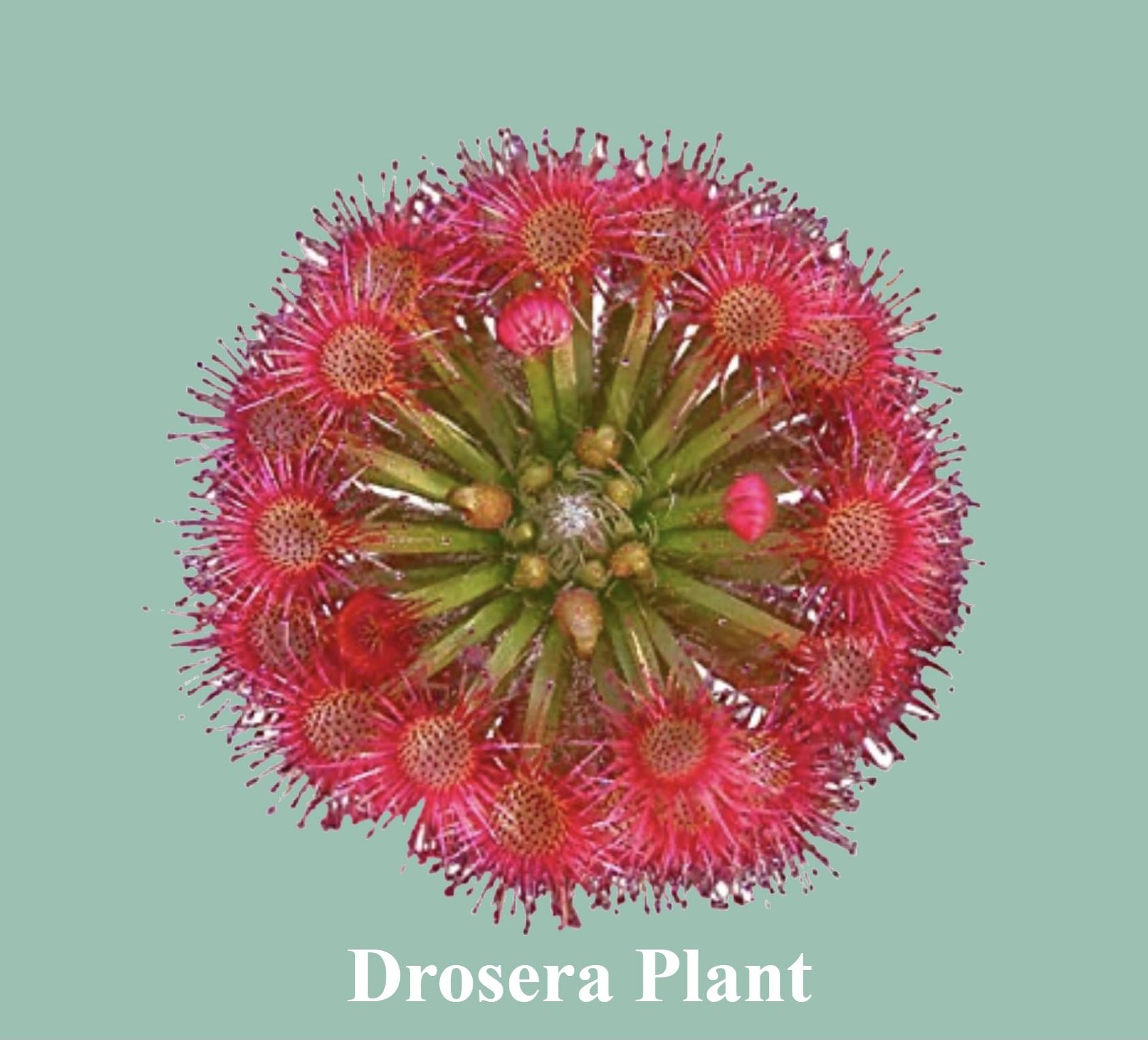
Hint: Drosera is commonly known as the sundew plant. In this plant, leaves are circular like a spoon and possess a large number of sticky hairs. They usually secrete a mucilage glue. These sticky hairs are known to serve as a trap for insects.
Complete answer:
Drosera plant catches insects by means of its tentacles. Their leaves possess a large number of sticky hairs called tentacles. When insects come into contact with tentacles, they arch over and bind it. The captured insect is digested by proteolytic secretions from the leaf. Tentacles show seismonastic movement. The insects are used to supplement the poor mineral nutrition of the soil in which the plants grow. Various species, which vary greatly in size and form, are native to every continent except Antarctica. Drosera is one of the largest genera of carnivorous plants. They use a thick gluey goo called mucilage to trap and digest their prey. The mucilage is attached to special hairs called trichomes. This mucilage rolls down the plant, attracting sugar-loving insects day and night. The mucilage has enzymes that digest them so that the plants can get the nitrogen it needs from it. Like all plants, the sundew makes its own food and just uses insects for nitrogen and other nutrients.
Additional Information: -Insectivorous plants are those plants that feed on insects for their nutrition. They are also known as carnivorous plants.
-They trap and digest insects to absorb nutrients. They have special modifications for trapping organisms. There are certain plants having special modifications like a pitfall trap. They grow in humid areas with plenty of moisture and sunlight.
-They are found in nitrogen-deficient soil, that’s why they feed on insects for nutrients. They have special characteristics such as attractants, inescapable traps, digestive enzymes, sweet secretions, etc.
So, the correct answer is 'Tentacles secreting shining liquid’.
Note: -Insectivorous plants can be broadly divided into active and passive types based on their method of trapping their prey.
-The active one can close their leaf traps the moment insects land on them. The passive plants have a pitfall trap mechanism, having some kind of jar or a pitcher like structure onto which the insect’s slip and fall, to eventually be digested.
-These Insectivorous plants have several attractions such as brilliant colors, sweet secretions, etc.
Complete answer:
Drosera plant catches insects by means of its tentacles. Their leaves possess a large number of sticky hairs called tentacles. When insects come into contact with tentacles, they arch over and bind it. The captured insect is digested by proteolytic secretions from the leaf. Tentacles show seismonastic movement. The insects are used to supplement the poor mineral nutrition of the soil in which the plants grow. Various species, which vary greatly in size and form, are native to every continent except Antarctica. Drosera is one of the largest genera of carnivorous plants. They use a thick gluey goo called mucilage to trap and digest their prey. The mucilage is attached to special hairs called trichomes. This mucilage rolls down the plant, attracting sugar-loving insects day and night. The mucilage has enzymes that digest them so that the plants can get the nitrogen it needs from it. Like all plants, the sundew makes its own food and just uses insects for nitrogen and other nutrients.
Additional Information: -Insectivorous plants are those plants that feed on insects for their nutrition. They are also known as carnivorous plants.
-They trap and digest insects to absorb nutrients. They have special modifications for trapping organisms. There are certain plants having special modifications like a pitfall trap. They grow in humid areas with plenty of moisture and sunlight.
-They are found in nitrogen-deficient soil, that’s why they feed on insects for nutrients. They have special characteristics such as attractants, inescapable traps, digestive enzymes, sweet secretions, etc.
So, the correct answer is 'Tentacles secreting shining liquid’.
Note: -Insectivorous plants can be broadly divided into active and passive types based on their method of trapping their prey.
-The active one can close their leaf traps the moment insects land on them. The passive plants have a pitfall trap mechanism, having some kind of jar or a pitcher like structure onto which the insect’s slip and fall, to eventually be digested.
-These Insectivorous plants have several attractions such as brilliant colors, sweet secretions, etc.
Recently Updated Pages
Master Class 12 Business Studies: Engaging Questions & Answers for Success

Master Class 12 Biology: Engaging Questions & Answers for Success
Master Class 12 Chemistry: Engaging Questions & Answers for Success
Class 12 Question and Answer - Your Ultimate Solutions Guide
Master Class 11 Social Science: Engaging Questions & Answers for Success
Master Class 11 English: Engaging Questions & Answers for Success
Trending doubts
Which is more stable and why class 12 chemistry CBSE
Which are the Top 10 Largest Countries of the World?
Draw a labelled sketch of the human eye class 12 physics CBSE
Differentiate between homogeneous and heterogeneous class 12 chemistry CBSE
What are the major means of transport Explain each class 12 social science CBSE
Sulphuric acid is known as the king of acids State class 12 chemistry CBSE