




How can I draw two equivalent resonance structures for the formate ion, ${\text{HCO}}_{\text{2}}^{\text{ - }}$?
Answer
 Verified
599.4k+ views
Hint For the formation of equivalent resonance structures of formate ion (${\text{HCO}}_{\text{2}}^{\text{ - }}$), first we have to know about the valence shell or outermost electrons of each atoms present in the molecule.
Complete step by step solution:
Steps which are required for the formation of equivalent resonance structures for the formate ion are as follow:
-In the former ion, carbon atom is the central atom because it is more electropositive than oxygen atom.
-Now we calculate total number of valence electrons of ${\text{HCO}}_{\text{2}}^{\text{ - }}$ by adding valence electrons of all atoms and charge present in it.
-Valence electrons in ${\text{HCO}}_{\text{2}}^{\text{ - }}$= $1 + 4 + \left( {2 \times 6} \right) + 1 = 18$.
-Now we form single bonds between each atom and carbon atom.
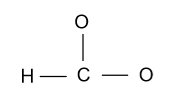
-After forming single bonds out of ${\text{18}}{{\text{e}}^{\text{ - }}}$, only ${\text{12}}{{\text{e}}^{\text{ - }}}$are left as six electrons are involved in the three single bonds.
-Now we divide this ${\text{12}}{{\text{e}}^{\text{ - }}}$among two oxygen atoms then each oxygen atom will have three lone pair of electrons.
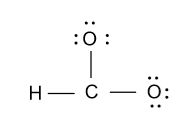
-As we know that a carbon atom bears four valence electrons but in the above diagram only three bonds are formed by the carbon atom. So we will convert one lone pair of electron from one oxygen atom to the double bond and we get following structure:
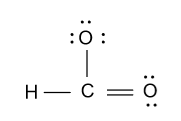
-In the above diagram we also have to show charge because number of electrons in the above diagram is counted by considering the negative charge’s electron.
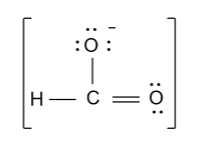
-Now the resonance structure of formate ion (${\text{HCO}}_{\text{2}}^{\text{ - }}$) are shown as follow:
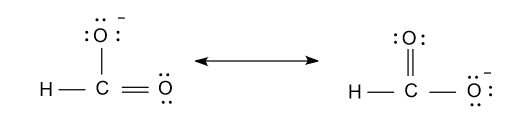
Note: Here some of you may think that why we didn’t divide ${\text{12}}{{\text{e}}^{\text{ - }}}$ among hydrogen atom also so, the reason is that in hydrogen only one valence electron is present and that value was fulfilled by the single bond. That’s why we divide ${\text{12}}{{\text{e}}^{\text{ - }}}$ among two oxygen atoms only.
Complete step by step solution:
Steps which are required for the formation of equivalent resonance structures for the formate ion are as follow:
-In the former ion, carbon atom is the central atom because it is more electropositive than oxygen atom.
-Now we calculate total number of valence electrons of ${\text{HCO}}_{\text{2}}^{\text{ - }}$ by adding valence electrons of all atoms and charge present in it.
-Valence electrons in ${\text{HCO}}_{\text{2}}^{\text{ - }}$= $1 + 4 + \left( {2 \times 6} \right) + 1 = 18$.
-Now we form single bonds between each atom and carbon atom.
-After forming single bonds out of ${\text{18}}{{\text{e}}^{\text{ - }}}$, only ${\text{12}}{{\text{e}}^{\text{ - }}}$are left as six electrons are involved in the three single bonds.
-Now we divide this ${\text{12}}{{\text{e}}^{\text{ - }}}$among two oxygen atoms then each oxygen atom will have three lone pair of electrons.
-As we know that a carbon atom bears four valence electrons but in the above diagram only three bonds are formed by the carbon atom. So we will convert one lone pair of electron from one oxygen atom to the double bond and we get following structure:
-In the above diagram we also have to show charge because number of electrons in the above diagram is counted by considering the negative charge’s electron.
-Now the resonance structure of formate ion (${\text{HCO}}_{\text{2}}^{\text{ - }}$) are shown as follow:
Note: Here some of you may think that why we didn’t divide ${\text{12}}{{\text{e}}^{\text{ - }}}$ among hydrogen atom also so, the reason is that in hydrogen only one valence electron is present and that value was fulfilled by the single bond. That’s why we divide ${\text{12}}{{\text{e}}^{\text{ - }}}$ among two oxygen atoms only.
Recently Updated Pages
Master Class 12 Economics: Engaging Questions & Answers for Success

Master Class 12 English: Engaging Questions & Answers for Success
Master Class 12 Social Science: Engaging Questions & Answers for Success
Master Class 12 Maths: Engaging Questions & Answers for Success
Master Class 12 Physics: Engaging Questions & Answers for Success
Master Class 12 Business Studies: Engaging Questions & Answers for Success
Trending doubts
Which are the Top 10 Largest Countries of the World?
Draw a labelled sketch of the human eye class 12 physics CBSE
Differentiate between homogeneous and heterogeneous class 12 chemistry CBSE
Why is the cell called the structural and functional class 12 biology CBSE
Draw ray diagrams each showing i myopic eye and ii class 12 physics CBSE
Which is the correct genotypic ratio of mendel dihybrid class 12 biology CBSE