




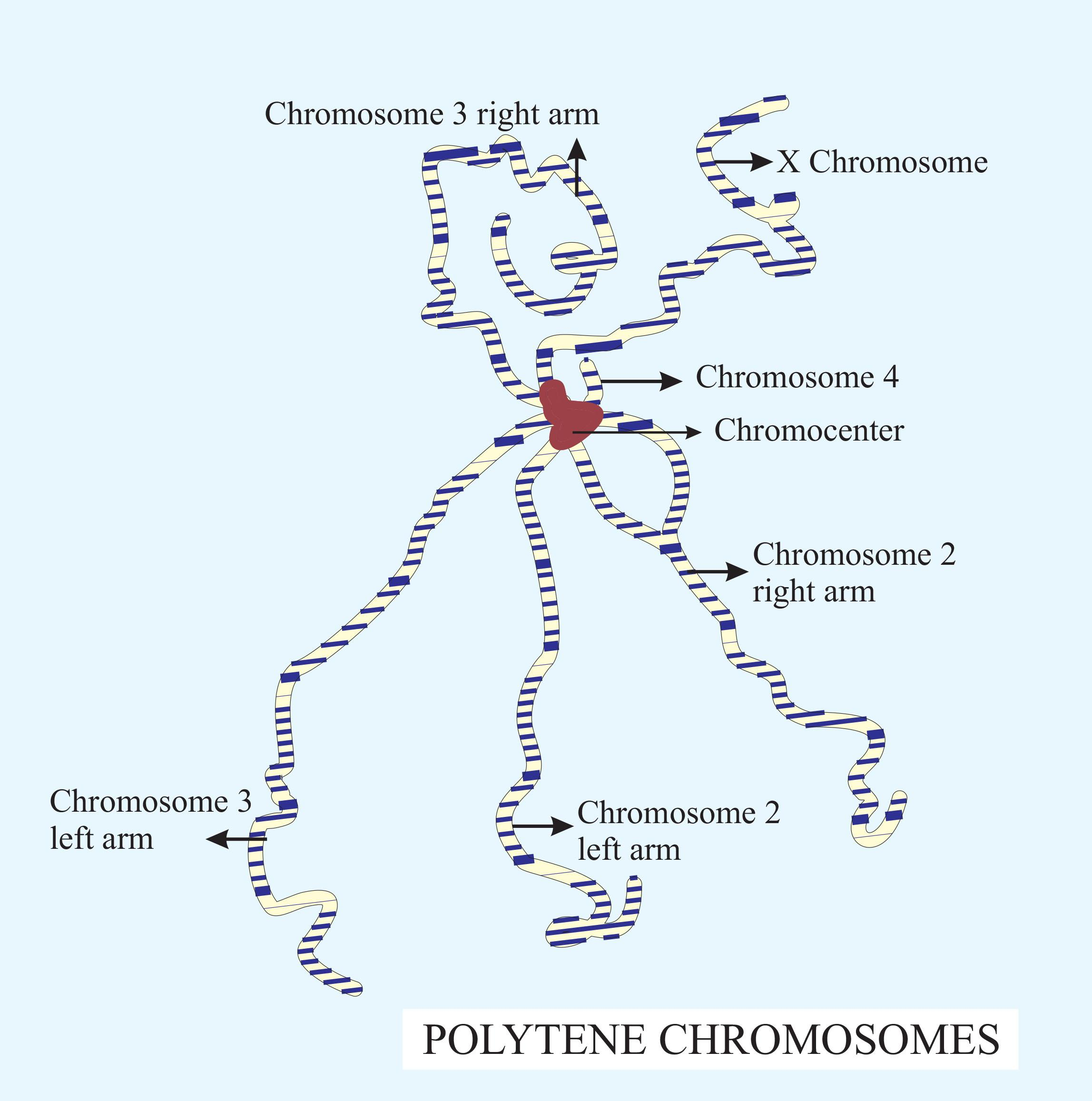
Draw the structure of the polytene chromosome and label its parts.
Answer
 Verified
626.7k+ views
Hint: Polytene chromosomes are different from the commonly isolated chromosomes as they have more than one strand of DNA. Some organisms have tissues that require overexpression of genes in order to carry out specialized functions. For this function, polytene chromosomes are required.
Complete answer:
- Polytene chromosomes are large chromosomes that contain thousands of DNA strands due to repeated DNA replication without cell division.
- They are found at the interphase nuclei of some larval tissue of flies.
- They are also found in the tissues of some insects, especially dipteran flies. They are most studied in Drosophila and other flies.
- Polytene chromosomes are seen at the interphase as distinct thick and thin banding patterns.
- The large size of the chromosome is attributed to the presence of longitudinal strands or chromonemata.
- Bands of the chromosome become enlarged at certain times to form swellings called puffs and the formation is called puffing. The puffs are indicative of mRNA synthesis.
- Their functions are as follows. The chromosomes help in cell expansion and increase the volume of cell nuclei. As they have a large amount of genetic material, it leads to the overexpression of genes which is required in some tissues of organisms.
- Polytene chromosomes are observed in the larval salivary glands of the drosophila. These genes are overexpressed to produce a large amount of saliva containing mucoprotein to help in pupation.
- The distinct bands are known as dark bands and interband.
Note:
- The puff regions in Chironomus are also known as Balbiani rings.
- Polytene chromosomes are also present in mammalian trophoblasts.
- The chromosomes are 70 to 110 times larger than normal metaphase chromosomes.
Complete answer:
- Polytene chromosomes are large chromosomes that contain thousands of DNA strands due to repeated DNA replication without cell division.
- They are found at the interphase nuclei of some larval tissue of flies.
- They are also found in the tissues of some insects, especially dipteran flies. They are most studied in Drosophila and other flies.
- Polytene chromosomes are seen at the interphase as distinct thick and thin banding patterns.
- The large size of the chromosome is attributed to the presence of longitudinal strands or chromonemata.
- Bands of the chromosome become enlarged at certain times to form swellings called puffs and the formation is called puffing. The puffs are indicative of mRNA synthesis.
- Their functions are as follows. The chromosomes help in cell expansion and increase the volume of cell nuclei. As they have a large amount of genetic material, it leads to the overexpression of genes which is required in some tissues of organisms.
- Polytene chromosomes are observed in the larval salivary glands of the drosophila. These genes are overexpressed to produce a large amount of saliva containing mucoprotein to help in pupation.
- The distinct bands are known as dark bands and interband.
Note:
- The puff regions in Chironomus are also known as Balbiani rings.
- Polytene chromosomes are also present in mammalian trophoblasts.
- The chromosomes are 70 to 110 times larger than normal metaphase chromosomes.
Recently Updated Pages
Explain the structure of megasporangium class 12 biology CBSE

Why is chloroform kept in dark coloured bottles class 12 chemistry CBSE
Derive the balancing condition of a Wheatstone bri class 12 physics CBSE
Draw VI characteristics of a pn junction diode Explain class 12 physics CBSE
Is it possible to carry pride in ones language too class 12 english CBSE
In a population at Hardy Weinberg equilibrium the allele class 12 biology CBSE
Trending doubts
Draw a labelled sketch of the human eye class 12 physics CBSE
Which are the Top 10 Largest Countries of the World?
Draw ray diagrams each showing i myopic eye and ii class 12 physics CBSE
Which is the correct genotypic ratio of mendel dihybrid class 12 biology CBSE
Differentiate between homogeneous and heterogeneous class 12 chemistry CBSE
Which animal never drinks water in its entire life class 12 biology CBSE