



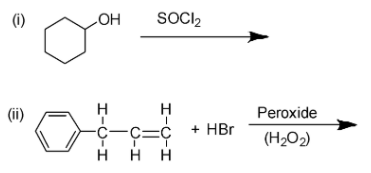
Draw the structure of a major monohalo product in each of the following reactions.
Answer
 Verified
580.5k+ views
Hint: If one or more of the hydrogen atoms are being replaced by an equivalent number of the halogens in a hydrocarbon, the final compounds attained are known as halogen derivatives of hydrocarbons.
Complete step-by-step answer:
Depending on the number of halogen atoms in the halogen derivatives of hydrocarbons are known as monohalogen or polyhalogen derivatives of hydrocarbons. Let us draw the structure of a major monohalo product by completing each of the given reactions one by one.
(i) \[SOC{l_2}\]i.e. thionyl chloride is generally used to prepare alkyl chlorides from alcohols. In the given reaction, cyclohexanol is made to react with thionyl chloride. The hydroxyl oxygen (of cyclohexanol) attacks the electrophilic Sulfur (of thionyl chloride) which leads to the formation of chlorosulfite ester (cyclohexyl sufurochloridite) and hydrogen chloride. The chlorosulfite ester then rearranges with the breaking of C-O and S-Cl bonds and leads to the formation of chlorocyclohexane and sulphur dioxide. The reaction is depicted below:

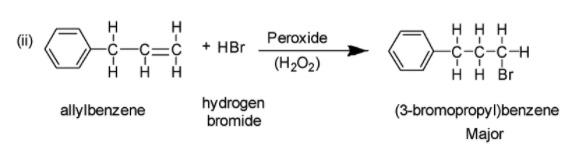
(ii) Addition reaction of allyl benzene in the presence of peroxide generally yields (3-bromopropyl)benzene in accordance with anti-Markovnikov rule of addition. According to anti-Markovnikov rule, the hydrogen atom of HX in an addition reaction of generic electrophile HX to either an alkene or alkyne, becomes bonded to carbon atom having the least number of hydrogen atoms in the starting alkyne or alkene. The reaction is depicted below:
Note: The major difference between Markovnikov and anti-Markovnikov rule is that Markinov rule states that in an addition reaction, hydrogen atoms are linked to the carbon atom having more hydrogen substituents while anti-Markovnikov rule states that in an addition reaction, hydrogen atoms are linked to the carbon atom having the least hydrogen substituents.
Complete step-by-step answer:
Depending on the number of halogen atoms in the halogen derivatives of hydrocarbons are known as monohalogen or polyhalogen derivatives of hydrocarbons. Let us draw the structure of a major monohalo product by completing each of the given reactions one by one.
(i) \[SOC{l_2}\]i.e. thionyl chloride is generally used to prepare alkyl chlorides from alcohols. In the given reaction, cyclohexanol is made to react with thionyl chloride. The hydroxyl oxygen (of cyclohexanol) attacks the electrophilic Sulfur (of thionyl chloride) which leads to the formation of chlorosulfite ester (cyclohexyl sufurochloridite) and hydrogen chloride. The chlorosulfite ester then rearranges with the breaking of C-O and S-Cl bonds and leads to the formation of chlorocyclohexane and sulphur dioxide. The reaction is depicted below:
(ii) Addition reaction of allyl benzene in the presence of peroxide generally yields (3-bromopropyl)benzene in accordance with anti-Markovnikov rule of addition. According to anti-Markovnikov rule, the hydrogen atom of HX in an addition reaction of generic electrophile HX to either an alkene or alkyne, becomes bonded to carbon atom having the least number of hydrogen atoms in the starting alkyne or alkene. The reaction is depicted below:
Note: The major difference between Markovnikov and anti-Markovnikov rule is that Markinov rule states that in an addition reaction, hydrogen atoms are linked to the carbon atom having more hydrogen substituents while anti-Markovnikov rule states that in an addition reaction, hydrogen atoms are linked to the carbon atom having the least hydrogen substituents.
Recently Updated Pages
Three beakers labelled as A B and C each containing 25 mL of water were taken A small amount of NaOH anhydrous CuSO4 and NaCl were added to the beakers A B and C respectively It was observed that there was an increase in the temperature of the solutions contained in beakers A and B whereas in case of beaker C the temperature of the solution falls Which one of the following statements isarecorrect i In beakers A and B exothermic process has occurred ii In beakers A and B endothermic process has occurred iii In beaker C exothermic process has occurred iv In beaker C endothermic process has occurred

Master Class 12 Social Science: Engaging Questions & Answers for Success
Master Class 12 Physics: Engaging Questions & Answers for Success
Master Class 12 Maths: Engaging Questions & Answers for Success
Master Class 12 Economics: Engaging Questions & Answers for Success
Master Class 12 Chemistry: Engaging Questions & Answers for Success
Three beakers labelled as A B and C each containing 25 mL of water were taken A small amount of NaOH anhydrous CuSO4 and NaCl were added to the beakers A B and C respectively It was observed that there was an increase in the temperature of the solutions contained in beakers A and B whereas in case of beaker C the temperature of the solution falls Which one of the following statements isarecorrect i In beakers A and B exothermic process has occurred ii In beakers A and B endothermic process has occurred iii In beaker C exothermic process has occurred iv In beaker C endothermic process has occurred
Master Class 12 Social Science: Engaging Questions & Answers for Success
Master Class 12 Physics: Engaging Questions & Answers for Success
Trending doubts
Which are the Top 10 Largest Countries of the World?
Draw a labelled sketch of the human eye class 12 physics CBSE
Explain the structure of megasporangium class 12 biology CBSE
What are the major means of transport Explain each class 12 social science CBSE
Differentiate between homogeneous and heterogeneous class 12 chemistry CBSE
Sulphuric acid is known as the king of acids State class 12 chemistry CBSE