



Draw the square ABCD of area 9 square centimeters.
Answer
 Verified
641.7k+ views
Hint: As the formula for finding the area of square is (s x s), that is \[{{\left( s \right)}^{2}}\]
Therefore, the side of this square will be equal to 3 centimeters because, (3 x 3) or \[{{\left( 3 \right)}^{2}}=9\] .
For making a right angle, we must first draw a semicircle, then where the semicircle cuts the line, we make another cut on the semicircle by putting the compass at the cut. Now we make two cuts by placing the compass at both the prior two cuts and then make a line which passes through the intersection.
Complete step-by-step answer:
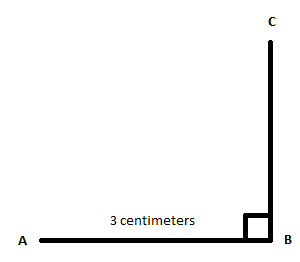
For the first step, we need to draw a line measuring 3 centimeter.

Now, secondly, draw another line forming a right angle at point B, measuring 3 centimeters.
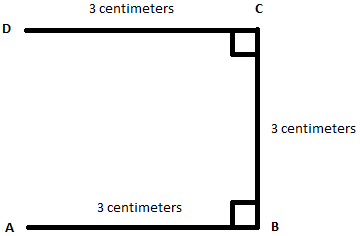
Thirdly, we need to draw one more line forming a right angle at point C, measuring 3 centimeters.
Lastly, we need to draw a line forming a right angle at point D, measuring 3 centimeters.
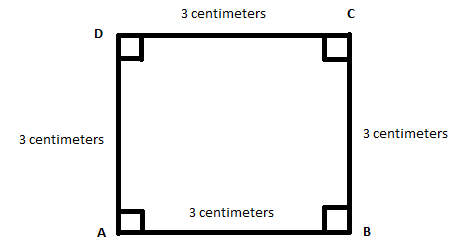
Now, let us calculate the area of this square ABCD,
Formula for the area of square = side x side
Area of the square ABCD = 3 x 3=9cm
Note:-
One must remember the formulas of the areas of some basic shapes such as rectangle, square, circle, triangle, rhombus, parallelogram, etc.
1. RECTANGLE: (l x b), i.e., (length x breadth), where length is the length of the rectangle and breadth is the breadth of the rectangle.
2. SQUARE: As mentioned above, (s x s) or \[{{\left( s \right)}^{2}}\], i.e., (side x side), where side refers to the length of one side of the square.
3. TRIANGLE - ( \[\dfrac{1}{2}base\times height\] ), where base refers to the length of the base of the triangle and height refers to the height of the triangle.
4. RHOMBUS - ( \[~\dfrac{1}{2}diagonal{{l}_{1}}\times diagonal{{l}_{2}}\] ), where diagonal1 refers to the length of a diagonal of the rhombus and diagonals 2 refers to the length of other diagonal of the rhombus.
5. PARALLELOGRAM: (b x h), i.e., (base x height), where base refers to the length of the base and height refers to the height of the rhombus.
6. CIRCLE- \[(~\pi {{r}^{2}})\]where \[{{\left( radius \right)}^{2}}\] refers to the square of the length of the radius of the square.
Therefore, the side of this square will be equal to 3 centimeters because, (3 x 3) or \[{{\left( 3 \right)}^{2}}=9\] .
For making a right angle, we must first draw a semicircle, then where the semicircle cuts the line, we make another cut on the semicircle by putting the compass at the cut. Now we make two cuts by placing the compass at both the prior two cuts and then make a line which passes through the intersection.
Complete step-by-step answer:
For the first step, we need to draw a line measuring 3 centimeter.
Now, secondly, draw another line forming a right angle at point B, measuring 3 centimeters.
Thirdly, we need to draw one more line forming a right angle at point C, measuring 3 centimeters.
Lastly, we need to draw a line forming a right angle at point D, measuring 3 centimeters.
Now, let us calculate the area of this square ABCD,
Formula for the area of square = side x side
Area of the square ABCD = 3 x 3=9cm
Note:-
One must remember the formulas of the areas of some basic shapes such as rectangle, square, circle, triangle, rhombus, parallelogram, etc.
1. RECTANGLE: (l x b), i.e., (length x breadth), where length is the length of the rectangle and breadth is the breadth of the rectangle.
2. SQUARE: As mentioned above, (s x s) or \[{{\left( s \right)}^{2}}\], i.e., (side x side), where side refers to the length of one side of the square.
3. TRIANGLE - ( \[\dfrac{1}{2}base\times height\] ), where base refers to the length of the base of the triangle and height refers to the height of the triangle.
4. RHOMBUS - ( \[~\dfrac{1}{2}diagonal{{l}_{1}}\times diagonal{{l}_{2}}\] ), where diagonal1 refers to the length of a diagonal of the rhombus and diagonals 2 refers to the length of other diagonal of the rhombus.
5. PARALLELOGRAM: (b x h), i.e., (base x height), where base refers to the length of the base and height refers to the height of the rhombus.
6. CIRCLE- \[(~\pi {{r}^{2}})\]where \[{{\left( radius \right)}^{2}}\] refers to the square of the length of the radius of the square.
Recently Updated Pages
Master Class 11 English: Engaging Questions & Answers for Success

Master Class 11 Maths: Engaging Questions & Answers for Success
Class 11 Question and Answer - Your Ultimate Solutions Guide
Master Class 11 Biology: Engaging Questions & Answers for Success
Master Class 11 Physics: Engaging Questions & Answers for Success
Master Class 11 Accountancy: Engaging Questions & Answers for Success
Trending doubts
Find the sum of series 1 + 2 + 3 + 4 + 5 + + 100 class 9 maths CBSE
Fill the blanks with the suitable prepositions 1 The class 9 english CBSE
Difference Between Plant Cell and Animal Cell
How many hours before the closure of election must class 9 social science CBSE
What is pollution? How many types of pollution? Define it
Name 10 Living and Non living things class 9 biology CBSE