




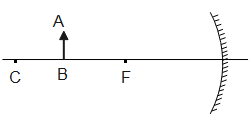
Draw the following diagram in your answer book and show the formation of the image of the object AB with the help of suitable rays.
Answer
 Verified
615.9k+ views
Hint: A concave mirror is also known as a converging mirror. If we place our object at infinity, the rays converge at focus and form a sharp image there. Here, we have an object between the centre of curvature and focus.
Complete answer:
The point C in the diagram is called the centre of curvature and point F is the focus of the mirror. An object placed at focus forms an image at infinity. An object placed at the C forms an image at C itself. Any object placed in between the two should likewise form an image between infinity and C. The image formed by a concave mirror when the object is between C and F will be real and inverted.
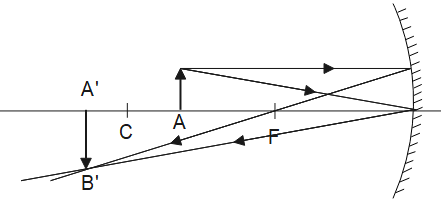
The ray diagram is depicted below.
To draw this, follow two steps:
1. Pass a ray parallel to the axis, so that it reflects from the mirror and passes through the focus.
2. Next, pass a ray to the pole of the mirror so that it reflects making the same angle with the principal axis as the incident.
Thus, an image A’B’ is obtained at a point that is beyond C. This image formed is a real and inverted image.
Note:
There are basically three ways of making rays: (i) parallel to the principal axis or through the focus, (ii) towards the pole, (iii) through the centre of curvature (to the other side in convex). Any two of these three can form the required image. It is not like we cannot form any other rays. Sure, an object consists of infinite rays, we only pick the standard ones that generalize our result.
Complete answer:
The point C in the diagram is called the centre of curvature and point F is the focus of the mirror. An object placed at focus forms an image at infinity. An object placed at the C forms an image at C itself. Any object placed in between the two should likewise form an image between infinity and C. The image formed by a concave mirror when the object is between C and F will be real and inverted.
The ray diagram is depicted below.
To draw this, follow two steps:
1. Pass a ray parallel to the axis, so that it reflects from the mirror and passes through the focus.
2. Next, pass a ray to the pole of the mirror so that it reflects making the same angle with the principal axis as the incident.
Thus, an image A’B’ is obtained at a point that is beyond C. This image formed is a real and inverted image.
Note:
There are basically three ways of making rays: (i) parallel to the principal axis or through the focus, (ii) towards the pole, (iii) through the centre of curvature (to the other side in convex). Any two of these three can form the required image. It is not like we cannot form any other rays. Sure, an object consists of infinite rays, we only pick the standard ones that generalize our result.
Recently Updated Pages
Explain the structure of megasporangium class 12 biology CBSE

Why is chloroform kept in dark coloured bottles class 12 chemistry CBSE
Derive the balancing condition of a Wheatstone bri class 12 physics CBSE
Draw VI characteristics of a pn junction diode Explain class 12 physics CBSE
Is it possible to carry pride in ones language too class 12 english CBSE
In a population at Hardy Weinberg equilibrium the allele class 12 biology CBSE
Trending doubts
Draw a labelled sketch of the human eye class 12 physics CBSE
Which are the Top 10 Largest Countries of the World?
Draw ray diagrams each showing i myopic eye and ii class 12 physics CBSE
One megawatt is equal to how many units of electri class 12 physics CBSE
Which is the correct genotypic ratio of mendel dihybrid class 12 biology CBSE
Give 10 examples of unisexual and bisexual flowers