




Draw rough diagrams of two angles such that they have
(a) One point in common
(b) Two points in common
(c) Three points in common
(d) Four points in common
(e) One ray in common
Answer
 Verified
601.8k+ views
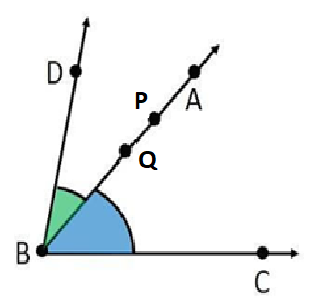
Hint: First draw an acute angle ABC with vertex at B and AB and BC as its sides. Now, take another point D outside the angle ABC and join BD to form the second angle ABD. From the figure, you will see that only points A and B, and the ray AB are the common elements between the two angles.
Complete step by step solution:
In this question, we need to draw rough diagrams of two angles such that they have:
One point in common, Two points in common, Three points in common, Four points in common, One ray in common
(a) First, we will draw an angle ABC with vertex at B and AB and BC as its sides.
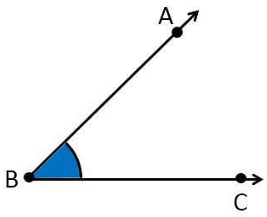
Here, we have three points: B as the vertex and A and C on the sides of the angle ABC.
Now, we will take another point D outside the angle ABC and join BD to form the second angle ABD.
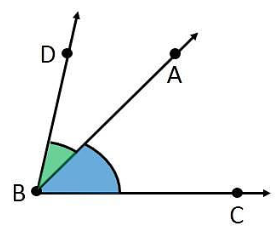
Now, from this new figure, we can see that the angles ABC and ABD have the point B common.
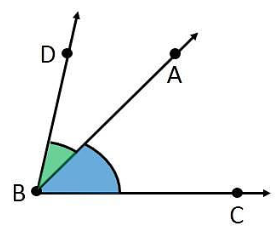
(b) Construct the diagram same as in part (a). We see that the angles ABC and ABD have two points in common. These are point B and point A.
(c) Since, we can have only one endpoint, hence it is impossible to draw two angles such that they have three points in common.
(d) Since, we can have only one endpoint, hence it is impossible to draw two angles such that they have four points in common.
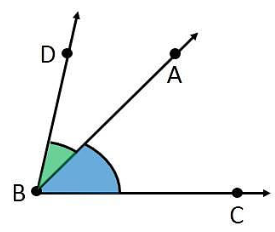
(e) Construct the diagram same as in part (a). We see that the angles ABC and ABD have the ray AB common.
Note: Another different approach to this problem can be: We draw the same figure as before for the two angles. Now we know that a ray has an infinite number of points. So, on the common side, we choose 2 additional points P and Q which are common to both the angles. In this way, two angles can have 4 common points. Similarly, we can have 3 common points.
Complete step by step solution:
In this question, we need to draw rough diagrams of two angles such that they have:
One point in common, Two points in common, Three points in common, Four points in common, One ray in common
(a) First, we will draw an angle ABC with vertex at B and AB and BC as its sides.
Here, we have three points: B as the vertex and A and C on the sides of the angle ABC.
Now, we will take another point D outside the angle ABC and join BD to form the second angle ABD.
Now, from this new figure, we can see that the angles ABC and ABD have the point B common.
(b) Construct the diagram same as in part (a). We see that the angles ABC and ABD have two points in common. These are point B and point A.
(c) Since, we can have only one endpoint, hence it is impossible to draw two angles such that they have three points in common.
(d) Since, we can have only one endpoint, hence it is impossible to draw two angles such that they have four points in common.
(e) Construct the diagram same as in part (a). We see that the angles ABC and ABD have the ray AB common.
Note: Another different approach to this problem can be: We draw the same figure as before for the two angles. Now we know that a ray has an infinite number of points. So, on the common side, we choose 2 additional points P and Q which are common to both the angles. In this way, two angles can have 4 common points. Similarly, we can have 3 common points.
Recently Updated Pages
Basicity of sulphurous acid and sulphuric acid are

Master Class 12 Economics: Engaging Questions & Answers for Success
Master Class 12 Biology: Engaging Questions & Answers for Success
Master Class 11 English: Engaging Questions & Answers for Success
Master Class 11 Physics: Engaging Questions & Answers for Success
Master Class 11 Computer Science: Engaging Questions & Answers for Success
Trending doubts
Difference Between Plant Cell and Animal Cell
Fill the blanks with the suitable prepositions 1 The class 9 english CBSE
What is pollution? How many types of pollution? Define it
What is the full form of pH?
What is the Full Form of ICSE, CBSE and SSC
Name 10 Living and Non living things class 9 biology CBSE