




Draw energy band diagrams of an n-type and p-type semiconductor at temperature $T$ > $0$. Mark the donor and acceptor energy levels with their energies. A semiconductor has equal electron and hole concentration of $6\times {{10}^{8}}{{m}^{-3}}$. On doping with certain impurity, electron concentration increases to $9\times {{10}^{12}}{{m}^{-3}}$. Calculate the new hole concentration.
Answer
 Verified
575.4k+ views
Hint: As a first step, one could recall the theory that they had learnt about the mentioned semiconductors. Then you could use the same to make the energy band diagram for both. After that recall the law of mass action and then substitute accordingly to solve the second part of the question.
Formula used:
Law of mass action,
$np={{n}_{i}}^{2}$
Complete answer:
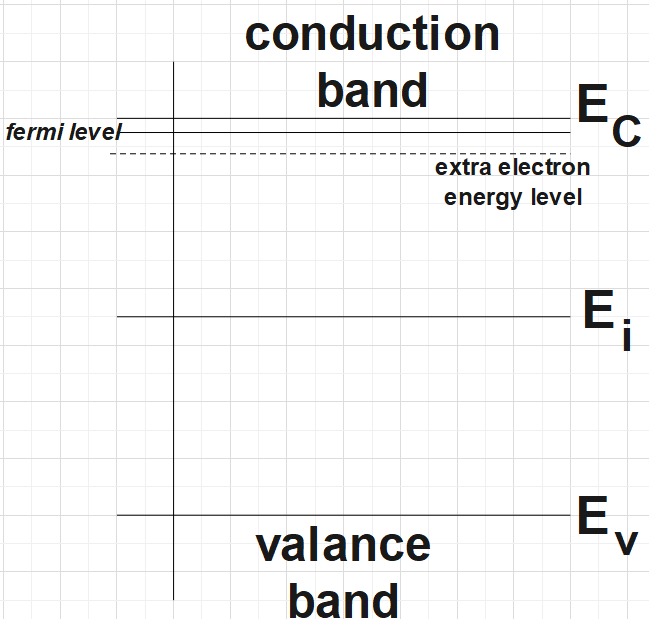
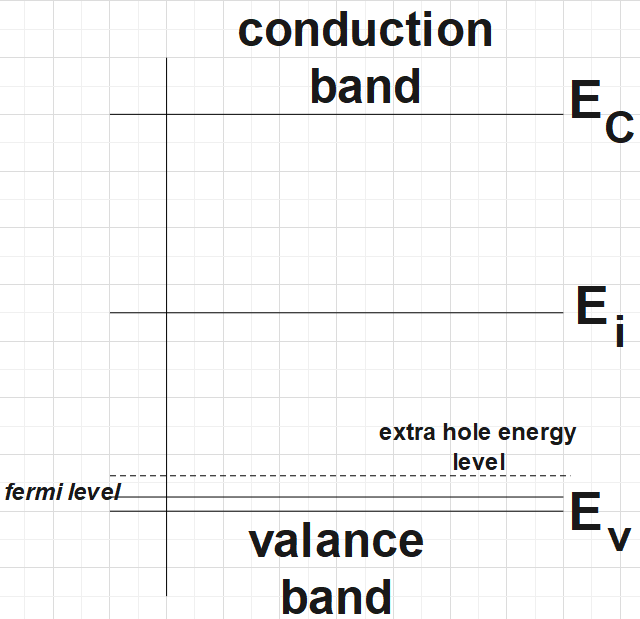
Firstly, we are asked to draw the energy band diagrams for the n-type and p-type semiconductor at some temperature less than 0. Following are the diagrams where we have clearly marked the donor and acceptor levels, fermi level, etc.
For the n-type semiconductor the energy diagram would look like as:
Now, for the p-type semiconductor the energy band diagram would look something like this:
Now, let us look at the second part of the question which is a numerical problem. In order to solve this problem let us recall the law of mass action given by,
$np={{n}_{i}}^{2}$
Here we are given the intrinsic carrier concentration as,
${{n}_{i}}=6\times {{10}^{8}}{{m}^{-3}}$
Now, we are given the increased level of electron as,
$n=9\times {{10}^{12}}{{m}^{-3}}$
Now, we could substitute these values into the law of mass action to get,
$p=\dfrac{{{\left( 6\times {{10}^{8}} \right)}^{2}}}{9\times {{10}^{12}}}$
$\therefore p=4\times {{10}^{4}}{{m}^{-3}}$
Therefore, the new hole concentration to be $p=4\times {{10}^{4}}{{m}^{-3}}$.
Note:
While making the diagram one should take care that they don’t miss out any of the energy level. You could recall your basic understanding of the given semiconductors, namely, the n-type and the p-type. So, you would get the basic idea as to where acceptor level and donor level are significant.
Formula used:
Law of mass action,
$np={{n}_{i}}^{2}$
Complete answer:
Firstly, we are asked to draw the energy band diagrams for the n-type and p-type semiconductor at some temperature less than 0. Following are the diagrams where we have clearly marked the donor and acceptor levels, fermi level, etc.
For the n-type semiconductor the energy diagram would look like as:
Now, for the p-type semiconductor the energy band diagram would look something like this:
Now, let us look at the second part of the question which is a numerical problem. In order to solve this problem let us recall the law of mass action given by,
$np={{n}_{i}}^{2}$
Here we are given the intrinsic carrier concentration as,
${{n}_{i}}=6\times {{10}^{8}}{{m}^{-3}}$
Now, we are given the increased level of electron as,
$n=9\times {{10}^{12}}{{m}^{-3}}$
Now, we could substitute these values into the law of mass action to get,
$p=\dfrac{{{\left( 6\times {{10}^{8}} \right)}^{2}}}{9\times {{10}^{12}}}$
$\therefore p=4\times {{10}^{4}}{{m}^{-3}}$
Therefore, the new hole concentration to be $p=4\times {{10}^{4}}{{m}^{-3}}$.
Note:
While making the diagram one should take care that they don’t miss out any of the energy level. You could recall your basic understanding of the given semiconductors, namely, the n-type and the p-type. So, you would get the basic idea as to where acceptor level and donor level are significant.
Recently Updated Pages
Basicity of sulphurous acid and sulphuric acid are

Master Class 12 Economics: Engaging Questions & Answers for Success
Master Class 12 Biology: Engaging Questions & Answers for Success
Master Class 11 English: Engaging Questions & Answers for Success
Master Class 11 Physics: Engaging Questions & Answers for Success
Master Class 11 Computer Science: Engaging Questions & Answers for Success
Trending doubts
The chemical formula of tear gas is A CO Cl 2 B C 10 class 12 chemistry CBSE
Which are the Top 10 Largest Countries of the World?
Differentiate between homogeneous and heterogeneous class 12 chemistry CBSE
Draw the diagram of the chloroplast class 12 biology CBSE
Lipids are insoluble in water because they are A Neutral class 12 biology CBSE
Decomposer also called as ATransducers BReducers CMicroconsumer class 12 biology CBSE