




Draw and label the animal cell.
Answer
 Verified
593.9k+ views
Hint: All the animal cells are eukaryotic. They differ from plant cells as they do not contain any cell walls, just like a plant cell. They do not have any chloroplast and have smaller vacuoles.
Complete answer:
Animal cells are the basic unit of life in the organisms that belong to the animal kingdom. They composed of a true nucleus and a specialized structure known as organelles. The cell is surrounded by the cell membrane or the plasma membrane. The plasma membrane comprises all the components which are hung in the gel-like fluid known as cytoplasm. A eukaryotic cell is different from a prokaryotic cell as it has membrane-bound organelles like mitochondria, endoplasmic reticulum and Golgi apparatus. The animal cells are multicellular as several cells work together to compose an organism. As in the case of humans, which is a complex organism these cells can be highly special to perform different functions.
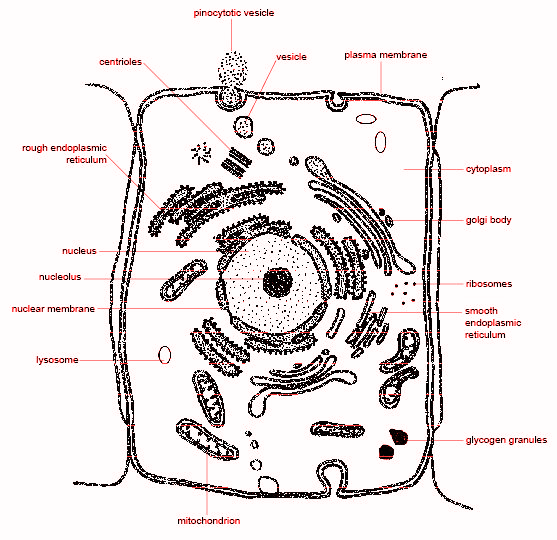
The multicellular organisms consist of other structures that give support to the other tissue and organs. Animal cells have various organelles that function together and allow the cell to perform its function. The nucleus contains all the genetic information and this genetic information is known as DNA. Ribosomes are the organelle that is found in both the eukaryotes and prokaryotes and it helps in the synthesis of protein. Endoplasmic reticulum functions in the transporting of proteins. Lysosomes provide digestive enzymes. Mitochondria is the organelle that gives energy to the cell.
Note: The various types of animal cells are skin cell, blood cell, nerve cell, muscles cell etc. A cell membrane is a type of semi-permeable membrane which is composed of protein and fats while the nuclear membrane is a double membrane structure which surrounds the nucleus.
Complete answer:
Animal cells are the basic unit of life in the organisms that belong to the animal kingdom. They composed of a true nucleus and a specialized structure known as organelles. The cell is surrounded by the cell membrane or the plasma membrane. The plasma membrane comprises all the components which are hung in the gel-like fluid known as cytoplasm. A eukaryotic cell is different from a prokaryotic cell as it has membrane-bound organelles like mitochondria, endoplasmic reticulum and Golgi apparatus. The animal cells are multicellular as several cells work together to compose an organism. As in the case of humans, which is a complex organism these cells can be highly special to perform different functions.
The multicellular organisms consist of other structures that give support to the other tissue and organs. Animal cells have various organelles that function together and allow the cell to perform its function. The nucleus contains all the genetic information and this genetic information is known as DNA. Ribosomes are the organelle that is found in both the eukaryotes and prokaryotes and it helps in the synthesis of protein. Endoplasmic reticulum functions in the transporting of proteins. Lysosomes provide digestive enzymes. Mitochondria is the organelle that gives energy to the cell.
Note: The various types of animal cells are skin cell, blood cell, nerve cell, muscles cell etc. A cell membrane is a type of semi-permeable membrane which is composed of protein and fats while the nuclear membrane is a double membrane structure which surrounds the nucleus.
Recently Updated Pages
If x a + bt + ct2 where x is in meters and t is in class 11 physics CBSE

A car covers the first half distance between two places class 11 physics CBSE
The resultant of two vectors overrightarrow P and overrightarrow class 11 physics CBSE
Find the value of cos 135 class 11 maths CBSE
A mass M is held in place by an applied force F and class 11 physics CBSE
A solution of glucose in water is labelled as 10 dfracwv class 11 chemistry CBSE
Trending doubts
Find the value of the expression given below sin 30circ class 11 maths CBSE
What is the maximum height of a projectile class 11 physics CBSE
Derive an expression for maximum height and range of class 11 physics CBSE
Describe various types of epithelial tissues with the class 11 biology CBSE
Lysosomes are known as suicidal bags of cell why class 11 biology CBSE
State and derive law of conservation of momentum class 11 physics CBSE