



Draw an angle to measure \[147^\circ \] and find its bisector.
Answer
 Verified
617.7k+ views
Hint: In the given question, we need to first draw an angle of the given measure, which is\[147^\circ \]. Clearly, this angle is an obtuse angle as it is greater than \[90^\circ \]. Then we need to follow some basic geometric steps to calculate and construct the bisector of the given angle using a scale, a pencil and a compass, i.e., without the help of a protractor.
Complete step-by-step answer:
In the given question, the required angle which is to be drawn is of measure \[147^\circ \]. Since this angle is not a multiple of \[15\], it cannot be drawn with just a scale, a pencil and a compass. So, we are going to have to use a protractor for drawing this angle.
So first, we draw a ray OA

Then, we place a protractor on the point O and mark a point B on the \[147^\circ \] marking on the protractor and join OB. Thus, \[\angle AOB = 147^\circ \]
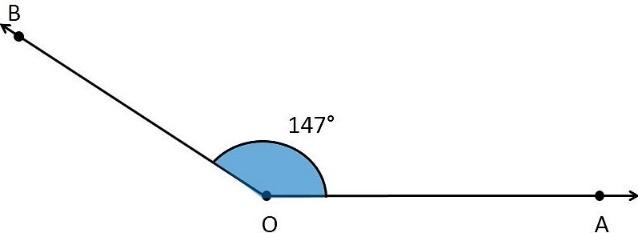
Now, we have to construct the bisector of \[\angle AOB\].
For that, we mark points C and D on the corners of the angle as shown.
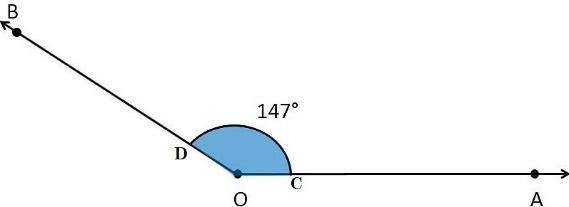
Now, taking C and D as centers and radius more than \[\frac{1}{2}{\rm{CD}}\], draw arcs to intersect each other.
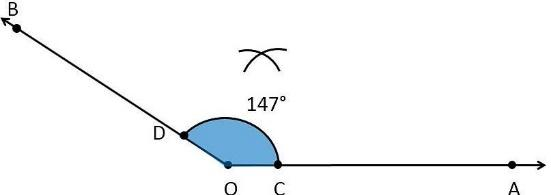
Let the intersecting point be E.
Join O and E. And we have our bisector.
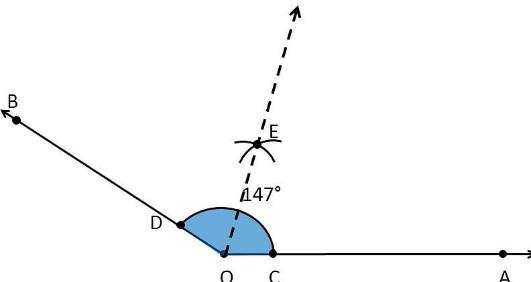
Thus, OE is the bisector of \[\angle AOB\].
Note: So, for solving questions of such type, we first write what has been given to us. Then we write down what we have to find. Then we think about the formulae which contains the known and the unknown and pick the one which is the most suitable for the answer. Then we put in the knowns into the formula, evaluate the answer and find the unknown. It is really important to follow all the steps of the formula to solve the given expression very carefully and in the correct order, because even a slightest error is going to make the whole expression wrong and is going to give us an incorrect answer.
Complete step-by-step answer:
In the given question, the required angle which is to be drawn is of measure \[147^\circ \]. Since this angle is not a multiple of \[15\], it cannot be drawn with just a scale, a pencil and a compass. So, we are going to have to use a protractor for drawing this angle.
So first, we draw a ray OA
Then, we place a protractor on the point O and mark a point B on the \[147^\circ \] marking on the protractor and join OB. Thus, \[\angle AOB = 147^\circ \]
Now, we have to construct the bisector of \[\angle AOB\].
For that, we mark points C and D on the corners of the angle as shown.
Now, taking C and D as centers and radius more than \[\frac{1}{2}{\rm{CD}}\], draw arcs to intersect each other.
Let the intersecting point be E.
Join O and E. And we have our bisector.
Thus, OE is the bisector of \[\angle AOB\].
Note: So, for solving questions of such type, we first write what has been given to us. Then we write down what we have to find. Then we think about the formulae which contains the known and the unknown and pick the one which is the most suitable for the answer. Then we put in the knowns into the formula, evaluate the answer and find the unknown. It is really important to follow all the steps of the formula to solve the given expression very carefully and in the correct order, because even a slightest error is going to make the whole expression wrong and is going to give us an incorrect answer.
Recently Updated Pages
Basicity of sulphurous acid and sulphuric acid are

Master Class 12 Economics: Engaging Questions & Answers for Success
Master Class 12 Biology: Engaging Questions & Answers for Success
Master Class 11 English: Engaging Questions & Answers for Success
Master Class 11 Physics: Engaging Questions & Answers for Success
Master Class 11 Computer Science: Engaging Questions & Answers for Success
Trending doubts
What is BLO What is the full form of BLO class 8 social science CBSE
Citizens of India can vote at the age of A 18 years class 8 social science CBSE
Full form of STD, ISD and PCO
Give me the opposite gender of Duck class 8 english CBSE
What is the feminine gender of a stag class 8 english CBSE
One cusec is equal to how many liters class 8 maths CBSE