




Draw an angle of \[{{50}^{\circ }}\] with the help of a protractor. Draw a ray bisecting this angle.
Answer
 Verified
560.1k+ views
Hint: Firstly, we have to construct an angle of \[{{50}^{\circ }}\]using protractor. And then using a compass, cut an arc of some radius on both the arms of the angle drawn and mark the points.. Now consider the radius more than half of previously considered radius and from the marked points, cut an arc from both the points and join with the vertex of the angle and produce it till some other point. This gives us the bisector of angle constructed.
Complete step by step answer:
Now let us learn about angles. The different types of angles are zero angle, acute angle, obtuse angle, right angle, straight angle, reflex angle and the complete angle. We can construct the angles using a protractor and also with the help of compass by cutting the arcs. Generally, using the method of arcs, the bisectors of the angles constructed are formed.
Now let us construct the angle of \[{{50}^{\circ }}\] and its bisector.
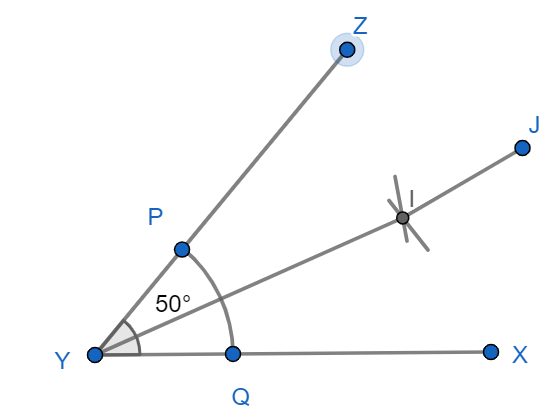
STEPS OF CONSTRUCTION:
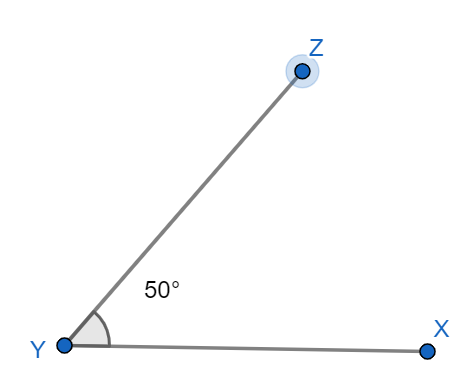
1. With the help of a protractor, construct an angle whose measure is \[{{50}^{\circ }}\], and name it as \[\angle XYZ\].
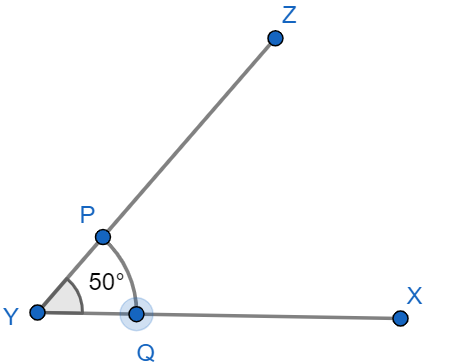
2. Now consider \[Y\]as centre, and consider any measure of radius, draw an arc cutting both the arms of the angle \[YZ\] and \[XY\]at \[P\] and \[Q\] respectively.
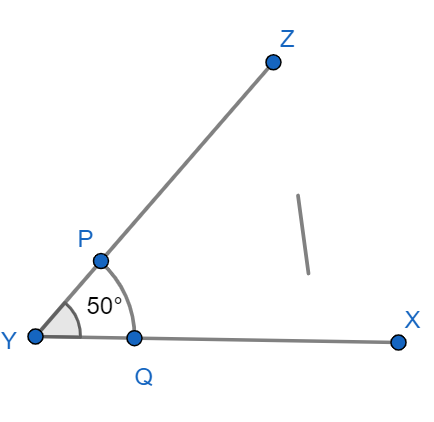
3. Now consider \[P\] as a centre with the radius more than half of \[PQ\], draw an arc.
4. Now consider \[Q\] as the centre and with the previously considered radius cut an arc such that it cuts the previously drawn arc and name this point of intersection as \[I\].
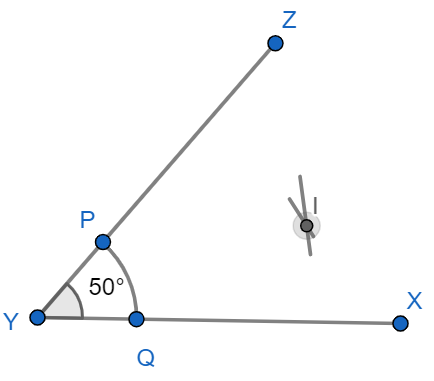
5. Now join the vertex of the angle and the point of intersection i.e. \[YI\].

6. Now produce this \[YI\]to \[J\].

7. So, the ray \[YJ\] would be the required angular bisector of the constructed angle.
Note: We must be careful while measuring the angles and constructing them because minor error can give us an incorrect angle. We must have a note of the process of the angles being constructed. We must cut the arcs accurately for accurate measure of angles.
Complete step by step answer:
Now let us learn about angles. The different types of angles are zero angle, acute angle, obtuse angle, right angle, straight angle, reflex angle and the complete angle. We can construct the angles using a protractor and also with the help of compass by cutting the arcs. Generally, using the method of arcs, the bisectors of the angles constructed are formed.
Now let us construct the angle of \[{{50}^{\circ }}\] and its bisector.
STEPS OF CONSTRUCTION:
1. With the help of a protractor, construct an angle whose measure is \[{{50}^{\circ }}\], and name it as \[\angle XYZ\].
2. Now consider \[Y\]as centre, and consider any measure of radius, draw an arc cutting both the arms of the angle \[YZ\] and \[XY\]at \[P\] and \[Q\] respectively.
3. Now consider \[P\] as a centre with the radius more than half of \[PQ\], draw an arc.
4. Now consider \[Q\] as the centre and with the previously considered radius cut an arc such that it cuts the previously drawn arc and name this point of intersection as \[I\].
5. Now join the vertex of the angle and the point of intersection i.e. \[YI\].
6. Now produce this \[YI\]to \[J\].
7. So, the ray \[YJ\] would be the required angular bisector of the constructed angle.
Note: We must be careful while measuring the angles and constructing them because minor error can give us an incorrect angle. We must have a note of the process of the angles being constructed. We must cut the arcs accurately for accurate measure of angles.
Recently Updated Pages
Master Class 11 English: Engaging Questions & Answers for Success

Master Class 11 Social Science: Engaging Questions & Answers for Success
Master Class 11 Maths: Engaging Questions & Answers for Success
Master Class 11 Biology: Engaging Questions & Answers for Success
Master Class 11 Physics: Engaging Questions & Answers for Success
Master Class 11 Chemistry: Engaging Questions & Answers for Success
Trending doubts