




Draw a schematic diagram of a part of double-stranded dinucleotide DNA chain having all the four nitrogenous bases and showing the correct polarity.
Answer
 Verified
588k+ views
Hint: DNA is deoxyribonucleic acid. It is a double-stranded helical structure. In most of the species, the DNA is the genetic material. It can be copied over a generation of cells by the process of DNA replication.
Complete answer:
Dinucleotide forms from a phosphodiester bond between the two mononucleotides. The phosphate of the mononucleotides in C5’ of its sugar bond to the C3’ of the sugar of the preceding mononucleotide. Now, a phosphate, 5’ sugar and 3’ sugar of this sugar is linked to the second phosphate -5’ sugar. The 3’ is free for the next step. The orientation of the molecule is\[5' \to 3'\]. The successive addition of the monomer units in a $5' \to 3'$ configuration formed a polynucleotide chain. The phosphate –sugar (nucleotide n) and phosphate sugar (nucleotide n+1) and so on, linked covalently. This is the backbone of the molecules.
Structure of DNA:
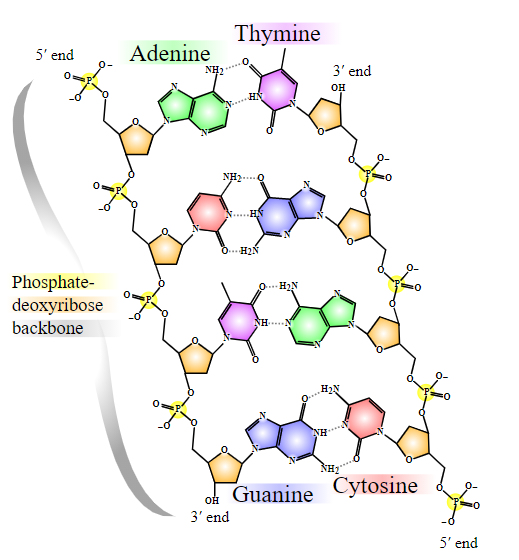
Additional information:
-In nucleus DNA is present as an acid substance was first discovered by Friedrich Meischer in 1869 and named it as “Nuclein”.
-The base pairing gives out a very unique property to the polynucleotide chain as they are complementary to each other. Hence the sequence of the DNA strand can be predicted if the sequence of the one strand is known.
-Each strand of the DNA strands acts as the template strand for the synthesis of new strands.
-The silent features of DNA (double helix structure) are as follow –
-DNA is made from two polynucleotide chains, where sugar-phosphate acts the backbone and bases are present inside it. These two chains are coiled in right-handed fashion.
-The bases are held together by the hydrogen bond which forms the base pairs. The double hydrogen bond is present between the adenine and thymine, whereas guanine and cytosine are held by triple hydrogen bonds.
-The helix’s pitch is 3.4nm.
-Approximately there are 10 base pairs in each turn and distance between the base pair in a helix is 0.34nm approximately.
Note: DNA is formed from a long polymer of deoxyribonucleotides. The length of the DNA is determined by the number of nucleotides present in it. The lengths of DNA vary from organisms to organisms. The human DNA is $3.3 \times {10^9}{\text{base pairs}}$(haploid).
Complete answer:
Dinucleotide forms from a phosphodiester bond between the two mononucleotides. The phosphate of the mononucleotides in C5’ of its sugar bond to the C3’ of the sugar of the preceding mononucleotide. Now, a phosphate, 5’ sugar and 3’ sugar of this sugar is linked to the second phosphate -5’ sugar. The 3’ is free for the next step. The orientation of the molecule is\[5' \to 3'\]. The successive addition of the monomer units in a $5' \to 3'$ configuration formed a polynucleotide chain. The phosphate –sugar (nucleotide n) and phosphate sugar (nucleotide n+1) and so on, linked covalently. This is the backbone of the molecules.
Structure of DNA:
Additional information:
-In nucleus DNA is present as an acid substance was first discovered by Friedrich Meischer in 1869 and named it as “Nuclein”.
-The base pairing gives out a very unique property to the polynucleotide chain as they are complementary to each other. Hence the sequence of the DNA strand can be predicted if the sequence of the one strand is known.
-Each strand of the DNA strands acts as the template strand for the synthesis of new strands.
-The silent features of DNA (double helix structure) are as follow –
-DNA is made from two polynucleotide chains, where sugar-phosphate acts the backbone and bases are present inside it. These two chains are coiled in right-handed fashion.
-The bases are held together by the hydrogen bond which forms the base pairs. The double hydrogen bond is present between the adenine and thymine, whereas guanine and cytosine are held by triple hydrogen bonds.
-The helix’s pitch is 3.4nm.
-Approximately there are 10 base pairs in each turn and distance between the base pair in a helix is 0.34nm approximately.
Note: DNA is formed from a long polymer of deoxyribonucleotides. The length of the DNA is determined by the number of nucleotides present in it. The lengths of DNA vary from organisms to organisms. The human DNA is $3.3 \times {10^9}{\text{base pairs}}$(haploid).
Recently Updated Pages
Master Class 12 Business Studies: Engaging Questions & Answers for Success

Master Class 12 Chemistry: Engaging Questions & Answers for Success
Master Class 12 Biology: Engaging Questions & Answers for Success
Class 12 Question and Answer - Your Ultimate Solutions Guide
Master Class 11 English: Engaging Questions & Answers for Success
Master Class 11 Maths: Engaging Questions & Answers for Success
Trending doubts
Which is more stable and why class 12 chemistry CBSE
Which are the Top 10 Largest Countries of the World?
Draw a labelled sketch of the human eye class 12 physics CBSE
Differentiate between homogeneous and heterogeneous class 12 chemistry CBSE
What are the major means of transport Explain each class 12 social science CBSE
Sulphuric acid is known as the king of acids State class 12 chemistry CBSE