




Draw a rough sketch and find the area of the region bounded by the parabolas $ {{y}^{2}}=4x\ and\ {{x}^{2}}=4y $ , using the method of integration.
Answer
 Verified
618.6k+ views
Hint: We will start by drawing the rough sketch of $ {{y}^{2}}=4x\ and\ {{x}^{2}}=4y $ . Then we will find their point of intersection by solving the curve. Then we will use integration to find the area of the bounded region.
Complete step-by-step answer:
Now, we will first draw a rough sketch of $ {{y}^{2}}=4x\ and\ {{x}^{2}}=4y $ as we know that both these equations are of parabola. Therefore, we have,
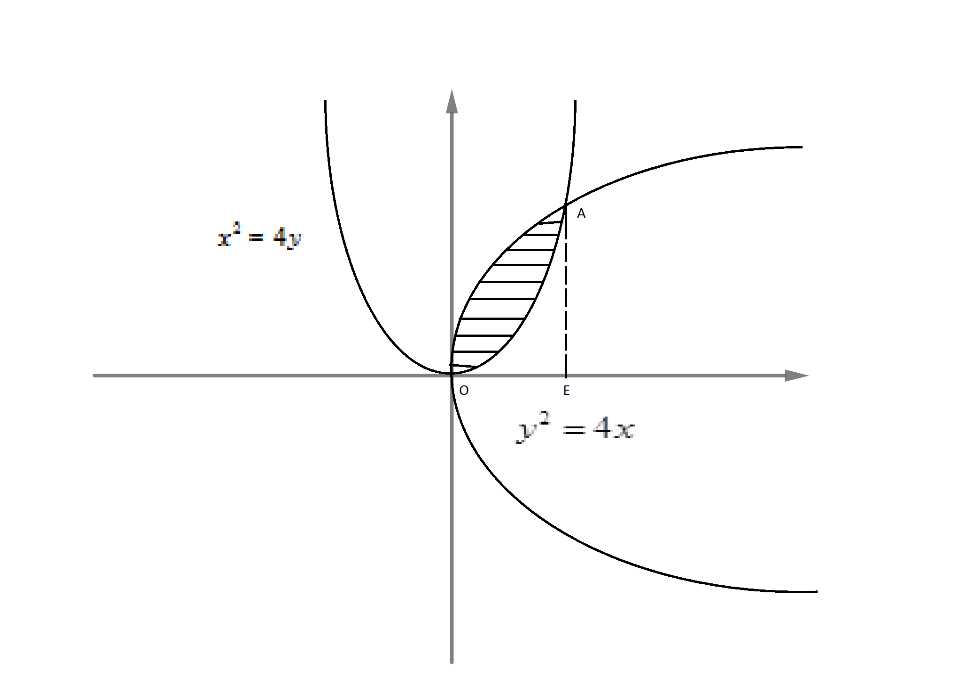
Now, we will first find the point A which is point of intersection of $ {{y}^{2}}=4x $ .
$ \begin{align}
& {{y}^{2}}=4x........\left( 1 \right) \\
& {{x}^{2}}=4y........\left( 2 \right) \\
\end{align} $
Now, we will substitute the value of y from (2) in (1).
\[\begin{align}
& \Rightarrow {{\left( \dfrac{{{x}^{2}}}{4} \right)}^{2}}=4x \\
& \Rightarrow \dfrac{{{x}^{4}}}{16}=4x \\
& \Rightarrow {{x}^{4}}=64x \\
& \Rightarrow {{x}^{4}}-64x=0 \\
\end{align}\]
Now, by taking x as common we have,
\[\begin{align}
& x\left( {{x}^{3}}-64 \right)=0 \\
& \Rightarrow x=0\ or\ x=4 \\
\end{align}\]
Now, substituting x = 0 and x = 4 in (1) we have,
\[\begin{align}
& \Rightarrow {{y}^{2}}=4\times 0 \\
& \Rightarrow {{y}^{2}}=0 \\
& \Rightarrow y=0 \\
& Also \\
& \Rightarrow {{y}^{2}}=4\times 4 \\
& \Rightarrow {{y}^{2}}=16 \\
& \Rightarrow y=\pm 4 \\
\end{align}\]
Now, since from (2) we have y > 0. Therefore, y = -4 is rejected. Hence, the coordinate of point A is (4, 4).
Now, the area of shaded region is,
ar upper region OAE – ar lower region OA
\[\begin{align}
& \Rightarrow \int\limits_{0}^{4}{\sqrt{4x}dx}-\int\limits_{0}^{4}{\dfrac{{{x}^{2}}}{4}dx} \\
& \Rightarrow \int\limits_{0}^{4}{2\sqrt{x}dx}-\int\limits_{0}^{4}{\dfrac{{{x}^{2}}}{4}dx} \\
\end{align}\]
Now, we know that the integral \[\int{{{x}^{n}}dx=\dfrac{{{x}^{n+1}}}{n+1}}\].
\[\begin{align}
& \Rightarrow \left( 2\dfrac{{{x}^{\dfrac{3}{2}}}}{\dfrac{3}{2}} \right)_{0}^{4}-\left( \dfrac{{{x}^{3}}}{12} \right)_{0}^{4} \\
& \Rightarrow \dfrac{4}{3}\left( {{x}^{\dfrac{3}{2}}} \right)_{0}^{4}-\dfrac{1}{12}\left( {{x}^{3}} \right)_{0}^{4} \\
& \Rightarrow \dfrac{4}{3}\left( {{\left( 4 \right)}^{\dfrac{3}{2}}} \right)-\dfrac{1}{12}\left( {{4}^{3}} \right) \\
& \Rightarrow \dfrac{4}{3}\left( {{2}^{3}} \right)-\dfrac{1}{12}\times {{4}^{3}} \\
& \Rightarrow \dfrac{32}{3}-\dfrac{16}{3} \\
& \Rightarrow \dfrac{16}{3}sq\ units \\
\end{align}\]
Note: It is important to note that while solving the question we have taken the limits as x = 0 to x = 4 in both the integral. Also we have subtracted the area formed by the lower region OAE from the upper region to find the bounded area.
Complete step-by-step answer:
Now, we will first draw a rough sketch of $ {{y}^{2}}=4x\ and\ {{x}^{2}}=4y $ as we know that both these equations are of parabola. Therefore, we have,
Now, we will first find the point A which is point of intersection of $ {{y}^{2}}=4x $ .
$ \begin{align}
& {{y}^{2}}=4x........\left( 1 \right) \\
& {{x}^{2}}=4y........\left( 2 \right) \\
\end{align} $
Now, we will substitute the value of y from (2) in (1).
\[\begin{align}
& \Rightarrow {{\left( \dfrac{{{x}^{2}}}{4} \right)}^{2}}=4x \\
& \Rightarrow \dfrac{{{x}^{4}}}{16}=4x \\
& \Rightarrow {{x}^{4}}=64x \\
& \Rightarrow {{x}^{4}}-64x=0 \\
\end{align}\]
Now, by taking x as common we have,
\[\begin{align}
& x\left( {{x}^{3}}-64 \right)=0 \\
& \Rightarrow x=0\ or\ x=4 \\
\end{align}\]
Now, substituting x = 0 and x = 4 in (1) we have,
\[\begin{align}
& \Rightarrow {{y}^{2}}=4\times 0 \\
& \Rightarrow {{y}^{2}}=0 \\
& \Rightarrow y=0 \\
& Also \\
& \Rightarrow {{y}^{2}}=4\times 4 \\
& \Rightarrow {{y}^{2}}=16 \\
& \Rightarrow y=\pm 4 \\
\end{align}\]
Now, since from (2) we have y > 0. Therefore, y = -4 is rejected. Hence, the coordinate of point A is (4, 4).
Now, the area of shaded region is,
ar upper region OAE – ar lower region OA
\[\begin{align}
& \Rightarrow \int\limits_{0}^{4}{\sqrt{4x}dx}-\int\limits_{0}^{4}{\dfrac{{{x}^{2}}}{4}dx} \\
& \Rightarrow \int\limits_{0}^{4}{2\sqrt{x}dx}-\int\limits_{0}^{4}{\dfrac{{{x}^{2}}}{4}dx} \\
\end{align}\]
Now, we know that the integral \[\int{{{x}^{n}}dx=\dfrac{{{x}^{n+1}}}{n+1}}\].
\[\begin{align}
& \Rightarrow \left( 2\dfrac{{{x}^{\dfrac{3}{2}}}}{\dfrac{3}{2}} \right)_{0}^{4}-\left( \dfrac{{{x}^{3}}}{12} \right)_{0}^{4} \\
& \Rightarrow \dfrac{4}{3}\left( {{x}^{\dfrac{3}{2}}} \right)_{0}^{4}-\dfrac{1}{12}\left( {{x}^{3}} \right)_{0}^{4} \\
& \Rightarrow \dfrac{4}{3}\left( {{\left( 4 \right)}^{\dfrac{3}{2}}} \right)-\dfrac{1}{12}\left( {{4}^{3}} \right) \\
& \Rightarrow \dfrac{4}{3}\left( {{2}^{3}} \right)-\dfrac{1}{12}\times {{4}^{3}} \\
& \Rightarrow \dfrac{32}{3}-\dfrac{16}{3} \\
& \Rightarrow \dfrac{16}{3}sq\ units \\
\end{align}\]
Note: It is important to note that while solving the question we have taken the limits as x = 0 to x = 4 in both the integral. Also we have subtracted the area formed by the lower region OAE from the upper region to find the bounded area.
Recently Updated Pages
Basicity of sulphurous acid and sulphuric acid are

Master Class 12 English: Engaging Questions & Answers for Success
Master Class 12 Social Science: Engaging Questions & Answers for Success
Master Class 12 Maths: Engaging Questions & Answers for Success
Master Class 12 Economics: Engaging Questions & Answers for Success
Master Class 12 Physics: Engaging Questions & Answers for Success
Trending doubts
Which are the Top 10 Largest Countries of the World?
Draw a labelled sketch of the human eye class 12 physics CBSE
Which country did Danny Casey play for class 12 english CBSE
Give 10 examples of unisexual and bisexual flowers
Coming together federation is practiced in A India class 12 social science CBSE
Write the formula to find the shortest distance between class 12 maths CBSE