



Draw a rough diagram of two angles such that they have:
I). One common point
II). Two common points
III). three common points
IV). Four common points
Answer
 Verified
602.1k+ views
Hint: In geometry, an angle is formed by two rays meeting at a common endpoint. An angle is represented by the symbol $\angle $. Angles are measured in degrees, using a protector.
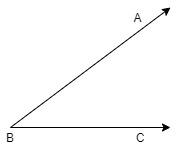
In the above figure,
The angle is $\angle ABC$.
The angle has two rays $\overrightarrow {BA} $ and $\overrightarrow {BC} $.
These two rays $\overrightarrow {BA} $ and $\overrightarrow {BC} $ start with a common point B.
Hence, the angle has one common point B.
Complete step-by-step solution:
I). Two angles have one common point:
If two angles have one common point then, their endpoint is the same.
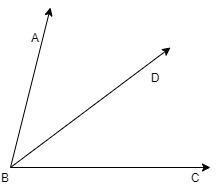
In the above figure, there are two angles.
The first angle is $\angle ABD$ and the second angle is $\angle DBC$.
In these two angles, there is only one common point ‘B’.
II). Two angles have two common points:
Since the angle has only one endpoint, we cannot have two angles with two points in common.
It is not possible.
III). Two angles have three common points:
Since the angle has only one endpoint, we cannot have two angles with three points in common.
It is not possible.
IV). Two angles have four common points:
Since the angle has only one endpoint, we cannot have two angles with four points in common.
It is not possible.
Note: Remember that two or more angles have only one endpoint. So, we can say that two or more angles have only one common point.
Parts of an Angle:
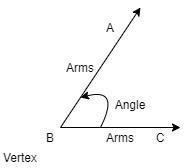
Arms: The two rays joining to form an angle are called arms of an angle. Here, OA and OB are the arms of the $\angle ABC$.
Vertex: The common end point at which the two rays meet to form an angle is called the vertex. Here, the point O is the vertex of $\angle ABC$.
In the above figure,
The angle is $\angle ABC$.
The angle has two rays $\overrightarrow {BA} $ and $\overrightarrow {BC} $.
These two rays $\overrightarrow {BA} $ and $\overrightarrow {BC} $ start with a common point B.
Hence, the angle has one common point B.
Complete step-by-step solution:
I). Two angles have one common point:
If two angles have one common point then, their endpoint is the same.
In the above figure, there are two angles.
The first angle is $\angle ABD$ and the second angle is $\angle DBC$.
In these two angles, there is only one common point ‘B’.
II). Two angles have two common points:
Since the angle has only one endpoint, we cannot have two angles with two points in common.
It is not possible.
III). Two angles have three common points:
Since the angle has only one endpoint, we cannot have two angles with three points in common.
It is not possible.
IV). Two angles have four common points:
Since the angle has only one endpoint, we cannot have two angles with four points in common.
It is not possible.
Note: Remember that two or more angles have only one endpoint. So, we can say that two or more angles have only one common point.
Parts of an Angle:
Arms: The two rays joining to form an angle are called arms of an angle. Here, OA and OB are the arms of the $\angle ABC$.
Vertex: The common end point at which the two rays meet to form an angle is called the vertex. Here, the point O is the vertex of $\angle ABC$.
Recently Updated Pages
Master Class 11 English: Engaging Questions & Answers for Success

Master Class 11 Social Science: Engaging Questions & Answers for Success
Master Class 11 Maths: Engaging Questions & Answers for Success
Master Class 11 Biology: Engaging Questions & Answers for Success
Master Class 11 Physics: Engaging Questions & Answers for Success
Master Class 11 Chemistry: Engaging Questions & Answers for Success
Trending doubts
Difference Between Plant Cell and Animal Cell
Fill the blanks with the suitable prepositions 1 The class 9 english CBSE
What is pollution? How many types of pollution? Define it
Name 10 Living and Non living things class 9 biology CBSE
What is the full form of pH?
On an outline map of India show its neighbouring c class 9 social science CBSE