




Draw a ray diagram to show the image formation by the combination of two thin convex lenses to contact. Obtain the expression for the power of this combination in terms of the focal length of the lenses.
Answer
 Verified
602.1k+ views
Hint: For this question we have to use the lens formula and power of lens formula. As two lenses are used, the image of the first lens will act as an object for the second lens. The principle and rules of ray optics are necessary for solving this problem.
Formula used:
Mirror formula- \[\dfrac{1}{f}=\dfrac{1}{v}-\dfrac{1}{u}\]
Power of lens - \[P=\dfrac{1}{f}\]
Complete step by step solution:
Let us consider two lenses be \[{{L}_{1}}\], \[{{L}_{2}}\] having optical centres \[{{C}_{1}}\]and \[{{C}_{2}}\] respectively. Let \[{{f}_{1}}\] and \[{{f}_{2}}\] be focal length of lens \[{{L}_{1}}\] and \[{{L}_{2}}\]. Below is the ray diagram representing the path the light ray has travelled to form an image. The object is placed at O and passes through lens \[{{L}_{1}}\]and \[{{L}_{2}}\]forming an image at P then this image will act as an object for lens \[{{L}_{2}}\] and final image is formed at I.
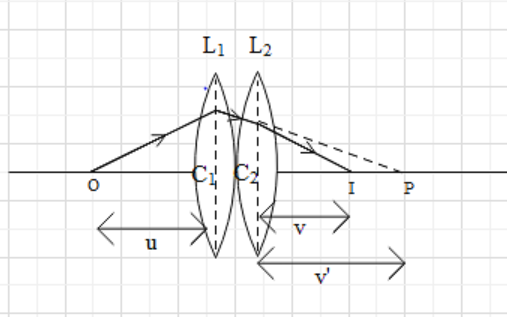
The distance between object O and \[{{C}_{1}}\]is represented as \[u\], distance between \[{{C}_{2}}\] and I is \[v\] and distance between \[{{C}_{2}}\] to P is \[{{v}^{'}}\].
Applying lens formula for convex lens \[{{L}_{1}}\]
\[\dfrac{1}{{{f}_{1}}}=\dfrac{1}{{{v}^{'}}}-\dfrac{1}{u}\]…….. (1)
Similarly for lens \[{{L}_{2}}\],
\[\dfrac{1}{{{f}_{2}}}=\dfrac{1}{v}-\dfrac{1}{{{v}^{'}}}\]……... (2)
For the lens \[{{L}_{2}}\], P will act as virtual image object
Adding equation (1) and (2)
\[\dfrac{1}{{{f}_{1}}}+\dfrac{1}{{{f}_{2}}}=\dfrac{1}{v}-\dfrac{1}{u}\]
\[\dfrac{1}{F}=\dfrac{1}{{{f}_{1}}}+\dfrac{1}{{{f}_{2}}}\]
Where, $F$ be the focal length of the combined lens.
Power of lens is given by
\[P=\dfrac{1}{F}\]
Therefore power of combined lens
\[P=\dfrac{1}{{{f}_{1}}}+\dfrac{1}{{{f}_{2}}}\]
Hence the answer has been calculated.
Note: The sign used in the formula should be taken care of properly. As two lenses are there, one should always solve for lens 1, the result of which will be used for lens 2. A ray diagram should always be drawn with a sharp pencil and the direction of the ray should be marked properly.
Formula used:
Mirror formula- \[\dfrac{1}{f}=\dfrac{1}{v}-\dfrac{1}{u}\]
Power of lens - \[P=\dfrac{1}{f}\]
Complete step by step solution:
Let us consider two lenses be \[{{L}_{1}}\], \[{{L}_{2}}\] having optical centres \[{{C}_{1}}\]and \[{{C}_{2}}\] respectively. Let \[{{f}_{1}}\] and \[{{f}_{2}}\] be focal length of lens \[{{L}_{1}}\] and \[{{L}_{2}}\]. Below is the ray diagram representing the path the light ray has travelled to form an image. The object is placed at O and passes through lens \[{{L}_{1}}\]and \[{{L}_{2}}\]forming an image at P then this image will act as an object for lens \[{{L}_{2}}\] and final image is formed at I.
The distance between object O and \[{{C}_{1}}\]is represented as \[u\], distance between \[{{C}_{2}}\] and I is \[v\] and distance between \[{{C}_{2}}\] to P is \[{{v}^{'}}\].
Applying lens formula for convex lens \[{{L}_{1}}\]
\[\dfrac{1}{{{f}_{1}}}=\dfrac{1}{{{v}^{'}}}-\dfrac{1}{u}\]…….. (1)
Similarly for lens \[{{L}_{2}}\],
\[\dfrac{1}{{{f}_{2}}}=\dfrac{1}{v}-\dfrac{1}{{{v}^{'}}}\]……... (2)
For the lens \[{{L}_{2}}\], P will act as virtual image object
Adding equation (1) and (2)
\[\dfrac{1}{{{f}_{1}}}+\dfrac{1}{{{f}_{2}}}=\dfrac{1}{v}-\dfrac{1}{u}\]
\[\dfrac{1}{F}=\dfrac{1}{{{f}_{1}}}+\dfrac{1}{{{f}_{2}}}\]
Where, $F$ be the focal length of the combined lens.
Power of lens is given by
\[P=\dfrac{1}{F}\]
Therefore power of combined lens
\[P=\dfrac{1}{{{f}_{1}}}+\dfrac{1}{{{f}_{2}}}\]
Hence the answer has been calculated.
Note: The sign used in the formula should be taken care of properly. As two lenses are there, one should always solve for lens 1, the result of which will be used for lens 2. A ray diagram should always be drawn with a sharp pencil and the direction of the ray should be marked properly.
Recently Updated Pages
Master Class 12 Business Studies: Engaging Questions & Answers for Success

Master Class 12 Biology: Engaging Questions & Answers for Success
Master Class 12 Chemistry: Engaging Questions & Answers for Success
Class 12 Question and Answer - Your Ultimate Solutions Guide
Master Class 11 Social Science: Engaging Questions & Answers for Success
Master Class 11 English: Engaging Questions & Answers for Success
Trending doubts
Which are the Top 10 Largest Countries of the World?
Draw a labelled sketch of the human eye class 12 physics CBSE
Differentiate between homogeneous and heterogeneous class 12 chemistry CBSE
Sulphuric acid is known as the king of acids State class 12 chemistry CBSE
Why is the cell called the structural and functional class 12 biology CBSE
Which is the correct genotypic ratio of mendel dihybrid class 12 biology CBSE