




Draw a ray diagram to show how a converging lens is able to form the image of the sun.
Answer
 Verified
585.9k+ views
Hint : Since, the sun is very far, it can be assumed that the rays of light coming from it are parallel. Parallel rays focus at the focal point after striking a lens.
Formula used: In this solution we will be using the following formula;
$ \dfrac{1}{f} = \dfrac{1}{u} + \dfrac{1}{v} $ where $ f $ is the focal length of the convex lens, $ u $ is the distance of the object from the lens, and $ v $ is the distance of the image from the lens.
Complete step by step answer
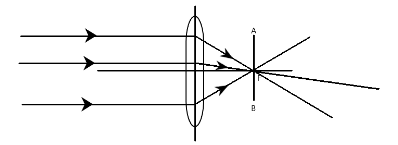
We are asked to show how a converging lens (also known as convex lens) can be used to form the image of the sun using a ray diagram. To do this, we must note that the sun is very far away, hence, objects can be said to be at infinity. In this situation, all rays of light coming from the object striking the lens can be said to be parallel to each other.
Now, as a rule of drawing ray diagrams, all rays of light parallel to the optical (or principal) axis of the lens, must be drawn to converge at the focal point of the lens, hence the image of the sun will be formed on a screen AB at the focal point as shown in the diagram. It used to largely be diminished.
Note
For clarity, mathematically, it can be proven that an object at infinity would produce its image at the focal point.
From the thin lens equation
$ \dfrac{1}{f} = \dfrac{1}{u} + \dfrac{1}{v} $ where $ f $ is the focal length of the convex lens, $ u $ is the distance of the object from the lens, and $ v $ is the distance of the image from the lens.
Hence, if $ u = \infty $
$ \dfrac{1}{f} = \dfrac{1}{\infty } + \dfrac{1}{v} $
$ \Rightarrow \dfrac{1}{f} = \dfrac{1}{v} $
Then by inverting
$ v = f $ .
Formula used: In this solution we will be using the following formula;
$ \dfrac{1}{f} = \dfrac{1}{u} + \dfrac{1}{v} $ where $ f $ is the focal length of the convex lens, $ u $ is the distance of the object from the lens, and $ v $ is the distance of the image from the lens.
Complete step by step answer
We are asked to show how a converging lens (also known as convex lens) can be used to form the image of the sun using a ray diagram. To do this, we must note that the sun is very far away, hence, objects can be said to be at infinity. In this situation, all rays of light coming from the object striking the lens can be said to be parallel to each other.
Now, as a rule of drawing ray diagrams, all rays of light parallel to the optical (or principal) axis of the lens, must be drawn to converge at the focal point of the lens, hence the image of the sun will be formed on a screen AB at the focal point as shown in the diagram. It used to largely be diminished.
Note
For clarity, mathematically, it can be proven that an object at infinity would produce its image at the focal point.
From the thin lens equation
$ \dfrac{1}{f} = \dfrac{1}{u} + \dfrac{1}{v} $ where $ f $ is the focal length of the convex lens, $ u $ is the distance of the object from the lens, and $ v $ is the distance of the image from the lens.
Hence, if $ u = \infty $
$ \dfrac{1}{f} = \dfrac{1}{\infty } + \dfrac{1}{v} $
$ \Rightarrow \dfrac{1}{f} = \dfrac{1}{v} $
Then by inverting
$ v = f $ .
Recently Updated Pages
Master Class 12 Social Science: Engaging Questions & Answers for Success

Master Class 12 Physics: Engaging Questions & Answers for Success
Master Class 12 Maths: Engaging Questions & Answers for Success
Master Class 12 Economics: Engaging Questions & Answers for Success
Master Class 12 Chemistry: Engaging Questions & Answers for Success
Master Class 12 Business Studies: Engaging Questions & Answers for Success
Trending doubts
Which are the Top 10 Largest Countries of the World?
Draw a labelled sketch of the human eye class 12 physics CBSE
Explain the structure of megasporangium class 12 biology CBSE
What are the major means of transport Explain each class 12 social science CBSE
How many chromosomes are found in human ovum a 46 b class 12 biology CBSE
The diagram of the section of a maize grain is given class 12 biology CBSE