




How do you draw a punnett showing all the possible blood types for the offspring produced by a type “O” mother and a type “AB '' father?
Answer
 Verified
541.5k+ views
Hint: ${ I }^{ A }$, ${ I }^{ B }$, ${ I }^{ O }$ are the three alleles of a gene I. The child receives one of the three alleles from each parent, gives raise to six possible genotypes, and four possible blood types.
Complete answer:
The four types of blood groups found in humans are A, B, AB, and O. Human blood grouping is one of the best examples of multiple allelism because more than two alleles exist on the same gene. The formation of blood groups in the offspring depends on the blood group of the parents. For example, when the father is of the AB blood group and the mother with O blood group, the father contains alleles ${ I }^{ A }$ and ${ I }^{ B }$and the mother contains alleles ${ I }^{ O }{ I }^{ O }$. When the cross over between these two genes takes place, the offspring formed may have a blood group type of either A or B.
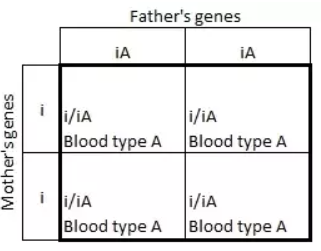
Additional information:
- Blood group phenotypes in humans are inherited from the three autosomal alleles of the gene I located on chromosome 9.
- It was discovered by the scientist Bernstein.
Note:
The antibodies present in the human blood group are called isoagglutinin also called isohaemagglutinins. They are of IgM type.
Karl Landsteiner and Alexander S. Wiener discovered another antigen called Rh-antigen or Rh factor on the surface of RBCs for Rhesus monkeys (Macaca mulatta).
Complete answer:
The four types of blood groups found in humans are A, B, AB, and O. Human blood grouping is one of the best examples of multiple allelism because more than two alleles exist on the same gene. The formation of blood groups in the offspring depends on the blood group of the parents. For example, when the father is of the AB blood group and the mother with O blood group, the father contains alleles ${ I }^{ A }$ and ${ I }^{ B }$and the mother contains alleles ${ I }^{ O }{ I }^{ O }$. When the cross over between these two genes takes place, the offspring formed may have a blood group type of either A or B.
Additional information:
- Blood group phenotypes in humans are inherited from the three autosomal alleles of the gene I located on chromosome 9.
- It was discovered by the scientist Bernstein.
Note:
The antibodies present in the human blood group are called isoagglutinin also called isohaemagglutinins. They are of IgM type.
Karl Landsteiner and Alexander S. Wiener discovered another antigen called Rh-antigen or Rh factor on the surface of RBCs for Rhesus monkeys (Macaca mulatta).
Recently Updated Pages
Master Class 12 Economics: Engaging Questions & Answers for Success

Master Class 12 Physics: Engaging Questions & Answers for Success
Master Class 12 English: Engaging Questions & Answers for Success
Master Class 12 Social Science: Engaging Questions & Answers for Success
Master Class 12 Maths: Engaging Questions & Answers for Success
Master Class 12 Business Studies: Engaging Questions & Answers for Success
Trending doubts
Which are the Top 10 Largest Countries of the World?
What are the major means of transport Explain each class 12 social science CBSE
Draw a labelled sketch of the human eye class 12 physics CBSE
Why cannot DNA pass through cell membranes class 12 biology CBSE
Differentiate between insitu conservation and exsitu class 12 biology CBSE
Draw a neat and well labeled diagram of TS of ovary class 12 biology CBSE