




Draw a neat labeled diagram of a screw gauge. Name its main parts and state their functions.
Answer
 Verified
592.8k+ views
Hint :Screw gauge is an instrument which is used for measuring dimensions of small objects like the radius of a tiny sphere or radius of a thin wire etc. It can measure with an accuracy of $ 0.01mm $ or $ 0.005mm $ for some Screw Gauges that are available in the market.
Complete Step By Step Answer:
We know, Screw Gauge is a mechanical tool which facilitates measuring diameter or radius or thickness of thin wire or of metal sheets with accuracy.
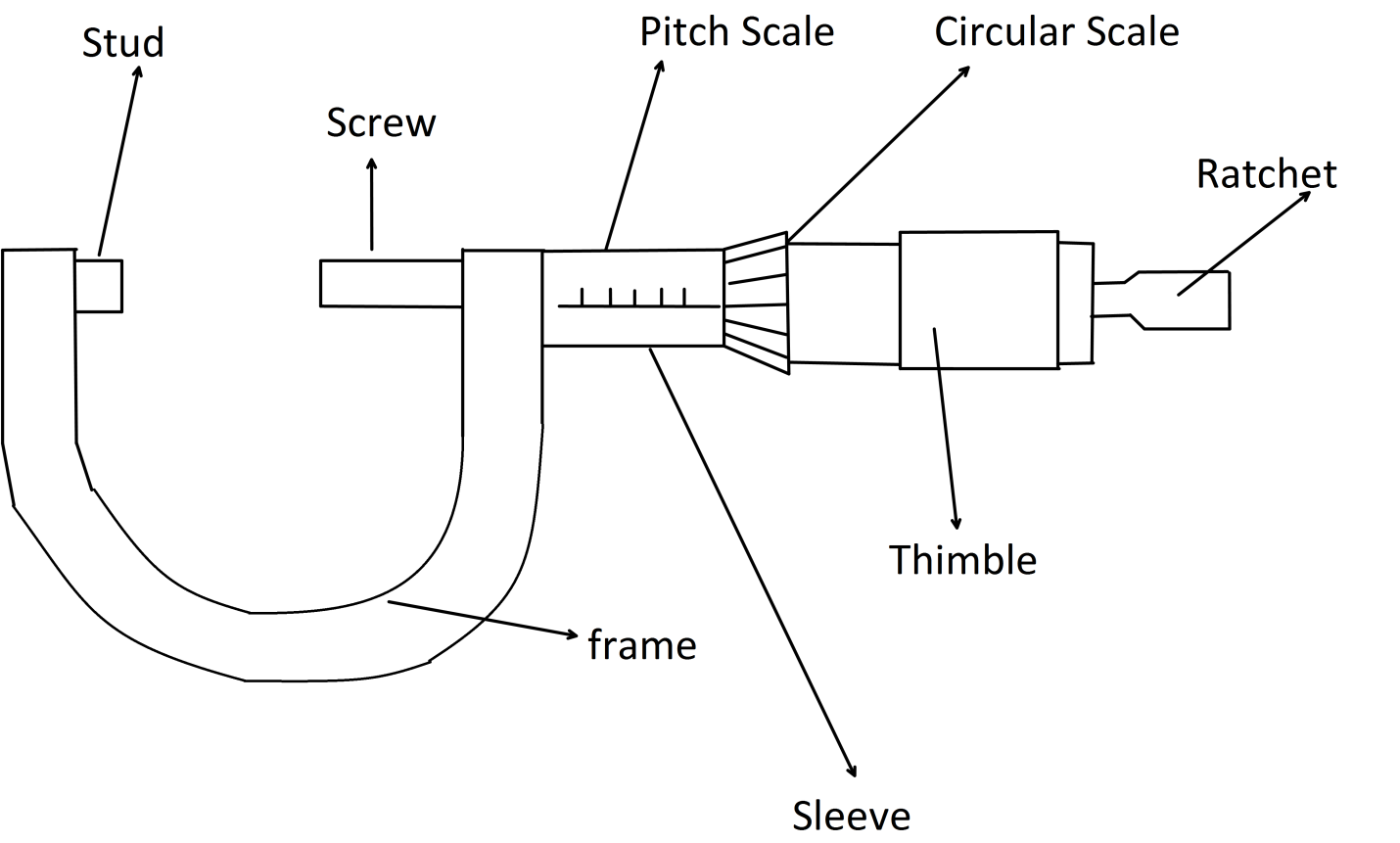
Upon one rotation of the screw moves the base line a distance equal to the pitch of the screw. The measurements are done through a screw of a pitch of $ 0.5mm $ , that means on completion of one revolution of the circular scale the displacement of the baseline is $ 0.5mm $ .
Main parts and their functions of a Screw gauge are given below:
Ratchet : It is used to rotate the screw by turning it so that the object is gently held between the stud and the spindle of the screw
Thimble: It is a hollow cylinder and used to mark on the circular scale.
Sleeve: It is the base line on which the main scale is marked.
Main Scale: it reads length in the dimension of 1mm
Circular Scale: It reads length more precisely accurate up to 0.01mm or 0.005mm
Note :
The instrument is not error free. when the end of the screw and the surface of the stud are in contact with each other, the linear scale and the circular scale reading should be zero. If that is not achieved, the screw gauge is said to have an error called zero error.
Complete Step By Step Answer:
We know, Screw Gauge is a mechanical tool which facilitates measuring diameter or radius or thickness of thin wire or of metal sheets with accuracy.
Upon one rotation of the screw moves the base line a distance equal to the pitch of the screw. The measurements are done through a screw of a pitch of $ 0.5mm $ , that means on completion of one revolution of the circular scale the displacement of the baseline is $ 0.5mm $ .
Main parts and their functions of a Screw gauge are given below:
Ratchet : It is used to rotate the screw by turning it so that the object is gently held between the stud and the spindle of the screw
Thimble: It is a hollow cylinder and used to mark on the circular scale.
Sleeve: It is the base line on which the main scale is marked.
Main Scale: it reads length in the dimension of 1mm
Circular Scale: It reads length more precisely accurate up to 0.01mm or 0.005mm
Note :
The instrument is not error free. when the end of the screw and the surface of the stud are in contact with each other, the linear scale and the circular scale reading should be zero. If that is not achieved, the screw gauge is said to have an error called zero error.
Recently Updated Pages
Which will be the least stable resonating structure class 11 chemistry CBSE

How many 5 digit telephone numbers can be construc-class-11-maths-CBSE
How do you find the angle of the resultant vector class 11 physics CBSE
Draw labelled diagram of the following i Gram seed class 11 biology CBSE
1 Quintal is equal to a 110 kg b 10 kg c 100kg d 1000 class 11 physics CBSE
What is the need and importance of classification class 11 biology CBSE
Trending doubts
Find the value of the expression given below sin 30circ class 11 maths CBSE
One Metric ton is equal to kg A 10000 B 1000 C 100 class 11 physics CBSE
10 examples of friction in our daily life
Draw a diagram of a plant cell and label at least eight class 11 biology CBSE
Difference between physical and chemical change class 11 chemistry CBSE
Proton was discovered by A Thomson B Rutherford C Chadwick class 11 chemistry CBSE