




Draw a neat diagram of spirogyra and label on it:
Dark coloured and dot like structure generally present in the centre of the cell.
Answer
 Verified
633k+ views
Hint:Spirogyra is a filament-like alga composed of spiral chloroplasts and many pyrenoids.
Complete answer:
To answer this question, first, we have to know about the structure and composition of spirogyra. Spirogyra belongs to green algae. They are mostly found in freshwater. A cell of spirogyra comprises a cell wall, pyrenoids, nucleus, cytoplasmic threads, spiral chloroplasts, and vacuole.
The labeled diagram of spirogyra is given below.
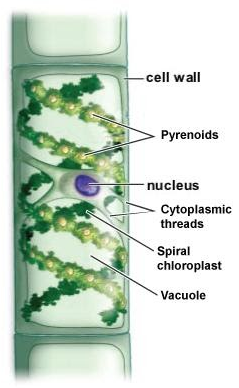
Fig: A labeled diagram of spirogyra
Additional information:
In a microscopic view we can see the various parts of the cell of spirogyra. Cell wall is the outermost layer of a plant cell. Pyrenoid is a structure inside or beside the chloroplasts of definite algae, consisting mainly of ribulose bisphosphate carboxylase, one of the enzymes needed in photosynthesis for carbon fixation and sugar formation. Starch, a form of glucose storage, is often found around pyrenoids. Cytoplasmic strands are spindle-like strands found in all cells that also contain a nucleus. Vacuoles are membrane-bound sacs within a cell cytoplasm that function in a number of ways. Vacuoles can be very large in mature cells. They provide structural support and serve functions such as preservation, waste disposal, protection and growth to the cell.
Note: In spirogyra, chloroplasts create a spiral around the vacuole and have special bodies called pyrenoids. The nucleus is found in the middle of the cell. It is suspended from the strands of cytoplasm.
Complete answer:
To answer this question, first, we have to know about the structure and composition of spirogyra. Spirogyra belongs to green algae. They are mostly found in freshwater. A cell of spirogyra comprises a cell wall, pyrenoids, nucleus, cytoplasmic threads, spiral chloroplasts, and vacuole.
The labeled diagram of spirogyra is given below.
Fig: A labeled diagram of spirogyra
Additional information:
In a microscopic view we can see the various parts of the cell of spirogyra. Cell wall is the outermost layer of a plant cell. Pyrenoid is a structure inside or beside the chloroplasts of definite algae, consisting mainly of ribulose bisphosphate carboxylase, one of the enzymes needed in photosynthesis for carbon fixation and sugar formation. Starch, a form of glucose storage, is often found around pyrenoids. Cytoplasmic strands are spindle-like strands found in all cells that also contain a nucleus. Vacuoles are membrane-bound sacs within a cell cytoplasm that function in a number of ways. Vacuoles can be very large in mature cells. They provide structural support and serve functions such as preservation, waste disposal, protection and growth to the cell.
Note: In spirogyra, chloroplasts create a spiral around the vacuole and have special bodies called pyrenoids. The nucleus is found in the middle of the cell. It is suspended from the strands of cytoplasm.
Recently Updated Pages
Master Class 11 English: Engaging Questions & Answers for Success

Master Class 11 Social Science: Engaging Questions & Answers for Success
Master Class 11 Maths: Engaging Questions & Answers for Success
Master Class 11 Biology: Engaging Questions & Answers for Success
Master Class 11 Physics: Engaging Questions & Answers for Success
Master Class 11 Chemistry: Engaging Questions & Answers for Success
Trending doubts