




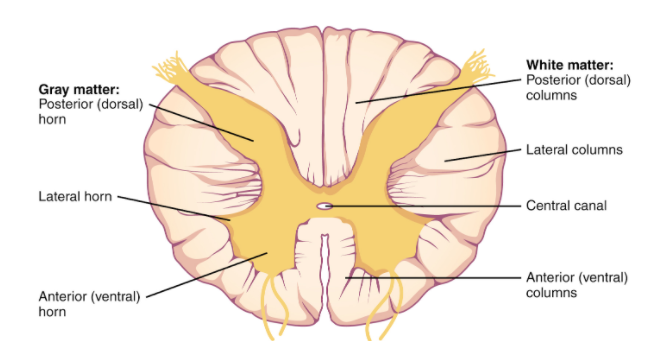
Draw a labelled diagram of T.S of Spinal cord.
Answer
 Verified
614.1k+ views
Hint:The spinal cord is a long, delicate structure of a tube that starts at the end of the stem of the brain and goes down almost to the bottom of the spine. Nerves that carry incoming and outgoing signals between the brain and the rest of the body consist of the spinal cord.
Complete answer:
The spinal cord is typically 40 cm long and 2 cm thick in adults. It is a crucial link between the brain and the body.
The spinal cord is divided into five sections.
->Sacral cord
->Lumbar cord
->Thoracic cord
->Cervical cord
->Coccygeal
Several spinal nerves arise from each part of the spinal cord. There are 8 pairs of cervical, 5 lumbar, 12 thoracic, 5 sacral, and 1 coccygeal spinal nerve pair.
The cross-section of the spinal cord reveals the following details:
1. It is surrounded by three meninges: the outer dura mater, the middle arachnoid mater, and the inner pia mater.
2. White matter is external and internal is grey matter.
3. Grey matter is H-shaped due to two dorsal horns and two ventral horns. The dorsal horns reach the dorsal root of the spinal nerves and the ventral horns reach the ventral root of the spinal nerves.
4. Grey matter is made up of nerve cells, relay neurons, and glial cells.
5. The white matter consists of myelinated axons.
6. 31 pairs of nerves are developed from the spinal cord.
7. There is a central canal in the middle that holds the cerebrospinal fluid.
Note:The essential functions of the spinal cord are described below:
->Forms a link between the brain and the PNS
->Provides structural support and constructs a body posture;
->Facilitates flexible movements;
->Myelin present in white matter serves as an electrical insulator
->Communicates signals from the brain to various parts of the body;
->Coordinate the reflexes
->Receives sensory input from the receptors and approaches to the brain for processing.
Complete answer:
The spinal cord is typically 40 cm long and 2 cm thick in adults. It is a crucial link between the brain and the body.
The spinal cord is divided into five sections.
->Sacral cord
->Lumbar cord
->Thoracic cord
->Cervical cord
->Coccygeal
Several spinal nerves arise from each part of the spinal cord. There are 8 pairs of cervical, 5 lumbar, 12 thoracic, 5 sacral, and 1 coccygeal spinal nerve pair.
The cross-section of the spinal cord reveals the following details:
1. It is surrounded by three meninges: the outer dura mater, the middle arachnoid mater, and the inner pia mater.
2. White matter is external and internal is grey matter.
3. Grey matter is H-shaped due to two dorsal horns and two ventral horns. The dorsal horns reach the dorsal root of the spinal nerves and the ventral horns reach the ventral root of the spinal nerves.
4. Grey matter is made up of nerve cells, relay neurons, and glial cells.
5. The white matter consists of myelinated axons.
6. 31 pairs of nerves are developed from the spinal cord.
7. There is a central canal in the middle that holds the cerebrospinal fluid.
Note:The essential functions of the spinal cord are described below:
->Forms a link between the brain and the PNS
->Provides structural support and constructs a body posture;
->Facilitates flexible movements;
->Myelin present in white matter serves as an electrical insulator
->Communicates signals from the brain to various parts of the body;
->Coordinate the reflexes
->Receives sensory input from the receptors and approaches to the brain for processing.
Recently Updated Pages
Master Class 12 Economics: Engaging Questions & Answers for Success

Master Class 12 English: Engaging Questions & Answers for Success
Master Class 12 Social Science: Engaging Questions & Answers for Success
Master Class 12 Maths: Engaging Questions & Answers for Success
Master Class 12 Physics: Engaging Questions & Answers for Success
Master Class 9 General Knowledge: Engaging Questions & Answers for Success
Trending doubts
Which are the Top 10 Largest Countries of the World?
Draw a labelled sketch of the human eye class 12 physics CBSE
Differentiate between homogeneous and heterogeneous class 12 chemistry CBSE
Why is the cell called the structural and functional class 12 biology CBSE
Draw ray diagrams each showing i myopic eye and ii class 12 physics CBSE
Which is the correct genotypic ratio of mendel dihybrid class 12 biology CBSE