



Draw a labeled diagram of a replicating fork.
Answer
 Verified
658.5k+ views
Hint: Replicating fork is the structure of the DNA double helix after the unzipping by ligase enzyme. This leads to two strands called leading and lagging strands.
Complete answer:
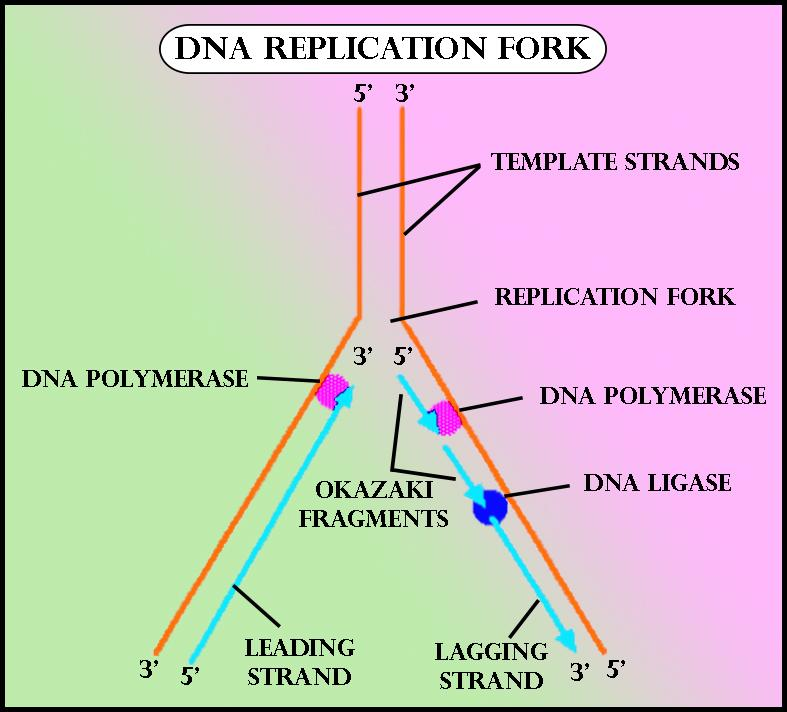
DNA replication is the process of duplication of DNA during cell division. DNA is a self-replicating structure and the semi-conservative process of DNA replication occurs in the sequence of initiation, elongation, and termination. The "unzipping" of the DNA double helix occurs by helicase enzyme which breaks the hydrogen bonds holding the complementary bases.
The structure after the unzipping resembles a Y shape and is called a replicating fork. One of the strands orients in the 3' to 5' direction and called as leading strand whereas the other, called the lagging strand, is oriented in 5' to 3' direction.
Additional Information: -Leading strand: Primer, a piece of RNA, comes and binds to the end of the leading strand. This acts as the starting point for DNA synthesis. DNA polymerase adds new complementary DNA in the 5' to 3' direction. This type of replication is continuous.
-Lagging strand: At various points along the lagging strand, the primase enzyme makes numerous RNA primers. Ozaki fragments, which are chunks of DNA, are added to the lagging strand in the 5' to 3' direction. This is discontinuous replication as the fragments need to be joined up later.
After all, bases are matched up, the enzyme exonuclease strips away the primers. An enzyme called DNA ligase seals the sequence of DNA and makes it into two continuous double strands.
Note: The replicating fork is asymmetrical because of the semi-conservative nature. By semi-conservative, we mean that after the replication of the double helix of DNA, new and old strands are formed. In replicating a fork, one half is a part of the original DNA whereas the other is brand new.
Complete answer:
DNA replication is the process of duplication of DNA during cell division. DNA is a self-replicating structure and the semi-conservative process of DNA replication occurs in the sequence of initiation, elongation, and termination. The "unzipping" of the DNA double helix occurs by helicase enzyme which breaks the hydrogen bonds holding the complementary bases.
The structure after the unzipping resembles a Y shape and is called a replicating fork. One of the strands orients in the 3' to 5' direction and called as leading strand whereas the other, called the lagging strand, is oriented in 5' to 3' direction.
Additional Information: -Leading strand: Primer, a piece of RNA, comes and binds to the end of the leading strand. This acts as the starting point for DNA synthesis. DNA polymerase adds new complementary DNA in the 5' to 3' direction. This type of replication is continuous.
-Lagging strand: At various points along the lagging strand, the primase enzyme makes numerous RNA primers. Ozaki fragments, which are chunks of DNA, are added to the lagging strand in the 5' to 3' direction. This is discontinuous replication as the fragments need to be joined up later.
After all, bases are matched up, the enzyme exonuclease strips away the primers. An enzyme called DNA ligase seals the sequence of DNA and makes it into two continuous double strands.
Note: The replicating fork is asymmetrical because of the semi-conservative nature. By semi-conservative, we mean that after the replication of the double helix of DNA, new and old strands are formed. In replicating a fork, one half is a part of the original DNA whereas the other is brand new.
Recently Updated Pages
Master Class 12 Physics: Engaging Questions & Answers for Success

Master Class 12 Social Science: Engaging Questions & Answers for Success
Master Class 12 English: Engaging Questions & Answers for Success
Master Class 12 Maths: Engaging Questions & Answers for Success
Master Class 12 Business Studies: Engaging Questions & Answers for Success
Master Class 12 Chemistry: Engaging Questions & Answers for Success
Trending doubts
Draw a labelled sketch of the human eye class 12 physics CBSE
One megawatt is equal to how many units of electri class 12 physics CBSE
Draw a well labelled diagram of the human brain class 12 biology CBSE
What is a transformer Explain the principle construction class 12 physics CBSE
Differentiate between homogeneous and heterogeneous class 12 chemistry CBSE
Draw a labelled diagram of a female reproductive s class 12 biology CBSE